
1-805-484-2992
Quotes - Engineering - SalesDesigning Heat Exchangers for True Sanitary CIP
A truly sanitary CIP-capable heat exchanger must be engineered from the start with polished surfaces, full drainability, no dead legs, and cleanable connections — allowing automated cleaning cycles to achieve complete soil and microbial removal.
- Polished Surfaces: Ra less than or equal to 32 microinch (0.8 micrometer) on all product-contact areas.
- Full Drainability: Self-draining design with no horizontal runs or low-point traps.
- No Dead Legs: L/D ratio less than or equal to 2:1 on all branches and ports.
- Cleanable Seals: 3-A 18-03 compliant elastomers, fully removable and flushable.
- Sanitary Connections: Clamp or weld-end only — no threads in product zone.
- High-Velocity Flow: Designed for greater than 5 ft/s during CIP for turbulent cleaning.
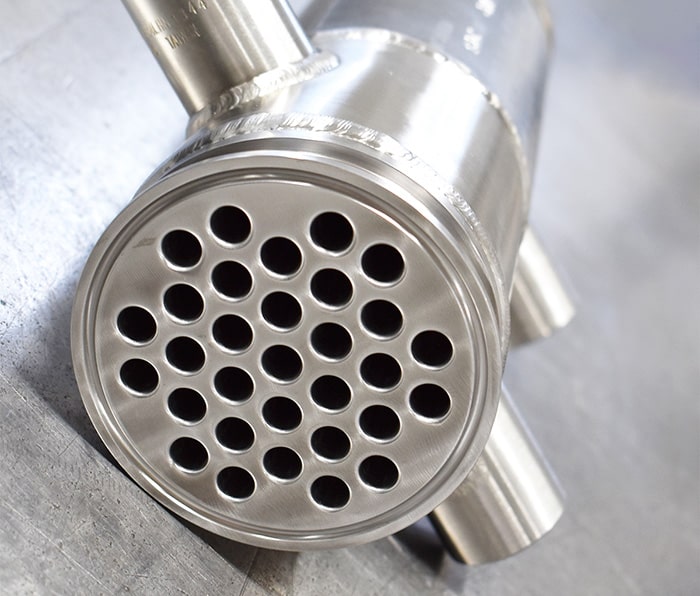
Sanitary CIP Heat Exchangers
Built for Complete Cleanability
Sanitary CIP heat exchangers are specifically constructed to withstand aggressive cleaning chemicals and high-velocity flow while achieving log reductions in bacteria — ensuring food safety and regulatory compliance in hygienic processes.
- 316L stainless steel with electropolish option
- Ra less than or equal to 32 microinch product contact finish
- 100% drainable, no internal pockets
- 3-A, EHEDG, and ASME BPE compliant designs
- Double tubesheet options for leak detection
- Validated CIP performance with riboflavin testing
What Makes a Heat Exchanger Sanitary CIP Capable?
True sanitary CIP goes beyond basic cleaning — it requires equipment designed to be cleaned in place effectively every time. This means polished surfaces, drainable geometry, and turbulence-capable flow paths that remove soil and kill microbes consistently.
Properly designed units support validated cleaning protocols required by FDA, USDA, and PMO standards.
Surface Finish & Material Requirements
All product-contact surfaces must be 316L stainless steel with Ra less than or equal to 32 microinch mechanical polish (20 microinch electropolished preferred). No pits, cracks, or discoloration allowed.
Drainability & Dead-Leg Elimination
Heat exchangers must drain completely when shut down. No horizontal tubes, no trapped areas. All ports and branches follow less than or equal to 2D rule to prevent stagnant zones.
CIP Flow & Turbulence
Designed for greater than 5 ft/s (1.5 m/s) velocity during CIP to achieve Reynolds numbers greater than 4,000 — creating mechanical scrubbing action essential for soil removal.
Seals, Gaskets & Connections
Only sanitary clamp or permanent weld connections. Elastomers must be FDA/3-A compliant and fully encapsulated or flush-mounted to prevent entrapment.
Validation & Testing
Riboflavin coverage testing proves 100% wetting. Microbial challenge tests and ATP swabbing confirm sanitary condition post-CIP. Documentation included with every unit.
Why Sanitary CIP Matters
In food and pharma, ineffective cleaning leads to recalls, spoilage, or contamination. Sanitary CIP-capable heat exchangers eliminate risk and ensure consistent product safety.
Common FAQs
It means the heat exchanger is specifically designed and constructed to be fully cleaned and sanitized in place using automated CIP — achieving hygienic condition without disassembly.
No — only units built with polished sanitary surfaces, drainable design, and no dead zones can be reliably cleaned in place.
Minimum Ra less than or equal to 32 microinch (0.8 micrometer) mechanical polish; 15-20 microinch electropolished preferred for pharma and high-risk foods.
Residual product or cleaning solution left in pockets becomes a microbial growth site and prevents proper sanitization.
Yes — due to higher-grade materials, precision fabrication, and certification — but they save significantly on labor, downtime, and risk.
Through riboflavin coverage testing (100% wetting), ATP swabbing, and microbial plate counts after validated CIP cycles.