
1-805-484-2992
Quotes - Engineering - SalesFood soils are the heaviest on this site
Food plants cover the widest range of soils we heat against. A sauce kettle leaves starch cooked onto steel at product temperatures near 250°F and fat rendered into the corners. An egg pasteurizer leaves a protein film very much like a dairy's. A pet-food extruder leaves fat and meat fines, and a brine tank leaves salt. The caustic circuit that handles all of this runs at the top of the range, 165–175°F, often at 2–3% sodium hydroxide, and for 30–45 minutes rather than 20.
Those figures make the food-plant caustic heater one of the largest on this site relative to the equipment it serves. A kettle room with a 3,000-gallon CIP tank that must be at 170°F for the first wash of the shift wants about 3.3 MBtu/h to get there from 70°F in 45 minutes, which is roughly 3,400 lb/h of 15 psig steam at the heater inlet. The removable U-bundle matters because burnt starch that does not come off the kettle ends up as a film on the heater's shell side, and because carbonate scale follows hard water everywhere.
Brine and meat plants add the only material question on the site. 316L shrugs off nitric and phosphoric at CIP strength, but chloride at temperature is what pits and cracks it, and a brine circuit's rinse water carries salt into the heater. We call that out on its own page, because the answer is sometimes a higher alloy on the solution side rather than a different heater.
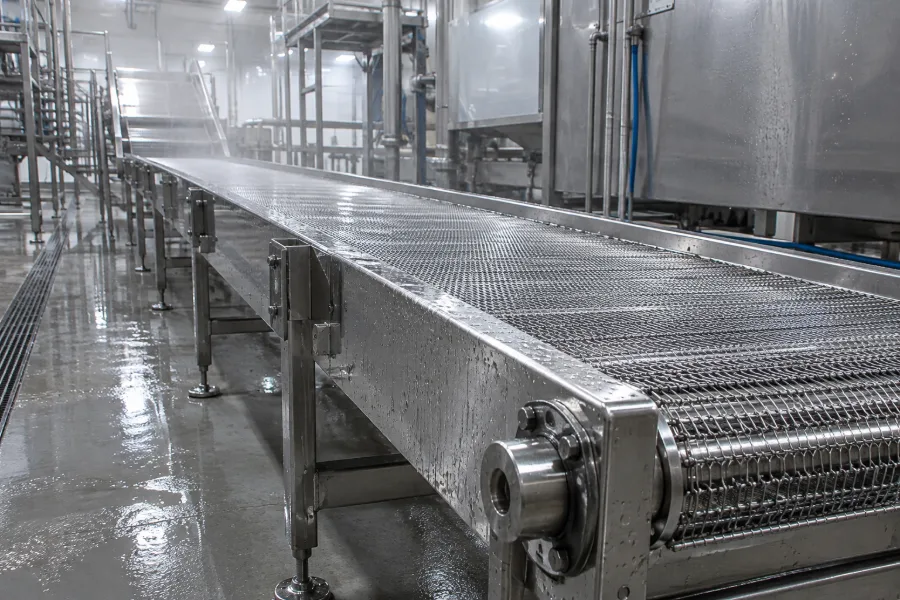
Kettle and sauce lines
- Caustic 165–175°F at 2–3% for burnt starch
- 3,000-gallon tank up to temperature in 45 minutes
- Bundle pulls for starch film and carbonate
Brine and meat lines
- Caustic 160°F for fat, acid for mineral scale
- Chloride in the rinse is the 316L question
- Head alloy chosen for the salt, not the acid
Four food circuits, four different soils
No two food plants clean the same thing, but the circuits fall into four groups that each push the heater in a particular direction: hotter, more often, more flow or a different metal. The figures here are the ones that decide which.
Cook kettles and sauce lines
- Starch and caramelized sugar burnt on at product temperature
- Caustic 2–3% at 170°F for 45 minutes, sometimes with a surfactant
- Tank recirculation from a large shared CIP tank
- Acid for carbonate, since kettle rooms run hard water hot
Egg and puree pasteurizers
- Protein film like a dairy's, plus pulp and fiber from fruit
- Caustic 165°F on a line circuit at 30–70 gpm
- Cycles after every run, so the heater works several times a shift
- Removable bundle; the heater fouls on the same film
Meat and pet-food lines
- Rendered fat and fines; caustic at 160°F with surfactant
- Grinder and extruder circuits are short, heavy and frequent
- Phosphoric acid for mineral from bone and hard water
- Return screens keep fines off the heater's shell side
Brine and pickle tanks
- Salt carried into the rinse: chloride against 316L
- Caustic capped near 145°F for fat and residue on the tank wall
- Rinse to low conductivity before the hot caustic step
- Solution-side alloy and head material called out at the quote
Why food-plant tanks are bigger
A kettle room cleans several large vessels in sequence and wants the caustic hot for all of them, so CIP tanks of 3,000–5,000 gallons are common. The heater on a tank that size is sized by the heat-up the plant allows before the first wash, not by the circuits. Give it 60 minutes from 70 to 170°F on a 3,000-gallon tank and 2.5 MBtu/h does it; demand 20 minutes and the heater triples.
Starch, fat and the surfactant question
Burnt starch is lifted by hot caustic; rendered fat is saponified by it. Both go faster at 170°F and 3% than at 150°F and 1%, and many food plants add a wetting agent. None of that changes the heater's metal, but a stronger, hotter caustic leaves more carbonate when the water is hard, so the acid step and the removable bundle matter more in a kettle room than in a brewery.
Chloride and 316L
Nitric and phosphoric acid at CIP strength are not a problem for 316L. Chloride is. A brine plant that rinses a tank with salt-laden water and then heats the next caustic charge is putting warm chloride against stainless, and over a few years that shows up as pitting in the heads and under the gaskets. We ask brine and pickle plants for their rinse-water chloride level before quoting, and the answer decides the solution-side alloy.
Rinse and recovery in a food plant
Food plants spend a lot of heat on intermediate and final rinses because the soil is heavy and the tanks are large. A gasketed plate exchanger on the 150°F return against 60°F makeup returns 60–70% of it and shortens the next heat-up. Final rinse at 120–140°F and any sanitize hold at 180°F come from a steam-to-water shell-and-tube on the rinse line.
Food plant questions
Hotter helps up to about 175°F, and so does concentration up to 3%, but the first thing to check is whether the solution is at temperature when the cycle starts. A tank that reads 170°F at the heater outlet and 145°F at the kettle after a long cold pipe run is washing at 145°F. If the heater is the limit, the fix is capacity or a longer heat-up allowance, and that is a sizing conversation we can have from the tank size and the schedule.
Yes. A liquid-egg or puree pasteurizer circuit behaves like an HTST loop: line flow at 30–70 gpm, caustic at 165°F, protein film on everything hot including the heater, and an acid step for the mineral. The construction is the same U-tube with the solution in the shell and the bundle removable, and we size it the same way, with a fouling allowance of 0.001–0.002 on the solution side.
It depends on the chloride level and the temperature the heater sees. If the brine tank is rinsed to low conductivity before the hot caustic step, 316L is usually fine and we build the standard heater. If salt-laden rinse water goes through the heater warm, we reccomend a higher alloy for the solution-side heads and bundle, and we will say which once we see the water analysis.
No. A gasketed plate pack does recovery well, taking heat from the hot return into makeup water, and it handles rinse water at modest pressure. The steam-to-caustic duty goes to a shell-and-tube, because pressure and temperature cycling on a steam-fed plate pack shortens gasket life and a heavy starch film can plug a 3–5 mm channel. Two exchangers, each on the job it suits.
Related
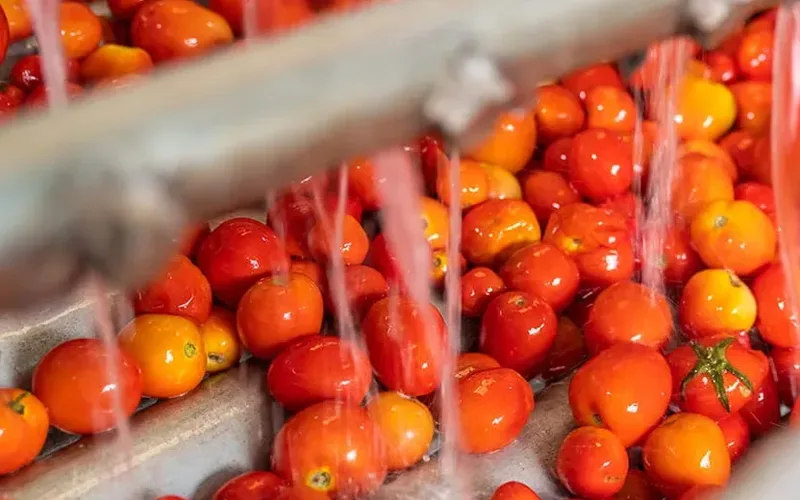
Applications
Kettle & Sauce Lines
Burnt-on starch and fat need caustic at the top of the range for most of an hour. Sizing a kettle-line tank heater that holds 175°F while the soil fights back.
+ Learn More
Applications
Egg & Puree Pasteurizers
Egg albumin cooks onto a pasteurizer faster than milk does, so the line cleans every few hours. The heater that keeps a caustic tank at 165°F through that schedule.
+ Learn More
Applications
Meat, Pet Food & Brine
Fat wants the caustic hot and salt wants the stainless cool. Where the chloride line falls for a 316L heater, and how brine plants keep salt out of the caustic loop.
+ Learn More
