
1-805-484-2992
Quotes - Engineering - SalesFat sets the temperature, salt sets the metal
Meat, poultry and pet food plants clean a soil that is mostly fat with protein and blood bound into it, and on extruder and cooker lines a layer of cooked starch and meat meal over that. Fat does not move until the caustic is above its melting point and strong enough to saponify it, so these plants run sodium hydroxide at 2–3%, often chlorinated, at 160–175°F, and they pre-rinse warm at 110–120°F to melt the tallow before it reaches the caustic tank. The heater sees the same soap and grease carryover as a sauce cook room and is built the same way: U-tube, removable bundle, solution side in 316L.
What is different is the salt. Brine chillers, injection lines, curing tanks and marinade systems carry sodium chloride at 5–25% in the product, and rinse water carries some of it back toward the CIP tank. Chloride is the one thing in a food plant that attacks 316L: above roughly 140°F a solution carrying a few hundred ppm of chloride can start pitting and crevice attack at gasket faces and under deposits, and hot chloride is the classic cause of stress-corrosion cracking in stainless tubes. The acids never do that at CIP strength; chloride does.
So the brine-side rule is to keep the salt out of the heated loop. Rinse brine equipment to drain, not to the tank, hold a chloride limit on the recirculated caustic, and let the heater see only solution that passed that test.
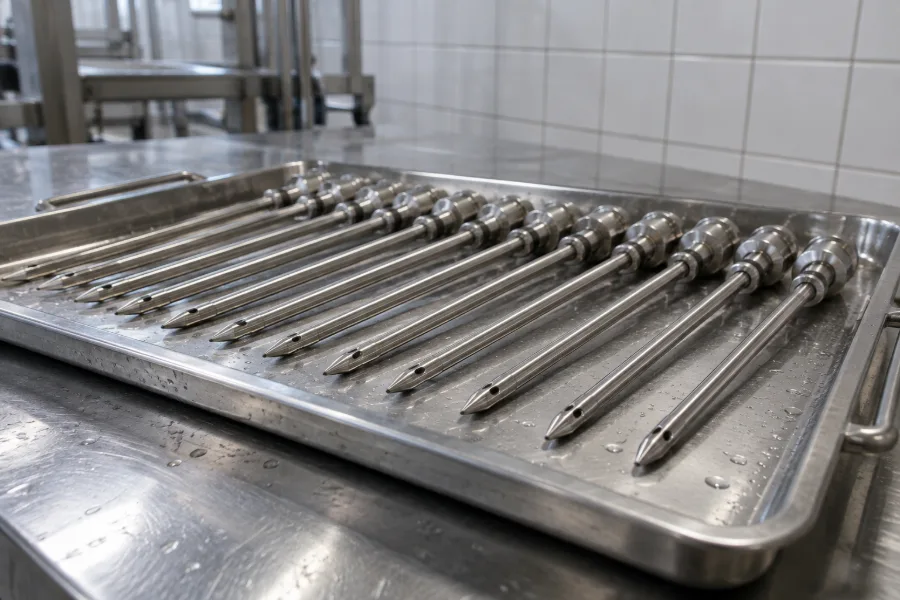
Keep the brine out of the heated caustic loop and 316L lives for decades
- Chloride above a few hundred ppm at 140°F and up attacks stainless
- Pre-rinse brine equipment to drain before the solution returns to the tank
- Caustic at 2–3% and 160–175°F turns rendered fat into soap that floats
The meat and pet food circuit and the heater behind it
Figures below cover a meat or poultry further-processing plant and a dry or wet pet food line. The right column is the heater we build and the chloride rule that comes with it.
How these plants run CIP
- Chemical: Chlorinated sodium hydroxide 2–3%; nitric or phosphoric 0.5–1% for mineral scale
- Temperature: Pre-rinse 110–120°F to melt fat; caustic 160–175°F; acid 120–140°F
- Flow: 70–120 gpm on 3- and 4-inch marinade and cooker lines; 100–300 gpm on tank spray
- Cycle: Caustic 30–45 minutes; acid two or three times a week on cookers and brine tanks
- Soil: Tallow and lard, blood and protein, cooked starch and meat meal, salt and phosphate residue
- Chloride: Rinse to drain; keep the recirculated solution well under a few hundred ppm
The heater we recommend
- Construction: U-tube shell-and-tube, steam in the tubes, caustic on the shell, bundle removable
- Materials: 316L shell, bundle and heads on a chloride-controlled loop; higher alloy quoted if it is not
- Gasket: EPDM on caustic and phosphoric; FKM where nitric runs hot or often
- Rating: 150 psig at 250°F solution side; 150 psig at 400°F steam side
- Connections: 150-pound flanges or tri-clamp to 4 inches; mill finish on the utility loop
- Send us: Caustic gpm and tank gallons, chloride in the recirculated solution, fat load, steam psig
Chloride, fat and the heater
Where the chloride comes from
Nobody puts brine in the CIP tank on purpose. It arrives in the pre-rinse from a brine chiller or injector that was not drained, in the return from a curing tank with salt crusted at the liquid line, and in makeup water from a softener that regenerates with salt and leaks a little. Each source is small; together they raise the recirculated caustic to a level where a stagnant pocket under a deposit on a hot tube wall concentrates it further. The attack starts there, out of sight, and shows up as a pinhole leak months later.
- Rinse brine-contact equipment to drain for the first 5–10 minutes
- Test the caustic tank for chloride weekly and dump when it climbs
- Keep the heater's steam pressure moderate so the tube wall stays cooler
What 316L tolerates
At CIP caustic temperature, 316L lives comfortably with chloride under about 100–200 ppm, becomes a judgment call in the few-hundred range, and should not be asked to work above that at 160°F and up. The oxidizing nitric step actually helps, because it repassivates the surface. Where a plant cannot hold the limit, because the brine and CIP systems share piping, we quote the bundle in a higher-alloy stainless rather than pretend 316L will do. Tell us the chloride figure and we pick the metal; guessing is what produces the pinhole.
Fat and the pre-rinse
Tallow melts near 110°F and lard a little lower. A cold pre-rinse pushes solid fat into the drain and the caustic tank where it congeals on the tank wall and the heater shell. A warm pre-rinse at 110–120°F melts it and carries it to drain before the caustic step, which keeps the tank cleaner and the heater tubes free of soap for longer. That warm rinse water is a modest heater duty of its own, often served from recovered heat or a small plate rinse heater rather than from steam.
Pet food extruders and cookers
A pet food extruder, preconditioner or steam cooker lays down cooked starch and meat meal that behaves like a sauce kettle soil, baked and tenacious, with rendered fat through it. The CIP circuit for that equipment runs the hottest and strongest caustic in the plant, 165–170°F and 2–3%, for 30–45 minutes, and the heater is sized as a cook-room tank heater: heat-up duty first, hold duty second, and a fouling allowance of 0.002 on the solution side for the soap and starch that come back.
Brine and chloride questions
Only if the plant can hold the chloride in the recirculated caustic under a few hundred ppm by rinsing brine equipment to drain and dumping the tank on a schedule. If the brine and CIP systems share piping and the number can not be held, we quote the bundle in a higher-alloy stainless and keep the shell 316L. Send a chloride reading from the tank; it decides the metal.
Temperature and deposits. Chloride attack on stainless speeds up sharply above about 140°F, and the heater tube wall is the hottest surface the solution touches. Soap and protein deposits on the tubes create crevices where the solution sits still and concentrates. The tank at 160°F with clean walls is at less risk than a tube under a deposit at 250°F wall temperature.
Chlorinated alkaline cleaners carry hypochlorite, not chloride ion, at least until the chlorine is spent. At the 100–200 ppm available chlorine most meat plants use, 316L is fine in the hot caustic because the high pH protects it. The spent chlorine does end up as chloride, which is one more reason to track the tank. Rinse the heater before the acid step so hypochlorite and acid never meet.
Above the fat's melting point with margin, which puts the caustic at 160–175°F, and strong enough to saponify what the rinse left behind, which puts it at 2–3%. A warm pre-rinse at 110–120°F does most of the work by melting the bulk fat to drain. Plants that skip the warm rinse ask the caustic heater to melt tallow instead, and the tank fills with soap.
Related
Applications
Kettle & Sauce Lines
Burnt-on starch and fat need caustic at the top of the range for most of an hour. Sizing a kettle-line tank heater that holds 175°F while the soil fights back.
+ Learn More
Applications
Egg & Puree Pasteurizers
Egg albumin cooks onto a pasteurizer faster than milk does, so the line cleans every few hours. The heater that keeps a caustic tank at 165°F through that schedule.
+ Learn More
Applications
Food Plants
Food soils are the heaviest we heat against: hotter, stronger caustic, bigger tanks and a chloride check for brine plants. How the heater is sized for each.
+ Learn More
