
1-805-484-2992
Quotes - Engineering - SalesThe duty point in four figures
A heat exchanger is sized at one operating point, and for a CIP heater that point is four numbers: solution flow in gpm, solution inlet temperature, solution target temperature, and steam pressure measured at the heater inlet. Everything else on the data sheet, from surface area to nozzle size, is derived from them. When an inquiry carries all four we can price a heater the same day. When one of them is a guess, the heater is wrong by whatever the guess was wrong by.
Turning the duty into steam
The first three give the duty. Water-like solution needs about 500 Btu/h for every gpm raised one degree, so 100 gpm taken from 105 to 165°F is a 60°F rise and about 3,000,000 Btu/h, which we write as 3 MBtu/h. Caustic at 1–2% behaves like water for this purpose. Flow comes from the circuit: about 5 ft/s in the line gives 30 gpm in a 2-inch, 70 gpm in a 3-inch, 120 gpm in a 4-inch and 200 gpm in a 6-inch line, while a silo circuit set by its spray devices may run 100–300 gpm. Inlet temperature is the cold return from the equipment on a tank system, or the city-water supply in winter on a once-through heater.
The fourth figure, steam pressure, sets the temperature difference that drives the heat through the tubes. Plant steam at the heater is usually 15–125 psig, condensing at 250°F for 15 psig, 298°F at 50 psig, 338°F at 100 psig and 353°F at 125 psig. Lower pressure means a smaller approach and more surface for the same duty. Pressure at the boiler is not the figure: a control valve and a long header stand between the boiler and the heater, and the pressure that reaches the tube inlet is what counts.
The arithmetic we run on every inquiry
- Duty in Btu/h = gpm × temperature rise × about 500
- Steam at 15 psig gives up roughly 945 Btu per pound, so 3 MBtu/h condenses about 3,100 lb/h
- Higher steam pressure condenses fewer pounds per MBtu/h but gives a larger approach and a smaller bundle
- Approach at 15 psig to a 175°F target is about 75°F; at 100 psig it is 163°F
- Fouling allowance of 0.001–0.002 on the solution side adds 10–20% to the surface
- Control valve and trap are sized for the same lb/h, with the valve taking the pressure drop, not the heater
100 gpm raised 60 degreesThat duty condenses about 3,100 lb/h of 15 psig steam, and the boiler has to deliver it at the heater inlet, not at its own outlet gauge.
Where duty points go wrong
Each of the four figures has a usual way of being misreported, and each produces a heater that is right on paper and wrong on the floor. Check these before sending the inquiry.
- Flow taken from the pump nameplate rather than the circuit; the pump runs on its curve, not its rating
- Inlet temperature taken in summer; the winter supply can be 40°F colder and the duty a third larger
- Target temperature stated at the tank when the heater has to hold it at the farthest spray device
- Steam pressure read at the boiler, when the header and valve leave 15 psig at the heater
- Duty stated at nominal flow when the sanitize step pulls twice the gpm for 5–15 minutes
- Rise stated for the hold condition rather than the heat-up, which is usually the governing case
Call and talk it through with an engineer: 1-805-484-2992
Reading the steam side correctly
Low-pressure steam is not a problem for a CIP heater; it is the normal case. At 15 psig the steam condenses at 250°F, which still stands roughly 75°F above a 175°F caustic target and more than 60°F above a 190°F sanitize hold. That margin is why steam-to-solution duties stay on shell-and-tube and why we rarely ask a plant to raise its header pressure. What we do ask is that the 15 psig be real: measured or regulated at the heater, with the control valve upstream sized so that it does not starve the bundle at full duty.
Higher pressure buys a smaller heater. The same 3 MBtu/h at 100 psig has an approach of 163°F instead of 75°F and needs noticeably less tube surface, though the steam-side rating of the heater must then cover 338°F. Our standard tube-side rating of 150 psig at 400°F handles any plant steam a CIP system is likely to see; the shell side on the solution carries 150 psig at 250°F. If the plant has only 125 psig at the boiler and a long run to the sanitation room, we size for what arrives.
The condensate side matters as much as the supply. A trap sized for the heater's full lb/h, a condensate line that drains downhill, and a vacuum breaker on the steam inlet keep the tubes from flooding when the control valve throttles back at low load. A flooded bundle gives up part of its surface and the plant sees it as a heater that can not reach temperature, when the heater is fine and the trap is undersized. We include the trap and valve sizing figures with the quotation so the installer has them.
Modulating control is normal on both tank and inline heaters, and it means the heater spends most of its life well below the duty point. That is why we size at the demanding case, the cold winter start-up or the sanitize surge, and let the valve throttle the rest of the time. The heater does not care about running at 30% load; the control valve does, and a valve sized for the full lb/h with a reasonable turndown is part of the answer.
Send us the four figures and the steam pressure as it arrives at the heater. If you have only the boiler pressure, say so and tell us the header size and length and we will estimate the drop. If the plant runs two steam pressures, tell us which one the sanitation room is on. We would rather size for a measured 15 psig than an assumed 100 psig that is never there when the caustic tank is cold at 5 a.m.
Steam pressure at the heater inlet, not the boiler gauge, is the figure that sizes the bundle.
A duty point with a guessed steam pressure is a heater sized for a plant that does not exist.
Request a QuoteSteam pressure questions
Yes. Steam at 15 psig condenses at 250°F, which stands about 75°F above the target and well above the 165°F most dairies actually run. The heater needs more tube surface than it would on 100 psig steam, roughly three-quarters more, but the duty is met and the lower tube-wall temperature slows milkstone on the shell side. Low pressure is the normal CIP case, not a limitation.
Divide the duty by the latent heat at the steam pressure. At 15 psig that is about 945 Btu per pound, so 3 MBtu/h takes roughly 3,100 lb/h; at 100 psig the figure is closer to 3,400 lb/h because the latent heat is lower. The boiler must deliver that at the heater during the heat-up or sanitize surge, which is usually the largest single steam draw in the plant.
On whichever is larger, and on a tank system that is nearly always the heat-up. Bringing 2,000 gallons from 70 to 165°F in 20 minutes is about 4.75 MBtu/h, while holding the same tank against a cold return during a 30-minute wash is often under 1 MBtu/h. On a once-through heater there is no heat-up and the sanitize surge at highest gpm and coldest inlet governs.
Related
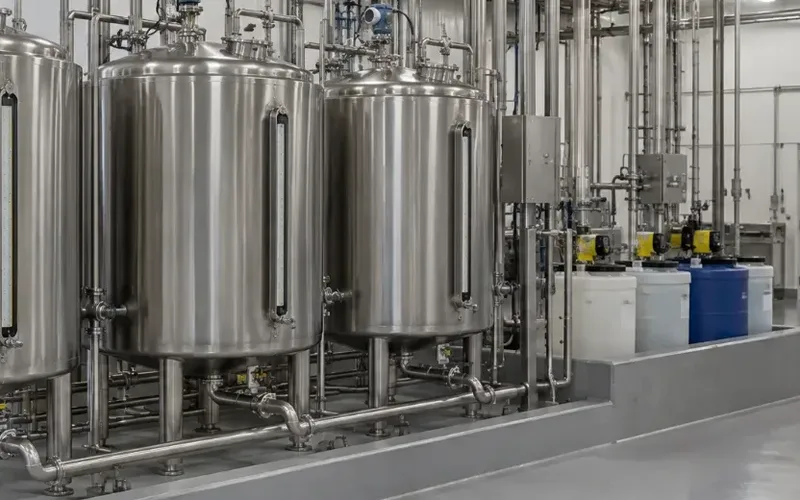
Sizing & Selection
Circuit, Chemical & Concentration
Caustic, acid, rinse or recovery, which chemical and at what strength. Why those three answers decide the metal and the gasket before a single Btu is counted.
+ Learn More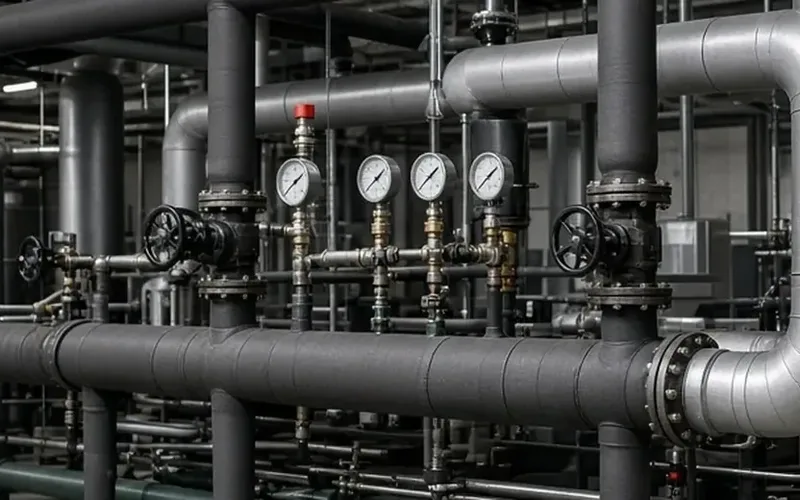
Sizing & Selection
Tank Recirculation or Once-Through
A tank loop is sized in gallons and minutes, an inline heater in gpm and degrees. How to tell which circuit you are heating and why the answer can triple the duty.
+ Learn More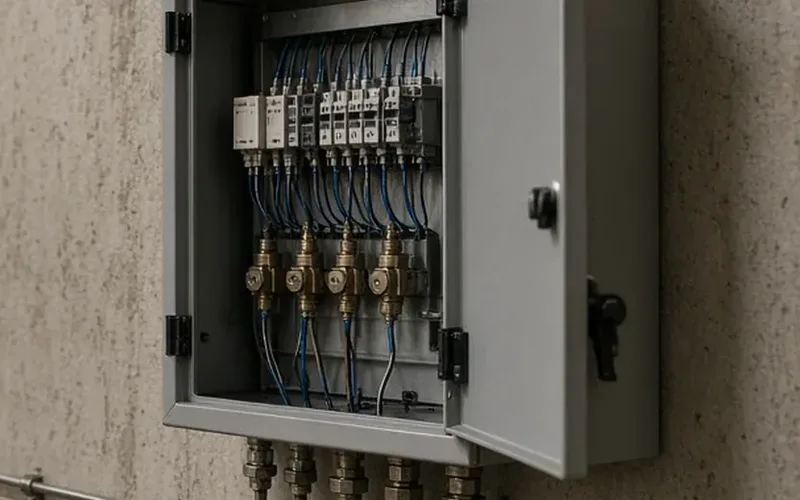
Sizing & Selection
Define the Duty
Five answers size the heater: circuit and chemical, tank or inline, gpm, inlet and target temperature, and steam pressure at the heater. Collect them here first.
+ Learn More
