
1-805-484-2992
Quotes - Engineering - SalesClean, warm, and poured down the drain
Recovering the final rinse
The final rinse is the cleanest hot water in a CIP cycle. It follows the acid and the intermediate rinse, it carries almost no soil, and it leaves the circuit at 120–140°F on its way to drain. On a 70 gpm circuit running a 5–10 minute rinse that is 350–700 gallons of warm water per cycle, several cycles a day. The heat in it is worth collecting, and the water is clean enough that collecting it is simple.
The recovery exchanger is a gasketed plate pack: 316L plates, EPDM gaskets, the rinse on one side and the cold stream to be heated on the other. Against 60°F incoming water at matched flow, a 130°F rinse lifts the cold side to about 105°F and leaves at about 85°F. That 45°F of lift on 70 gpm is about 1.6 MBtu/h that the steam heater does not have to supply, whether the warmed water becomes the next pre-rinse or the caustic makeup.
The difficulty is not thermal, it is timing. The final rinse of one cycle and the pre-rinse of the next do not run at the same moment, so the plate pack almost always sits between the rinse return and a recovered-water tank, and the pre-rinse pump draws from that tank later. What the exchanger can do is make the stored water as warm as possible; the steam-to-water heater downstream then has 45°F less to add.
See the Plate Pack & Frame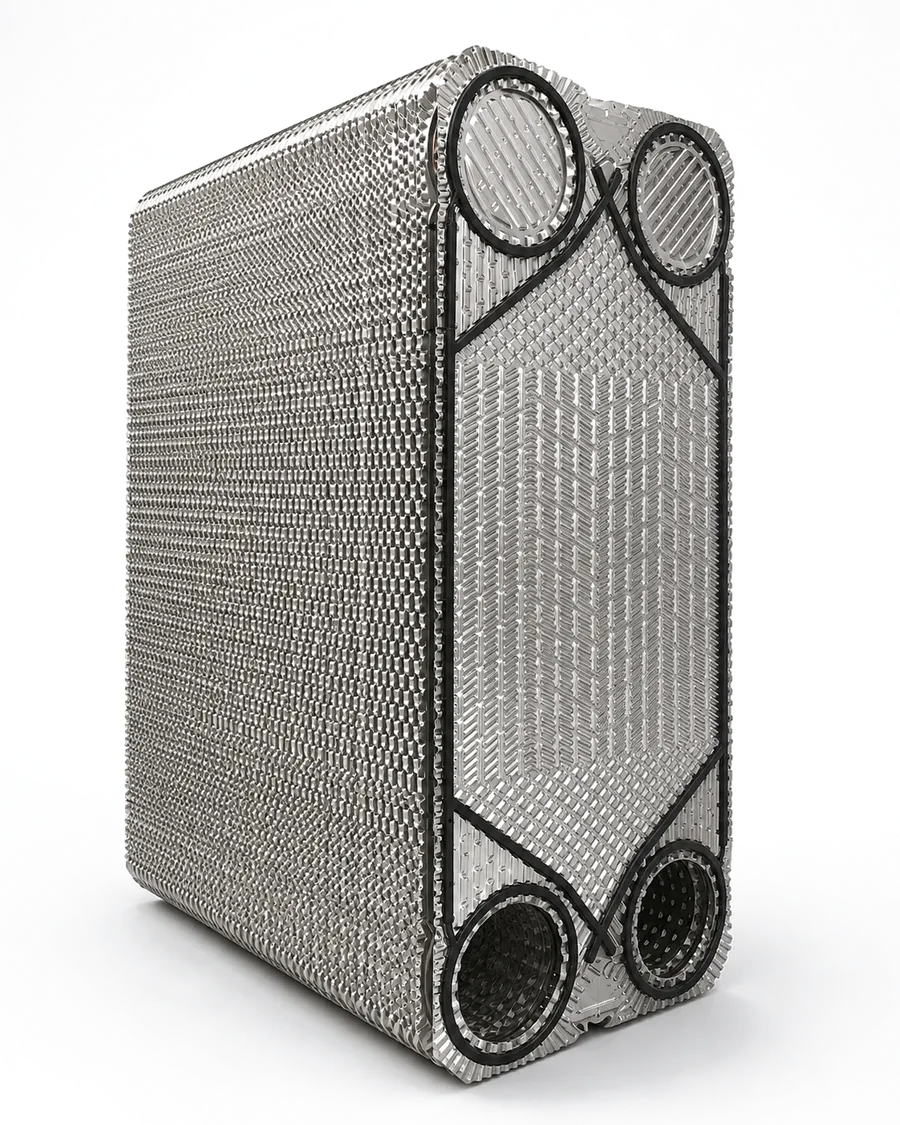
Rinse water recovery, typical conditions
Basis for a plate pack recovering heat from the final rinse. Flows assume the rinse and the stream it heats are matched through a tank.
| Condition | Typical value |
| Hot side in | Final rinse water, 120–140°F, near neutral, little soil |
| Hot side out | To drain at about 85°F |
| Cold side in | City or well water at 55–65°F |
| Cold side out | About 105°F to the recovered-water tank |
| Flow | 30–200 gpm, set by the rinse circuit line size |
| Approach | About 25°F at the design above; 60–70% of the rinse heat recovered |
| Plates | 316L, 0.5–0.6 mm, EPDM gaskets |
| Frame and ports | 150 psig frame; tri-clamp to 4 inches or flanged |
Making rinse recovery actually recover
The tank in the middle
The pre-rinse of the next cycle may be an hour away, or a shift away. A recovered-water tank sized for one or two rinses, 500–1,500 gallons on a 70 gpm circuit, holds the warmed water until it is needed; without it the plate pack has nothing to heat while the rinse runs. The exchanger sits between the rinse return and that tank. We supply the exchanger; the tank, its pump and its controls belong to the plant or the integrator.
What the recovered water is good for
At about 105°F it is a pre-rinse that melts fat instead of setting it, which is the usual complaint about a cold pre-rinse. It is also a warm start for caustic makeup, in which case the steam heater on the tank lifts from 105 rather than 60°F. Either way, the 45°F is gained once and used once; do not count it twice when sizing the steam heater.
Keeping the pack clean
Rinse water is low in soil but it is not sterile, and a recovered-water tank sitting warm for hours grows things. The plate pack side that sees the rinse should be drainable, the tank should be covered and turned over daily, and the pack should open for inspection without moving pipe. On hard water the cold-side plates scale slowly near the hot inlet; a fouling allowance of 0.001–0.002 covers a season.
Where it does not pay
A plant running one or two cycles a day, or one whose final rinse is only 100°F, gets little back. The arithmetic is simple: gallons per cycle, times degrees recovered, times cycles per day. Below about 0.5 MBtu/h recovered the frame and tank cost more than the steam they save for years, and we will say so rather than sell a pack that sits idle.
What plants ask about recovery
No, and not for thermal reasons. The final rinse is the last water to touch product surfaces and plants want it fresh from the supply through the heater. Recovered rinse water is the right source for the pre-rinse, which is there to remove bulk soil, or for caustic makeup, where the chemistry does not care what the water did last. Keep the streams in that order.
Because they do not happen at the same time on the same circuit. A plate pack needs both streams flowing to move heat; with only the hot side running, the water simply passes through at rinse temperature to drain. A multi-circuit plant with staggered cycles can sometimes pair one circuit's rinse with another's pre-rinse directly, and we size for that when the schedule allows it.
On a 70 gpm final rinse at 130°F against 60°F water, about 1.6 MBtu/h while it runs, and over a 7-minute rinse roughly 190,000 Btu per cycle, about 190 lb of 15 psig steam. Five cycles a day is close to 1,000 lb of steam. It is smaller than the caustic return recovery and still worth a modest pack where the tank already exists.
Not for the rinse itself, which is near-neutral water. If the same return line and the same pack see the intermediate rinse after the acid step, traces of nitric or phosphoric pass through at rinse temperature and EPDM still handles them diluted. Only where the acid solution itself is routed through the recovery pack do we move to FKM. Tell us how the return is valved.
Related
CIP Heaters
Return-to-Makeup
What the return gives up, what the makeup gains, the approach to expect, and the steam the finishing heater no longer burns, worked for a 100 gpm caustic circuit.
+ Learn More
CIP Heaters
Recovery Exchangers
A plate exchanger between the return line and the makeup water hands back 60–70% of the heat the cycle would send to drain, and shrinks the steam heater behind it.
+ Learn More
CIP Heaters
Caustic Heaters
Steam into a sodium hydroxide loop at 140–175°F: how the U-tube heater is built, and whether the tank loop or the supply line is the right place to put it.
+ Learn More
