
1-805-484-2992
Quotes - Engineering - SalesWhich circuit are you heating?
Two plants can ask for a caustic heater at 165°F and 100 gpm and need exchangers that differ by a factor of three. The difference is whether the heater warms a tank of solution between washes or raises a stream from supply temperature to target in one pass while the circuit runs. The first is a batch problem measured in gallons and minutes; the second is a steady problem measured in gpm and temperature rise. Settle this before any other figure is written down.
Signs that tell you which one you have
In a recirculating tank system the solution lives in a CIP tank of 500–5,000 gallons. A loop pump draws from the tank, pushes through the heater and returns to the tank, and the circuit pump draws from the same tank to feed the equipment being cleaned. The heater's duty is set by how many gallons must rise how many degrees in how many minutes, with the circuit's heat loss added on top. A 2,000-gallon tank brought from 70 to 165°F in 20 minutes needs about 4.75 MBtu/h; the same tank given 60 minutes needs about 1.6 MBtu/h. The schedule, not the chemistry, is what sizes it.
In a once-through inline system there is no hot tank. Water or made-up solution comes in at supply temperature, the heater raises it to target in a single pass, and the circuit uses it immediately. Duty is flow times rise: 100 gpm raised 60°F is roughly 3 MBtu/h, every minute the circuit runs, with no heat-up period to spread it over. An inline heater is therefore often large relative to a tank heater given an hour, needs a fast steam valve, and must hold temperature within a few degrees as flow changes.
Walk the circuit and check
- A CIP tank that is hot before the wash starts means tank recirculation
- A temperature setpoint on the heater outlet, not on the tank, points to once-through
- A separate loop pump that runs when no circuit is selected is a tank heater loop
- Solution made up fresh at the start of each cycle and dumped at the end is once-through
- A sanitize-water heater almost always runs once-through at 180–190°F
- Flow that swings with the circuit chosen, 30 to 200 gpm, is inline duty on the heater
the spread between the two methodsA 20-minute heat-up and a 60-minute heat-up of the same 2,000-gallon tank sit three to one apart in duty, and an inline heater at the circuit flow sits between them.
What each circuit puts on the inquiry
The two methods need different numbers, and an inquiry that mixes them produces a heater sized for a circuit that does not exist. Pick the column that matches the plant and send those figures.
- Tank: tank volume in gallons, starting temperature, target temperature and the minutes allowed
- Tank: loop pump flow in gpm, or tell us there is none and the circuit pump does the work
- Tank: how long a wash runs and how cold the return comes back, so the hold duty is right
- Inline: circuit flow in gpm at its highest, plus the lowest flow the heater must still control
- Inline: supply temperature in winter, because that sets the largest rise
- Both: steam pressure at the heater inlet and whether the solution is caustic, acid or water
Call and talk it through with an engineer: 1-805-484-2992
Choosing the heater for each
A tank recirculation heater is nearly always a U-tube steam heater with solution on the shell side. The loop pump gives a steady 50–150 gpm through the shell regardless of which circuit is running, which keeps velocity up and fouling down. Control is on tank temperature with the heater outlet as a high limit, and the steam valve moves slowly. Because the duty is spread over the heat-up period, the bundle is modest and the steam demand on the boiler is gentle.
An inline once-through heater carries the full circuit duty continuously and must respond to flow changes within seconds, so the steam valve, trap and condensate line are sized with more care and the heater is specified at the highest flow the circuit will see. Shell-and-tube still wins for steam-to-solution because the approach from 250°F steam at 15 psig to a 175°F target is comfortable, and because the bundle comes out when the hot surface scales. A gasketed plate exchanger takes the inline rinse-water job when the heating medium is hot water rather than steam.
Many plants have both without realizing it. The caustic tank is heated by a loop, but the sanitize step draws city water through a steam heater once-through at 180°F because nobody wants to store water that hot. The inquiry then describes two heaters, and the one for the sanitize water is often the larger of the pair even though it runs for 5–15 minutes a cycle.
The common mistake is to size a tank heater as though it were inline, by taking the circuit flow and the full temperature rise. The result is an exchanger several times too large that cycles its steam valve, hammers its trap and short-cycles the control. The opposite mistake, sizing an inline heater by tank volume, gives a heater that cannot keep up and a circuit that runs its whole caustic step 20°F cold. Both are avoided by writing down which circuit the heater serves.
If the plant has not decided, we can size both and show the difference. A tank system costs a tank and a loop pump but a smaller heater and a kinder steam load; once-through saves the tank and the heat-up wait but asks more of the boiler every cycle. For caustic the tank nearly always wins because the solution is reused; for sanitize and final-rinse water, once-through is the usual answer.
Gallons and minutes for a tank; gpm and degrees for once-through.
Tell us which pump the heater sits behind and the sizing method follows from it.
Request a QuoteTank or inline questions
Then the heater sees circuit flow and the tank is heated only during a wash, which puts it somewhere between the two. We size it as a tank heater for the heat-up and then check that at circuit flow, with cold return arriving from the equipment, it can hold the tank at target through a 20–45 minute caustic step. The hold case often governs when the circuit returns well below 140°F.
Mechanically yes, with valving, but the duties differ so much that the heater is wrong for one of them. Sized for the rinse it is oversized on the tank loop and cycles the steam; sized for the tank it cannot hold the rinse temperature. Two heaters, each sized for its job, cost little more than one that is three times too big for half its life.
As much as the production schedule gives. A plant that starts washing at 6 a.m. and can turn the heater on at 5 a.m. buys a heater one-third the size of a plant that needs the same tank hot in 20 minutes. Round-the-clock plants seldom see the tank below 130°F and size smaller again. Tell us the real schedule rather than a worst case nobody runs.
For caustic and acid it usually does, since solution is made up and sent to drain each cycle, which is why those circuits are almost always tank systems. For rinse and sanitize water there is nothing to recover but heat, and a return-to-makeup recovery exchanger captures 60–70% of that. Once-through is the right method for water; recirculation is the right method for chemical.
Related
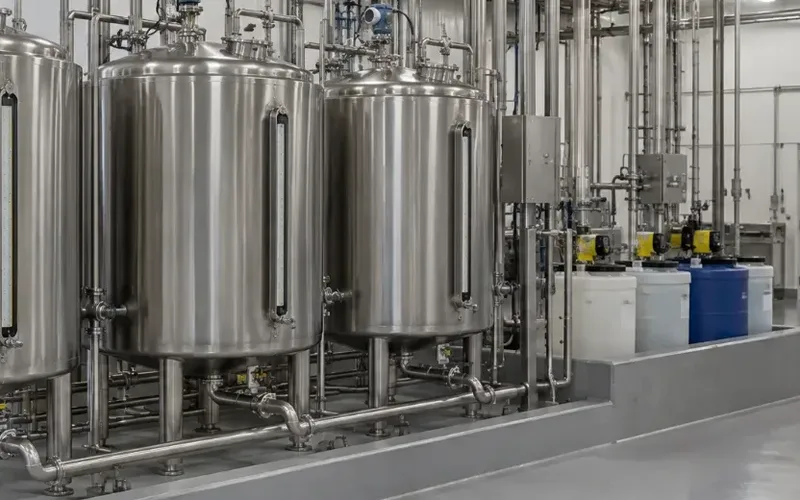
Sizing & Selection
Circuit, Chemical & Concentration
Caustic, acid, rinse or recovery, which chemical and at what strength. Why those three answers decide the metal and the gasket before a single Btu is counted.
+ Learn More
Sizing & Selection
Duty Point & Steam Pressure
Flow, inlet, target and steam pressure at the heater make the duty point. How Btu/h and steam lb/h fall out of them, and why the boiler gauge is the wrong figure.
+ Learn More
Sizing & Selection
Define the Duty
Five answers size the heater: circuit and chemical, tank or inline, gpm, inlet and target temperature, and steam pressure at the heater. Collect them here first.
+ Learn More
