
1-805-484-2992
Quotes - Engineering - SalesThe heater is the hottest surface in the caustic loop
Milkstone is calcium phosphate, with some magnesium and carbonate, bound into a layer of denatured whey protein. It forms wherever milk solids meet a surface above about 160°F, and on a dairy's caustic heater the surface that meets the solution is the shell side of a bundle whose tubes are carrying steam at 250–300°F. Residual protein in the returning caustic denatures on that bundle before it denatures anywhere else.
The caustic itself does half the job. At 1–2% and 160–175°F, sodium hydroxide hydrolyzes the protein and saponifies the fat, and most of the film leaves with it. What stays is the mineral, which caustic cannot dissolve and which hard water adds to every cycle as carbonate scale. The acid step, nitric or phosphoric at 0.5–1.5% and 120–150°F, is what takes the mineral off, and a plant that runs it only on weekends is letting the heater lose capacity five days out of seven.
This page is about the heater's own fouling: how fast it builds, what it costs in heat-up time, how we size for it, and why the bundle is built to come out. The equipment pages below it cover the two dairy circuits where the film is heaviest, butter and whey.
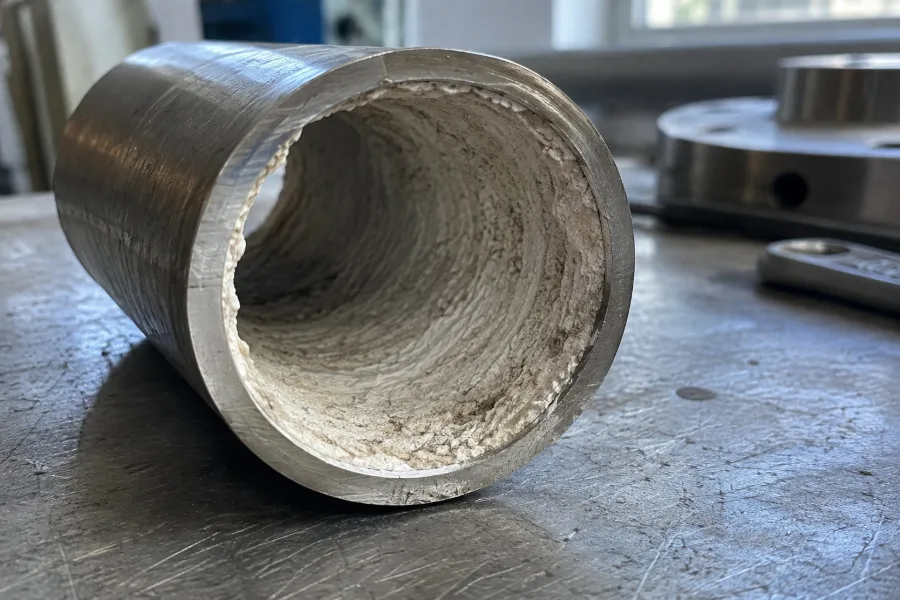
Three signs the heater is carrying milkstone
- Heat-up to 165°F takes longer every week
- Steam pressure at the heater inlet has not changed
- Acid step was skipped or ran below 120°F
The dairy caustic circuit and the heater that suits it
The left column is how a dairy caustic circuit typically runs; the right is the heater we put on it and what we need from the plant to size it. The numbers are standard ranges, and the quote is built on the plant's own.
How the circuit runs
- Chemical: Sodium hydroxide 1–2%, up to 3% on butter and whey soils
- Caustic temperature: 160–175°F; milkstone forms above about 160°F
- Acid step: Nitric or phosphoric 0.5–1.5% at 120–150°F, several times a week
- Cycle: Caustic 20–45 min inside a 45–90 min cycle
- Flow: 30–120 gpm on line circuits, 100–300 gpm on silos
- Water: Hard water roughly doubles the mineral load
The heater we recommend
- Construction: U-tube shell-and-tube, steam in the tubes, caustic in the shell
- Materials: 316L shell, bundle and heads; carbon steel only on the steam head
- Removability: Bundle pulls from the steam-head end; leave bundle length plus a foot
- Fouling allowance: 0.001–0.002 on the solution side, 10–20% added surface
- Head gasket: EPDM standard; FKM for hot nitric
- What to send: Tank gallons, heat-up minutes, water hardness, acid and frequency
Living with milkstone on the heater
How fast it builds
On a heater running 170°F in hard water with the acid step skipped, a visible mineral film forms within two or three weeks and a few thousandths of an inch is on the tubes within a couple of months. Calcium phosphate conducts heat far worse than 316L, so even a thin layer costs a measurable approach. The operator sees it as a caustic tank that used to be ready in 25 minutes now taking 35.
What we size for
We size a dairy caustic heater with a solution-side fouling allowance of 0.001–0.002, which adds roughly 10–20% surface over the clean duty. On a 2,000-gallon tank heated from 70 to 165°F in 20 minutes the clean duty is about 4.75 MBtu/h, and the allowance is what keeps the heater meeting that 20 minutes between acid steps rather than only on the day it was installed.
- Clean duty from gallons, rise and minutes
- Allowance for the mineral between acid steps
- Steam pressure at the heater inlet, not the boiler
- 15 psig steam still sits 85°F above a 165°F target
Why the bundle comes out
A straight-tube heater with the caustic inside the tubes can be brushed, and some plants prefer that. In a dairy we put the caustic in the shell and steam in a U-bundle because the film forms on the outside of the tubes where a brush cannot reach, and because the U-bundle expands freely with 250–350°F steam without a floating head or expansion joint. When the acid step has not kept up, the bundle lifts out, the shell side is inspected, and a new bundle drops in if the old one is beyond cleaning.
Protein first, then mineral
The order of the cycle matters to the heater. Caustic before acid lifts the protein that is holding the mineral in place; acid before caustic would dissolve exposed mineral but leave protein cooked onto the surface, where the next hot caustic sets it harder. Outside the mineral-heavy whey evaporator circuits, dairies that reverse the order to save a rinse usually find the heater, not the pasteurizer, is the first thing to show it.
Milkstone questions
Read the steam pressure at the heater inlet with the valve wide open and the tank cold. If it is at the design figure and the heat-up is still slow, the bundle is carrying mineral. If the gauge is low, look at the control valve and the trap first; a trap holding condensate halves a heater's capacity without any fouling at all. Both show up as a slow heat-up, but only one is fixed by the acid step.
Acid at 120–150°F dissolves calcium phosphate well; going hotter mostly shortens gasket life, especially with nitric. Frequency matters more than temperature. A dairy on hard water that runs acid daily keeps the heater clean indefinitely; one that runs it weekly will pull the bundle every year or two. Phosphoric is gentler on EPDM than nitric if the plant has a choice.
No. The steam side sees only steam and condensate and stays clean for the life of the bundle, which is the reason the bundle is built with steam inside the tubes. All of the fouling is on the solution side, where a removable bundle can be inspected and cleaned. A clean steam side and a fouled shell side is exactly what we expect to see when a dairy pulls a bundle.
If the shell is one we supplied, yes, from the drawing. If it is another shell in 316L and sound, we can usually build a new U-bundle to its tube-sheet dimensions, tube count and nozzle layout from measurements or the original drawing. The replacement is a new bundle; the old one comes out whole and stays with the plant, and the shell side gets inspected while it is open.
Related
Applications
Pasteurizer & Line Circuits
HTST and UHT loops run a fixed flow at the hottest caustic in the plant. How a tank loop and a once-through heater are sized differently for the same line.
+ Learn More
Applications
Vat & Silo Circuits
Vats and silos are cleaned by spray devices at 100–300 gpm, so the heater's real job is tank heat-up. How the minutes you allow set the heater size.
+ Learn More
Applications
Dairy
Dairy circuits run the hottest caustic on this site and foul the heater itself. Why dairies pull bundles, and how pasteurizer, vat and silo loops differ.
+ Learn More
