
1-805-484-2992
Quotes - Engineering - SalesCleaning in place, for the heater itself
Some sanitation departments own a tube brush and a drill and want to keep using them. Others have a heater jammed into a utility corridor with a wall two feet off the head, where no bundle will ever come out. Both of them get the same answer: a straight-tube exchanger with a bolted, removable head at each end. Pull the two heads and every tube is a straight hole you can see daylight through. A nylon brush or a rod goes in one end and out the other, the scale drops out of the bottom head, and the heads go back on with fresh gaskets. No crane, no laydown area, no rigging crew.
To make brushing worth doing, the fouling has to be inside the tubes, so on this construction the roles swap from our U-tube heater: the solution runs tube side and steam fills the shell. The tubes, both tubesheets, both heads and all solution nozzles are 316L. The shell carries only steam and condensate and can be carbon steel or 316L as the plant prefers.
Fixed tubesheets at both ends mean the tubes cannot grow freely, so the shell carries an expansion joint or the design keeps the tube wall temperature within what the joints tolerate. That is a real cost against the U-tube, and it is why we build this heater when brushing is the stated requirement, not as the default.
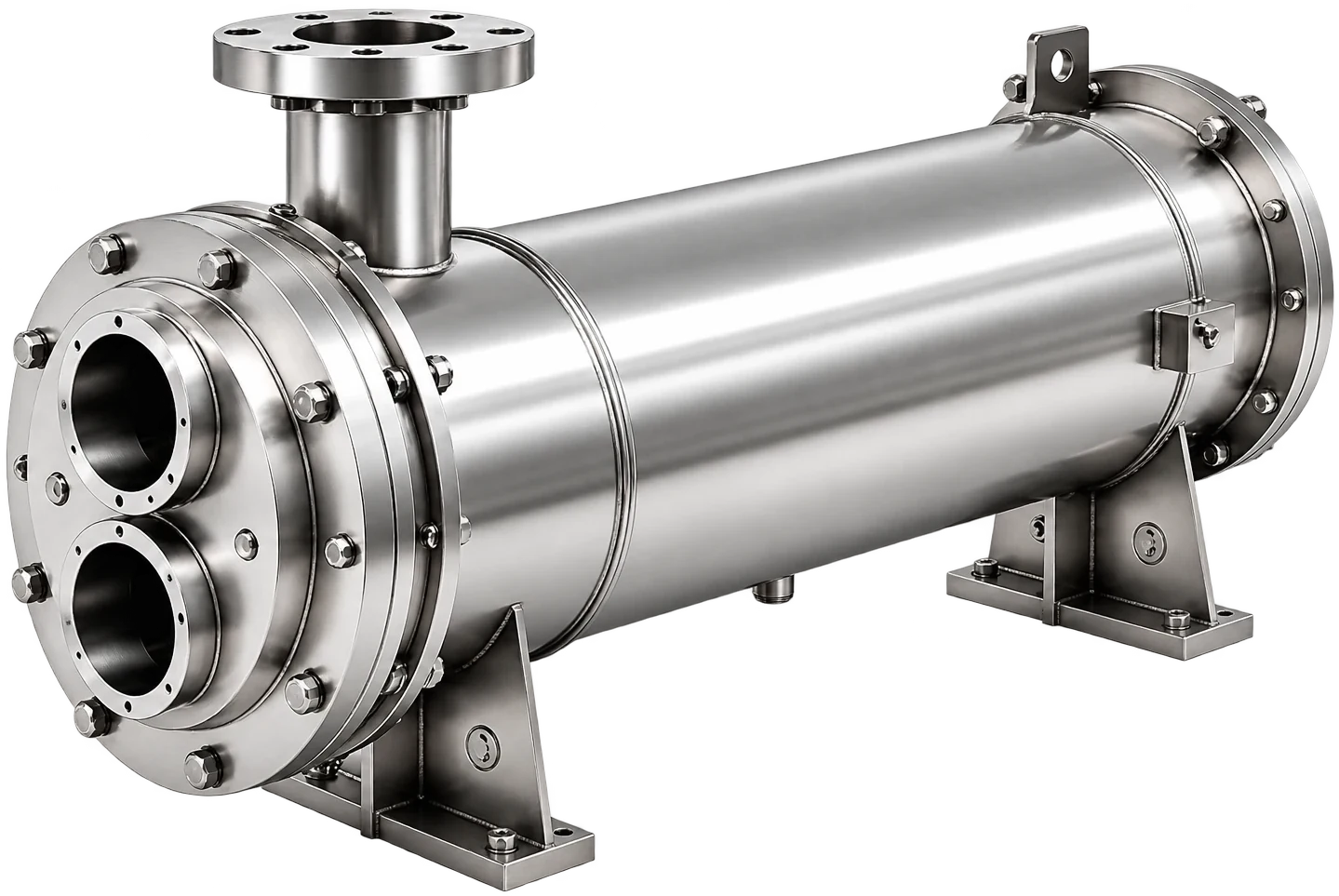
Straight 316L tubes, two bolted heads, and a scale layer that leaves with a brush instead of a crane.
The right choice for hard water, tight rooms and crews who clean on a schedule.
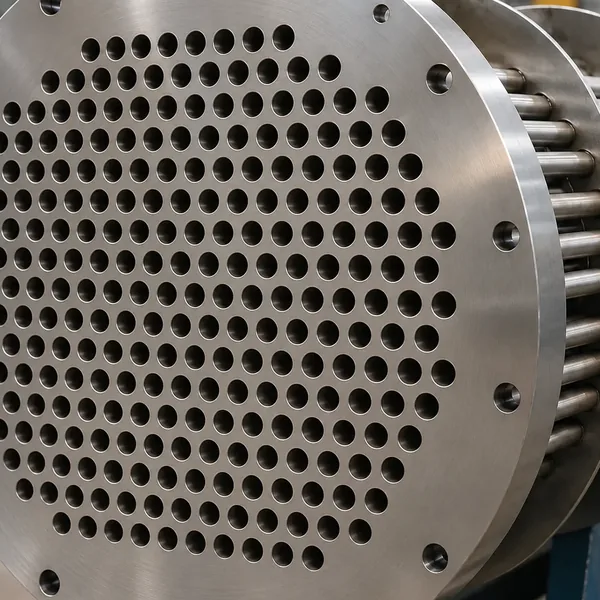
Built to be opened
- Bolted 316L heads at both ends, gasket in a machined groove
- Tube ends flush with the tubesheet face for a clean brush entry
- Tube pitch sized so a standard brush reaches every tube
- Heads lift off by hand on smaller shells; davit on larger ones
- Spare head gaskets listed on the drawing by size and compound
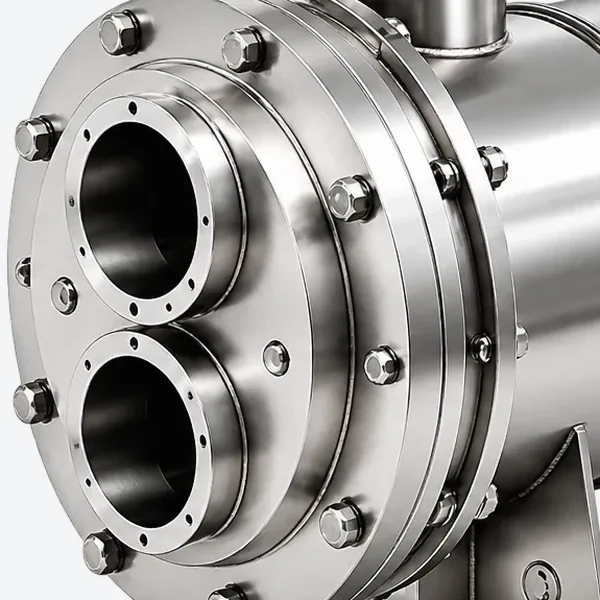
Built to heat
- Steam in the shell, 150 psig at 400°F design
- Solution in the tubes, 150 psig at 250°F design
- Impingement plate under the steam nozzle protects the top tubes
- Condensate outlet at the shell bottom, trap and drop leg below it
- Expansion joint or controlled design handles tube growth
Your call on the build




Standard build, straight tube
Solution inside the tubes, steam around them. Each row is the default; tell us where your plant differs.
| Feature | Standard build |
| Tube side (solution) | 150 psig at 250°F; caustic, acid or rinse water through the tubes |
| Shell side (steam) | 150 psig at 400°F; 15–125 psig plant steam with control valve and trap |
| Tubes | 316L, straight, 3/4-inch or 1-inch, rolled into both tubesheets |
| Tubesheets | Two, fixed, 316L on the solution face |
| Heads | Removable at both ends, 316L, bolted; pass partitions as the sizing requires |
| Head gaskets | EPDM standard; FKM where the circuit runs the acid step |
| Shell | Carbon steel or 316L; expansion joint when the differential calls for it |
| Connections | Tri-clamp on the heads to 4 inches; flanged above that; drainable with heads horizontal |
| Finish and code | 32 Ra on sanitary loops, mill finish on utility duty; ASME stamp on request |
What to know before you choose brushable
Hard water is the usual reason
Carbonate scale is what brushes off well. It forms fast where rinse water or weak caustic is heated above about 160°F in hard water, it is brittle, and a brush breaks it loose in one pass. Protein film and milkstone are a different story: they are soft and tenacious, they smear under a brush, and they really want an acid soak. So the plant that benefits from this construction is the one whose heater scales rather than films, typically a rinse heater or a brewery caustic heater on raw well water. If your fouling is dairy soil, the removable U-bundle and a soak tank will serve you better.
Velocity still matters more than the brush
A brush is a recovery tool, not a design strategy. We size the tube passes so the solution moves at a velocity that keeps most of the scale from settling in the first place: a 2-inch circuit at about 30 gpm, a 3-inch at 70 gpm, each kept in the tubes at a speed that scrubs. Doubling the passes doubles the velocity and the pressure drop together, so we trade those against the pump you have. Give us the pump curve or at least the available head and we will keep the tubes self-cleaning for as long as possable between brushings.
- One pass for high gpm and low head; two or four passes for low gpm
- Pressure drop through the tubes stays under what the circuit pump can spare
- Brushing interval stretches as design velocity rises
Gasket the heads for the chemical you run
Two heads means two large gaskets that come off every time the tubes are brushed. On a caustic or hot-water circuit EPDM is right and lasts many cycles of removal. If the circuit also runs the nitric acid step, specify FKM for both heads; nitric at 120–150°F hardens EPDM over a season and a hardened gasket does not reseal after the next brushing. Order two spare sets with the heater, so nobody reuses a gasket because the stores were empty.
Expansion is handled in the design, not left to chance
With tubes fixed at both ends, the temperature difference between 316L tubes full of 165°F caustic and a shell full of 298°F steam puts real force on the roll joints. We compute that differential for your steam pressure and solution temperatures and either add a shell expansion joint or hold the steam pressure to a range that keeps the stress acceptable. This is work we do before the quote drawing goes out, and it is one more reason we ask for the steam pressure at the heater inlet rather than a boiler nameplate.
Brushing and access questions
Roughly the head depth plus a hand's width on each end, typically 12–18 inches, which is why this heater fits where a U-bundle never will. The brush or rod then needs its own length in front of one end, but a sectional rod or a flexible shaft on a drill gets around a close wall. Mark the clearance on the layout anyway; it is cheap on paper.
The shell holds steam, so you isolate the steam valve and let the shell drain its condensate through the trap, which it does on its own. The solution side is what you open, and it has to be drained and rinsed first; 1–2% caustic at 165°F is not something to meet with a wrench in your hand. Lockout on the pump, drain both heads, then open.
No. For the same surface and the same velocities, the two constructions move the same heat. The differences are mechanical: the straight tube buys brushing access and loses free expansion, so it costs more for the expansion joint and the second tubesheet and head. Thermally they are equals. We size both to the same gpm, inlet, target and steam pressure.
The inside of the tubes, which is the point. The steam side of the shell stays clean because condensing steam leaves nothing behind. We put the fouling allowance of 0.001–0.002 on the tube side only, which adds roughly 10–20% surface, and we lean the pass count toward velocity so the scale that does form is thin and brittle rather than thick and bonded.
Related
Heat Exchangers
U-Tube Removable Bundle
The construction we quote first for steam-to-caustic: a U-bundle that grows and shrinks on its own and slides out of the shell when the solution side needs cleaning.
+ Learn More
Heat Exchangers
Replacement Bundles
When the shell is sound and the tubes are not, a new 316L bundle made to the old one's tubesheet and length drops back in without a pipe fitter.
+ Learn More
Heat Exchangers
Shell & Tube
The construction that carries the main CIP duty: a U-tube bundle condensing steam inside, a 316L shell around it, and three ways to buy it, full unit to bundle.
+ Learn More
