
1-805-484-2992
Quotes - Engineering - SalesA soil that has to be melted before it can be cleaned
Lotions, creams and ointments leave a film that is not protein and not sugar. It is cetyl and stearyl alcohol, beeswax, paraffin, petrolatum, mineral and vegetable oils and the emulsifier that held them together, and most of those melt between 120 and 160°F. Below the melt point caustic slides over them. A cosmetic plant therefore reverses the usual order of effort: the pre-rinse is hot, 140–150°F, to melt the bulk wax off the vessel wall, the agitator and the homogenizer head and carry it to drain, and only then does the caustic step have a surface to work on.
The caustic itself runs hot and is rarely plain. Sodium hydroxide at 1–2% with a surfactant or emulsifying additive at 170–175°F lifts the oil film, and plants with heavy silicone or petrolatum products hold the top of that range for 30–45 minutes. Acid is uncommon here; hard-water scale is dealt with weekly rather than per cycle. Hot water, not chemistry, is the main heat load, which means a tank heater that brings a 1,000–3,000-gallon tank to 175°F quickly and holds it while melted wax and oil come back in the return.
We put a U-tube steam heater on that tank loop, 316L on the solution side, bundle removable, because oil carried back into hot caustic emulsifies, cools on the shell wall between cycles and leaves a waxy skin that eventually has to be taken off by hand.
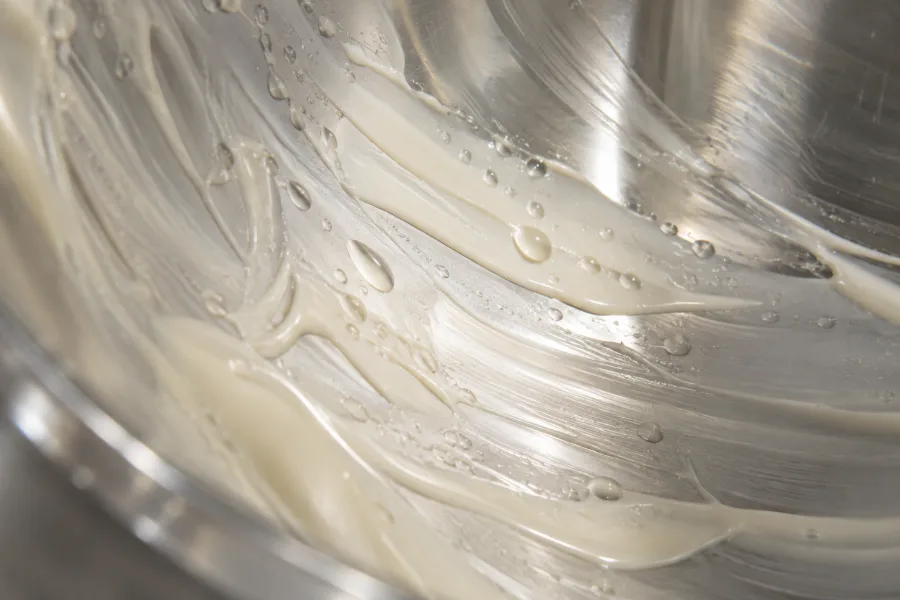
Pre-rinse at 140–150°F melts the wax so the caustic has something to lift
- Cetyl alcohol, beeswax and petrolatum melt between 120 and 160°F
- Caustic with surfactant at 170–175°F emulsifies the oil film that remains
- Wax cooling on the shell between cycles comes off at a pull
How a lotion plant runs CIP and the heater that fits
The left column shows a typical lotion, cream or sunscreen circuit; the right column is the tank heater we build for it. Lighter products sit at the cool end of each range.
The emulsion vessel circuit
- Chemical: Sodium hydroxide 1–2% with surfactant; weekly phosphoric acid 0.5% for scale
- Temperature: Hot pre-rinse 140–150°F; caustic 170–175°F; final rinse 120–140°F
- Flow: 100–200 gpm through vessel spray devices; 30–70 gpm on transfer and filling lines
- Cycle: Hot rinse 10 minutes, caustic 30–45 minutes, rinse, sanitize; 60–90 minutes total
- Soil: Fatty alcohols, waxes, petrolatum, silicones, oils, emulsifiers, pigment and fragrance
- Water: Softened or purified on final rinse; conductivity checked where the plant follows GMP
The heater we recommend
- Construction: U-tube shell-and-tube tank heater, steam in the tubes, solution on the shell
- Materials: 316L on every surface the solution touches; EPDM head gasket; utility steam head
- Duty: Heat-up of 1,000–3,000 gallons to 175°F, plus the hot pre-rinse at full gpm
- Connections: Tri-clamp to 4 inches where the loop is sanitary; 150-pound flanges on utility
- Finish: Mill finish is enough on most cosmetic CIP tanks; 32 Ra on request
- Send us: Tank gallons, minutes to temperature, product wax content, spray gpm, steam psig
Sizing around a melting soil
The hot pre-rinse is a second heater duty
In a dairy the pre-rinse is warm water from a recovery tank. In a lotion plant it has to be 140–150°F at the vessel at 100–200 gpm for 10 minutes, which is 1,000–2,000 gallons of water raised 80–90°F, or 4–9 MBtu/h while it runs. That is more heat than the caustic step takes. Plants cover it from a hot-water tank filled between cycles, from a once-through steam-to-water heater, or by running rinse water through the caustic tank heater on a bypass. Tell us which, because it decides whether the heater is sized for the caustic hold or the rinse peak.
Oil in the caustic
Melted wax and oil that escape the pre-rinse come back in the caustic return as an emulsion. Hot, agitated and alkaline, the tank holds it; cooling overnight in the heater shell and suction piping, it separates and sets as a soft wax on the walls. On a U-tube heater that layer forms on the shell and the outer tube rows, where it insulates and slowly cuts capacity. A bundle pull once or twice a year with a hot caustic soak of the bundle outside the shell removes it.
- Dump the caustic tank more often on high-wax products rather than trying to clean it chemically
- Keep the heater and its suction line warm between cycles if the schedule allows
- Order the bundle removable and leave the pull length clear of the mixer platform
Surfactants and foam
The surfactant that makes the caustic lift oil also makes it foam, and foam in the tank means air in the suction and cavitation at the loop pump. A heater on a loop with an unsteady pump sees pulsing flow and a wandering outlet temperature. Low-foam builders help; so does a return below the liquid line and a loop pump with suction margin. The heater is unaffected; 316L and EPDM are compatible with the builders this industry uses.
Where plate fits
A gasketed plate exchanger is a poor fit for the caustic loop here, because emulsified wax plugs 3–5 mm channels and the pack cannot be cleaned without opening the frame. It fits on the warm final rinse and on recovery from the hot rinse drain, where the water is clean and pressures are modest. For the caustic and the hot pre-rinse we keep shell-and-tube, with the solution on the shell side where wax has room to pass.
Lotion and emulsion questions
Petrolatum softens from about 100°F but does not clear from stainless untill the solution is well above 150°F and carries a surfactant or solvent-type builder. Most ointment plants run the pre-rinse at 150°F and the caustic at 175°F, the top of the range, and hold 45 minutes. The heater must reach and hold that with the return bringing back melted product, which argues for sizing on heat-up rather than on hold.
You can, and the result is a caustic tank full of emulsified wax after two cycles. Caustic that has to melt the bulk soil loses temperature to it, so the first ten minutes of the step go to getting the vessel surface above the melt point instead of cleaning. A hot pre-rinse to drain takes that heat load and the wax out of the chemical loop.
Rarely. Most personal-care plants treat the CIP supply as utility equipment and are satisfied with 316L at mill finish, tri-clamp or flanged as their piping dictates. Plants manufacturing under drug GMP, such as sunscreen and medicated ointment, more often specify 32 Ra and full drainability on anything feeding the vessel. We build either; say which rule set your site follows.
Look at the shell between cycles. Emulsified oil that stayed suspended in the hot, agitated tank separates when the loop stops and the heater cools, and it sets on the shell wall and outer tubes as a thin waxy skin that the next cycle softens but does not remove. It is invisible in a tank sample. A bundle pull shows it at once.
They change the chemistry more than the hardware. Dimethicone and cyclomethicone do not saponify, so plants lean on a stronger surfactant package and the hottest caustic the loop can hold, 175°F, with a longer contact time. The heater sees the same duty as on a wax product, with the same shell-side film to manage at a pull. 316L and EPDM are untroubled by silicones.
Related
Applications
Tank & Vessel Circuits
Pharma vessel CIP is light on soil and heavy on flow, water quality and paperwork. The sanitary drainable heater we build for spray circuits and hot purified rinse.
+ Learn More
Applications
Pharma & Personal Care
Pharma suites and cosmetics plants clean like a dairy but specify like a validation group. What changes in the heater, and what does not, for each circuit.
+ Learn More
Applications
Dairy
Dairy circuits run the hottest caustic on this site and foul the heater itself. Why dairies pull bundles, and how pasteurizer, vat and silo loops differ.
+ Learn More
