
1-805-484-2992
Quotes - Engineering - SalesA plate exchanger is only as good as its gasket
The elastomer is the exchanger
A gasketed plate pack puts 316L plates 0.5–0.6 mm thick a few millimeters apart and seals every channel with an elastomer gasket. The plates do not care about CIP chemistry; the gasket cares about nothing else. On a pack with a hundred plates there are hundreds of feet of gasket in contact with the solution, and when the chemical and the elastomer disagree the exchanger leaks or cross-contaminates within a season. That is why the acid step, not the caustic step, decides the gasket on any plate exchanger in a CIP loop.
EPDM is the default for good reason. It is rated to about 300°F, shrugs off sodium hydroxide at any CIP strength and is at home in hot water. It fails one test: hot, oxidizing nitric acid. Run nitric at 1–1.5% and 140°F through an EPDM pack two or three times a week and the gaskets go hard, lose their set and crack at the corners. Phosphoric does not do this, which is why a phosphoric-only plant can usually keep EPDM.
FKM, the fluoroelastomer, takes nitric at CIP strength and temperature and takes everything EPDM takes. It costs more per pack and is specified where it is needed, not everywhere.
See the EPDM & Acid Elastomers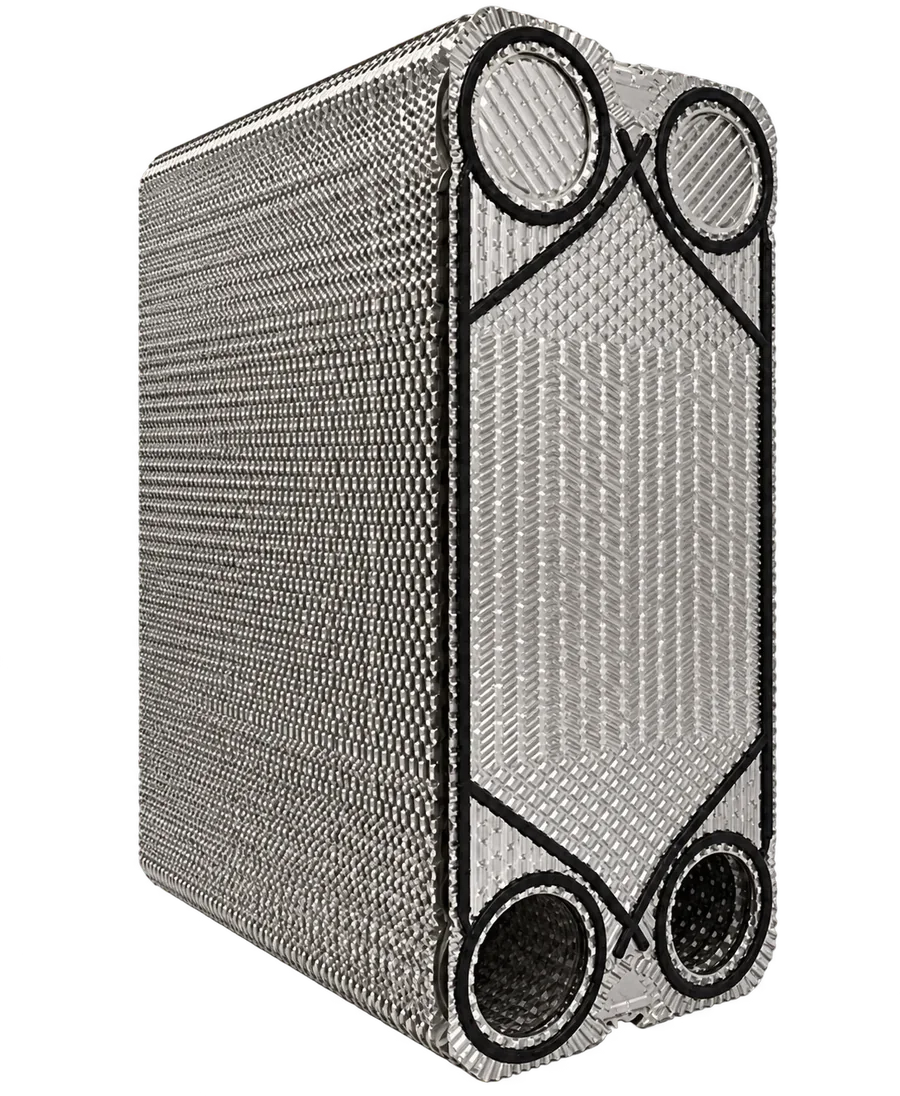
Elastomers against the CIP chemicals
How the two gaskets we specify stand up to each fluid in the CIP loop. NBR is left off because it has no place in CIP.
| Condition | Typical value |
| Caustic 1–2%, 140–175°F | EPDM; FKM also acceptable |
| Phosphoric 0.5–1.5%, 120–150°F | EPDM usually holds; FKM where the step runs daily |
| Nitric 0.5–1.5%, 120–150°F | FKM; EPDM hardens within months |
| Hot water and sanitize, to 190°F | EPDM |
| Temperature rating | EPDM about 300°F; FKM higher still |
| Frame pressure | To 150 psig with either gasket |
| Steam on a plate | Not recommended with either; cycling shortens gasket life |
| What failure looks like | Hard, glossy gasket, cracks at the corners, weeping at the frame |
Specifying the gasket before it fails
Where plate gaskets meet acid in a CIP loop
Plates do not take the main caustic duty on steam; that stays shell-and-tube. They appear where two liquids exchange heat at modest pressure: a return-to-makeup recovery exchanger, a rinse-water heater fed from plant hot water, or a solution heater on a plant with no steam in the CIP room. Any of those can see acid. The recovery exchanger sees the acid return as surely as the caustic return, and a solution heater on single-use CIP sees every chemical in sequence. If acid can reach the plates, the gasket is specified for it.
What a hardened gasket looks like
The first sign is a weep at the frame after the acid step that stops when the pack warms up on caustic. Open the frame and the gaskets have lost their softness, taken on a glossy surface and cracked where they turn the corner at the port. Under a thumbnail they feel like plastic rather than rubber. By this point tightening the frame only cracks them further. The cure is a new plate pack, this time in FKM; the frame itself is almost always reusable.
- Weeping at the frame after acid, dry on caustic
- Glossy, hard gasket surface
- Corner cracks at the port openings
- Frame bolts already at the minimum dimension
EPDM is still the right answer most of the time
Specifying FKM everywhere is the easy answer and costs more than it should. A recovery exchanger on a plant that runs phosphoric at 130°F once a week will run on EPDM for years. A rinse-water plate heater that never sees acid has no reason for FKM at all. The rule is simple: write down every fluid the pack will see, with temperature and frequency, and FKM goes where nitric appears hot or often. Where the program is unknown or might change to nitric, FKM is cheap insurance against a pack replacement.
Head gaskets on a shell-and-tube
The same chemistry applies to the one elastomer in a shell-and-tube acid heater, the solution-side head gasket, and the consequence is smaller: a single gasket, changed at the next opening, with the heater back in service the same shift. That is part of why the steam-to-acid heater stays shell-and-tube, and why a replacement plate pack in FKM is the answer once a plate exchanger has already been caught out.
Gasket questions on acid duty
Occasional and cool, often yes: nitric at 0.5% and 120°F once a week ages EPDM slowly enough that the pack reaches a normal service life. Raise it to 1.5% and 150°F three times a week and the same gasket hardens in a season. Because a chemistry program tends to drift harder, not softer, we lean to FKM whenever nitric is on the list.
Because nitrile has no place in a CIP loop. It swells and softens in hot caustic, is poor on nitric, and loses strength well below the sanitize temperature many plants run. Its strength is oils and fuels, which a CIP circuit never carries. EPDM and FKM are the only two elastomers we specify for CIP plate packs, and NBR is not offered.
At CIP strengths, yes. FKM is weaker than EPDM against concentrated caustic and steam, but 1–2% sodium hydroxide at 175°F is a mild duty for it. That is what makes FKM the single gasket for a pack that sees caustic, acid and rinse in turn. The trade is cost; FKM packs are noticeably more expensive than EPDM packs.
No. Thermal sizing comes from the plates, the flow and the temperatures; the gasket is a material callout on the same pack. What does change is the temperature limit we design to and, on a tight frame, the gasket thickness and groove, which the plate pattern already fixes. Tell us the chemistry and the sizing goes on unchanged.
Yes, as a new pack of 316L plates and FKM gaskets built to the plate pattern and frame length you have. We need the plate make-up, the frame nameplate and the connection layout, and we confirm the frame tightening dimension for the new pack. The frame and piping stay; the pack that failed comes out in an afternoon.
Related
CIP Heaters
Nitric & Phosphoric
Two acids, one alloy. What nitric and phosphoric each do to steel and elastomer at wash strength, and how concentration and temperature move the answer.
+ Learn More
CIP Heaters
Acid Heaters
The acid step runs cooler and less often than caustic, yet it decides the elastomer on every heater it touches. Materials, temperatures and when FKM is required.
+ Learn More
CIP Heaters
Caustic Heaters
Steam in to a sodium hydroxide loop at 140–175°F: how the U-tube heater is built, and whether the tank loop or the supply line is the right place to put it.
+ Learn More
