
1-805-484-2992
Quotes - Engineering - SalesA spray circuit moves a lot of solution and cools it very little
A cheese vat, a yogurt incubator or a raw-milk silo is cleaned from the inside by a spray device that floods the walls, and the flow is set by the device, not the pipe: 25–100 gpm per spray ball, so a silo circuit runs 100–300 gpm and a vat somewhat less. The solution runs down a wall that was holding 40°F milk an hour ago or 90°F curd, and comes back to the tank only 10–20°F cooler than it left.
That changes the heater's job. A pasteurizer loop asks for a large rise at a modest flow; a silo circuit asks for a small rise at a large flow, and almost all of the heating happens before the cycle starts, bringing a 2,000–5,000-gallon CIP tank from 70°F to 165°F. The heater is sized on the heat-up minutes the schedule allows, then checked against the circuit's losses, which at 200 gpm and 15°F are 1.5 MBtu/h on their own.
The soils are fat and protein on a cheese vat, cultured protein and stabilizer on a yogurt incubator, and milk film with a mineral ring from a silo's fill line. Caustic runs 160–170°F on vats and can run cooler on silos; the acid step handles the ring at the fill line and the carbonate from hard water.
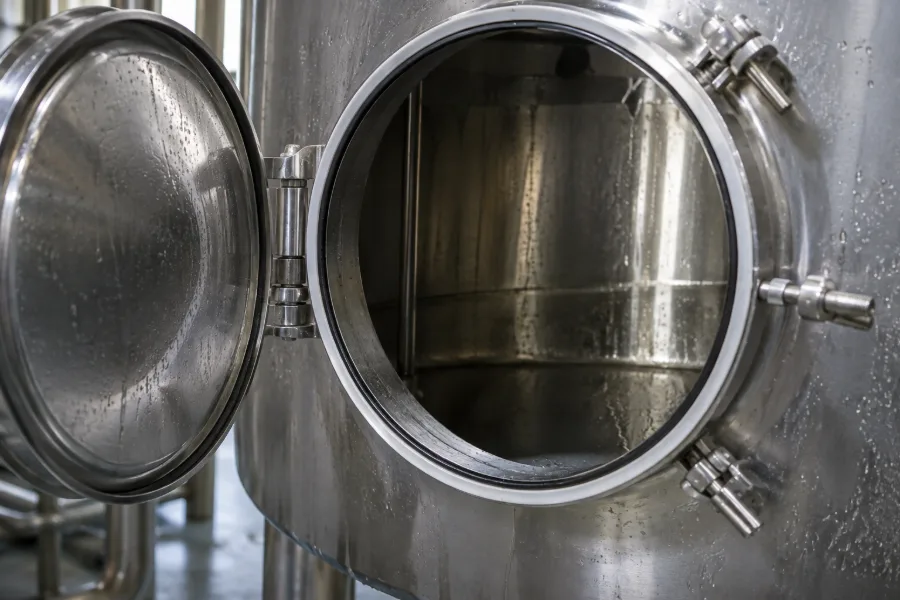
What a silo circuit does to the caustic tank
- Tank drawn down by the circuit's own holdup volume
- Return 10–20°F cooler than supply for the whole step
- Heater must restore 165°F before the next vessel
The vat and silo circuit and the heater for it
Spray circuits are tank-recirculation circuits almost without exception, so the heater lives on the CIP tank and the figures that size it are tank gallons, heat-up minutes and the number of vessels cleaned from one charge.
How the circuit runs
- Chemical: Sodium hydroxide 1–2%; 2–3% on fat-heavy cheese vats
- Caustic temperature: 160–170°F on vats; silos often 150–160°F
- Flow: 25–100 gpm per spray device; 100–300 gpm per circuit
- Rise through the circuit: Return 10–20°F below supply
- Cycle: Caustic 20–30 min; several vessels in sequence from one tank
- Tank: 2,000–5,000 gallons, heated before the first vessel
The heater we recommend
- Construction: U-tube shell-and-tube on the CIP tank loop, steam in the tubes
- Duty: Tank heat-up in the minutes allowed, plus circuit losses
- Example: 2,000 gal from 70 to 165°F in 20 min: about 4.75 MBtu/h
- Materials: 316L shell, bundle and heads; EPDM head gasket
- Connections: Flanged, 3- or 4-inch; tri-clamp where the loop is sanitary
- What to send: Tank gallons, heat-up minutes, vessels per shift, gpm, steam psig
Sizing the tank heater for spray circuits
Heat-up is the duty
Everything about a vat or silo heater follows from one question: how many minutes does the plant give the caustic tank to come up before the first vessel starts? A 2,000-gallon tank from 70 to 165°F in 20 minutes is about 4.75 MBtu/h; the same tank in 60 minutes is about 1.6 MBtu/h. The difference is a heater three times the size, so the schedule is worth a conversation before the quote.
- 20 minutes of heat-up: about 4.75 MBtu/h
- 60 minutes of heat-up: about 1.6 MBtu/h
- An overnight pre-heat makes the smallest heater of all
Then the losses
Once the tank is hot, the circuit carries heat out: a 200 gpm silo circuit returning 15°F cool is 1.5 MBtu/h, and a cheese vat at 100 gpm and 20°F is 1.0 MBtu/h. A heater sized only on heat-up will see the tank sag during a long step on a cold vessel. We add the largest circuit's losses to the heat-up duty and size to the sum.
Several vessels from one tank
Cheese plants clean vats in sequence from a shared tank, and silos are cleaned one after another at the end of receiving. The tank loses volume to each vessel's holdup and temperature to each vessel's walls, and the heater has to restore both between vessels. Tell us how many vessels run per shift and how long between them, and we check that the heater can bring the tank back to 165°F in that gap.
Fat on the vat, mineral on the silo
A cheese vat's soil is fat and curd protein, which want caustic at 165°F or more and a surfactant. A silo's soil is a thin milk film and a mineral ring at the fill line, which the acid step takes. Neither fouls the heater as hard as a pasteurizer loop does, but the carbonate from hard water at these volumes adds up, and the U-bundle still comes out when it does.
Vat and silo questions
No. On a tank-recirculation circuit the heater sits on its own loop from the CIP tank, with its own pump, and it can run at 100 gpm while the spray circuit draws 250 gpm from the tank. The heater's flow is chosen for a good shell-side velocity and a sensible pressure drop; the circuit's flow is chosen for the spray device. Only an inline once-through heater has to pass the circuit flow.
It is what happens when the heater was sized for heat-up alone. A vat at 90°F curd temperature with 100 gpm running over it pulls 1.0 MBtu/h or more out of the tank for the first several minutes, and a heater that was just large enough to bring the tank up cannot replace it. The fix is a heater sized for heat-up plus the largest vessel's losses, which is how we quote.
On recovery, yes: a gasketed plate pack taking heat from the 150°F return into makeup water is a good fit on a silo circuit, because the volumes are large and the payback is quick. For the steam-to-caustic heat-up we reccomend a shell-and-tube, with the solution in the shell where carbonate scale can be inspected and the bundle pulled, and steam inside a U-bundle that cycles without stressing gaskets.
165–170°F, and at the stronger end of the concentration range, 2–3%, because the soil is mostly fat and curd protein. Below about 150°F the fat does not saponify well and the vat corners stay greasy. Yogurt incubators and silos can run 150–160°F. We size the tank heater for the hottest vessel on the circuit, and the plant can run cooler when the schedule allows.
Related
Applications
Milkstone & Protein Film
Milkstone forms on the heater before it forms anywhere else. How the film builds, what it costs in heat-up time, and how the heater is sized and built for it.
+ Learn More
Applications
Pasteurizer & Line Circuits
HTST and UHT loops run a fixed flow at the hottest caustic in the plant. How a tank loop and a once-through heater are sized differently for the same line.
+ Learn More
Applications
Dairy
Dairy circuits run the hottest caustic on this site and foul the heater itself. Why dairies pull bundles, and how pasteurizer, vat and silo loops differ.
+ Learn More
