
1-805-484-2992
Quotes - Engineering - SalesDairy tank circuits
A gentle process leaves a stubborn film
A stirred-yogurt incubation tank holds inoculated milk at roughly 108–113°F for four to six hours while the culture drops the pH to about 4.5 and the casein sets into a gel. Nothing in that is hot enough to make milkstone, so the soil is different from a pasteurizer's: a continuous layer of acid protein gel on the wall, agitator and outlet, thicker at the fill line and the agitator shaft, with milk fat trapped in it. It is soft when fresh and rubbery once it dries, and it is this drying between emptying and washing that makes an incubator harder to clean than its mild temperature suggests.
The tank is cleaned as a tank circuit. Solution from the CIP tank is pumped through one or more spray devices in the roof at 25–100 gpm each and drains back through the outlet, so the wall sees a falling film rather than a flooded flow. Caustic at 1–2% and 160–165°F for 20–30 minutes lifts the protein gel, and because the gel is acid it is worth neutralizing it quickly with hot caustic rather than giving it a long cool rinse. The acid step at 0.5–1.5% runs a few times a week for the mineral the milk leaves.
The heater we supply sits between the CIP tank and the spray supply pump and must bring the tank up to temperature between batches. What follows is how the incubator tank sets that heater's size and construction.
The spray device sets the flow and the tank sets the clock
Two spray devices at 50 gpm each make a 100 gpm circuit, and a 1,000-gallon CIP tank has to be at 165°F when the incubator empties. Taken from 70°F in 20 minutes that is about 2.4 MBtu/h; given 60 minutes it falls to 0.8 MBtu/h.
The incubator circuit
Pre-rinse at 100–110°F for 5–10 minutes carries off the loose gel; a hotter pre-rinse can cook residual protein onto the wall, so plants keep it warm but not hot. Caustic then runs 20–30 minutes at 160–165°F through the spray devices, which on a 3,000 to 10,000-gallon incubation tank means 50–100 gpm per device and two or three devices per tank. Final rinse at 120–140°F, and many yogurt plants sanitize with hot water at 180°F before the next fill because the culture is sensitive to any chemical residue.
Incubators are emptied and refilled on a schedule, and the window between batches is short, which pushes the CIP cycle toward the fast end: a full wash in 45–60 minutes. The caustic tank therefore has to be at temperature when the incubator empties, and the heater's job is the tank heat-up between cycles as much as the hold during the wash.
The heater we recommend
A tank-recirculation steam-to-caustic U-tube, 316L shell and bundle, steam inside the tubes, rated 150 psig at 250°F on the shell side. Sizing starts with the CIP tank, not the incubator: heating a 1,000-gallon caustic tank from 70°F to 165°F in 20 minutes is about 2.4 MBtu/h and condenses about 2,500 lb/h of 15 psig steam, while the same lift over 60 minutes needs only 0.8 MBtu/h. Which figure applies is a scheduling decision the plant makes, and it changes the heater by a factor of three.
What to watch is residual gel. Protein that returns to the tank suspended in caustic settles in dead legs and collects on the heater's shell side where velocity is low, and a heater with a flooded horizontal shell and no drain accumulates it between washes. We lay the shell out to drain and keep the bundle removable so the solution side can be checked; the tank recirculation page covers the control valve and the holding load in more detail.
Send us the incubator circuit like this
The heat-up time between batches is the figure most quotes leave out, and it is the one that sets the heater.
- CIP tank volume and the minutes allowed to bring it to temperature
- Number of spray devices per incubator and the gpm of each
- Caustic target temperature, 160–165°F, and concentration
- Steam pressure at the heater inlet
- Whether the circuit is sanitary drainable with tri-clamp fittings
- Acid chemistry and frequency, for the head gasket
Call and talk it through with an engineer: 1-805-484-2992
Yogurt incubator questions
Usually schedule disguised as a heater problem. If the tank is drained for the previous wash and refilled twenty minutes before the next, a heater sized for a 60-minute heat-up has no chance; it needs three times the capacity. Measure how long the tank actually has, and either give the heater that time or size it for 2.4 MBtu/h rather then 0.8. Both are routine; the mismatch is what hurts.
Because yogurt protein is already set, and hitting a fresh gel with water above about 130°F tightens and cooks it onto the wall before the caustic arrives. A warm rinse at 100–110°F softens and floats most of it instead. The heater is not involved in that step on most plants; it is the caustic and the final rinse that need steam.
Yes, if it is on the supply side of the CIP set and the sanitize water is drawn through it. The duty is similar to the caustic case: 100 gpm raised from 120°F to 180°F is 3 MBtu/h. With 15 psig steam the approach at 180°F is only 70°F, so the heater will be larger than if it only ever had to reach 165°F. Tell us if sanitize water is on the list.
No. The gel is at about pH 4.5 and arrives in a pre-rinse, then meets caustic, and 316L is indifferent to both. The acid wash itself, nitric or phosphoric at 0.5–1.5%, is also well within 316L's range. The head gasket is the only part with a preference, EPDM by default and FKM where nitric is used hot or often.
Related
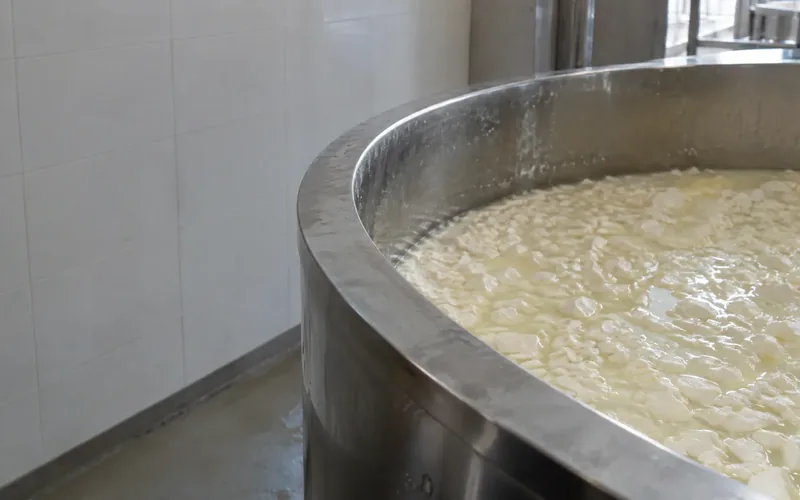
Applications
Cheese Vat CIP
An enclosed cheese vat is a big jacketed vessel with knives, agitators and a whey screen. Its CIP heater is sized by the spray circuit and a cooked-on whey film.
+ Learn More
Applications
Vat & Silo Circuits
Vats and silos are cleaned by spray devices at 100–300 gpm, so the heater's real job is tank heat-up. How the minutes you allow set the heater size.
+ Learn More
Applications
Milkstone & Protein Film
Milkstone forms on the heater before it forms anywhere else. How the film builds, what it costs in heat-up time, and how the heater is sized and built for it.
+ Learn More