
1-805-484-2992
Quotes - Engineering - SalesWhere the steam meets the caustic
Steam condenses inside 3/4-inch or 1-inch U-tubes while the caustic flows through the 316L shell around them. Putting the caustic on the shell side means the surface it fouls is the outside of a bundle that slides out of the shell, and the U-bend lets the tubes grow with steam temperature without a floating head or an expansion joint.
The steam side stays clean, so the exchanger carries its fouling allowance on one side only. The U-tube page covers ratings, tube wall temperature and the clearance a bundle pull needs.
A tank heater lives in a loop off the caustic tank: pump, heater, back to the tank. It raises 500–5,000 gallons between cycles and holds temperature during the wash, so its duty is set by gallons and minutes rather than by the circuit flow.
The common failure is a heater sized for holding, then asked to recover a cold tank in 20 minutes. Tank recirculation shows the arithmetic and where the sensor goes.
An inline heater sits in the supply line and takes the whole circuit flow through in one pass, so it must deliver target temperature at 30 gpm on a 2-inch circuit or 200 gpm on a 6-inch one, with no tank behind it to average anything out.
That puts the burden on the steam control valve as much as on the surface. Inline once-through covers valve response, turndown and sizing on the coldest pass.
The caustic step does most of the cleaning, so it gets most of the heat. Sodium hydroxide at 1–2% lifts protein and fat only when it is hot enough, and in a dairy that means 160–175°F at the spray device, not merely at the heater outlet. Breweries run cooler, 140–160°F, because cold fermenters pull the temperature down and absorbed CO2 eats the strength. The three pages below cover the construction and the two ways to pipe it.
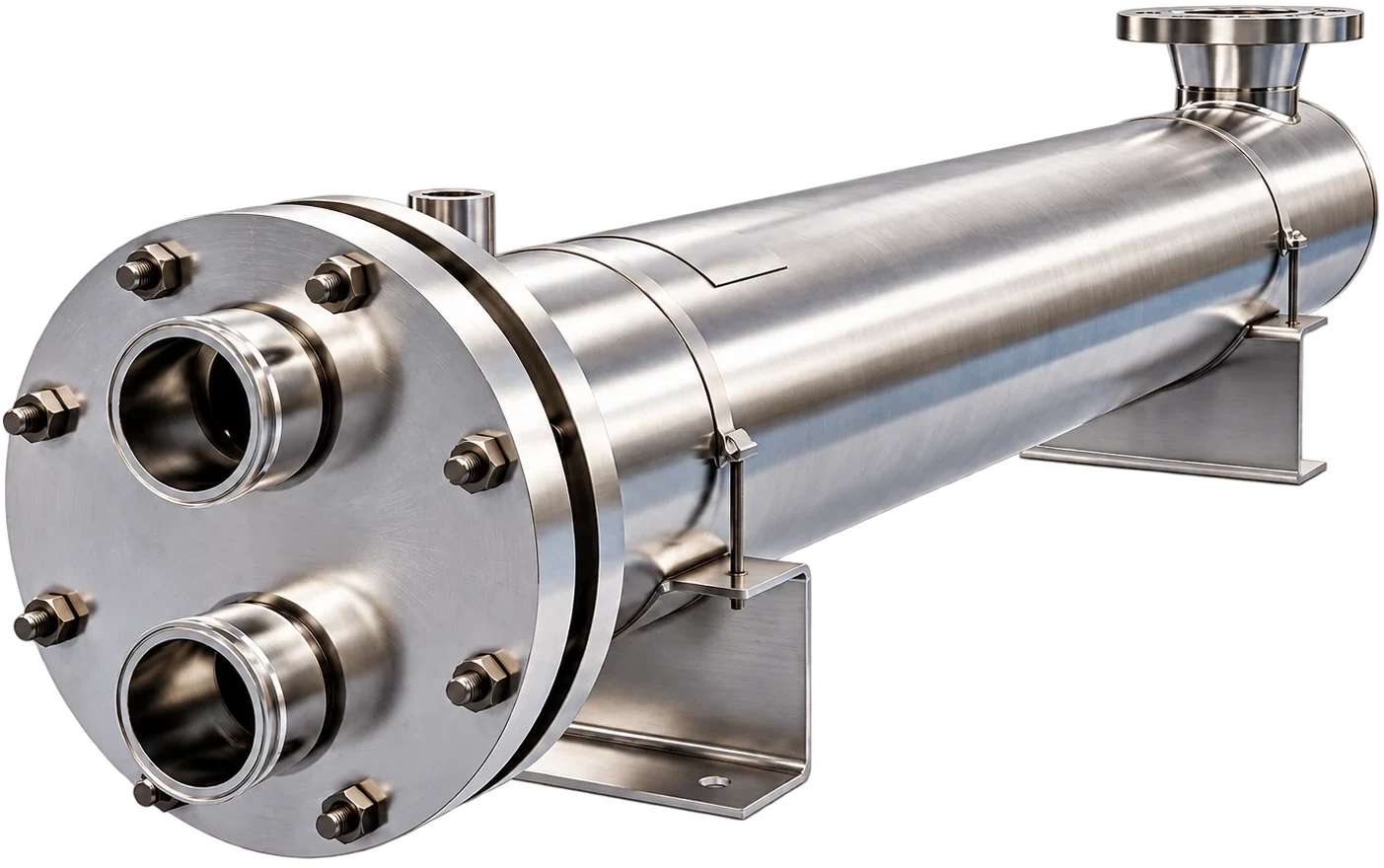
What a caustic heater has to survive, cycle after cycle
- Milkstone and protein film on the solution-side surface
- Steam at 15 to 125 psig cycling on and off every wash
- A bundle pull every season without cutting any pipe
Caustic cases and what we build for them
Six caustic duties we see most, matched to the construction we would quote. The reason column is the short form of the argument made on each circuit page.
| CAUSTIC CASE | CONSTRUCTION | WHY |
| Dairy tank loop, 2,000 gal, 70 to 165°F in 20 min | U-tube steam heater, about 4.75 MBtu/h | Heat-up duty, not holding duty, sets the surface; the U-bundle pulls for milkstone |
| Brewery caustic at 140–160°F with CO2 in the loop | U-tube steam heater, 316L shell side | Carbonate scale forms where CO2 meets caustic; shell-side fouling comes out with the bundle |
| Inline supply heater, 70 gpm on a 3-inch circuit | U-tube steam heater with modulating steam valve | Full flow in one pass; the valve must follow flow changes within seconds |
| Plant that brushes tubes rather than pulling bundles | Straight-tube steam heater, removable heads | Heads off, brush through; no bundle clearance needed at the head end |
| Existing shell with a tired bundle | New U-tube bundle to the existing shell drawing | Keeps shell, nozzles and piping in place; a day's outage instead of a repipe |
| Caustic heated from a plant hot-water loop, no steam in the CIP room | Gasketed plate pack, EPDM | Liquid to liquid at modest pressure; EPDM is good on caustic to about 300°F |
Four numbers that size the caustic heater
Caustic heater quotes go wrong when one of these four is guessed. Concentration sets the chemistry but barely changes the heat; temperature, flow and steam pressure set everything else. Send the four as they are at the heater, not as they appear on the boiler nameplate or the chemical sheet.
Concentration
Sodium hydroxide at 1–2% is the usual wash strength, with 0.5% on light soils and up to 3% on burnt-on fat. At these strengths the solution behaves like water for heat transfer, so concentration changes the elastomer choice and the 316L decision far more than it changes the surface area.
Target temperature
Dairy circuits want 160–175°F; breweries settle for 140–160°F. Above about 160°F in hard water, milkstone forms faster on the hot tube wall, so the heater that runs hottest fouls soonest. State the temperature where it matters, at the spray device or the return, and we size the heater to deliver it there.
Flow
- Tank loop: gallons and minutes to target, plus the loop pump gpm
- Inline: circuit gpm, about 5 ft/s in the line
- 30 gpm in 2-inch, 120 gpm in 4-inch, 200 gpm in 6-inch
- Spray balls take 25–100 gpm each; silo circuits reach 100–300 gpm
Steam pressure
Plant steam reaches a CIP heater at 15–125 psig, which condenses between 250 and 353°F. Even 15 psig gives at least 50°F of approach above a 175°F caustic target, which is why steam-to-caustic stays shell-and-tube. Quote the pressure after the control valve, at the heater inlet, not the header.
Before you size the caustic heater
Hardly at all between 0.5 and 3%. Dilute sodium hydroxide has a specific heat and viscosity close to water, so the surface area for a given gpm and temperature rise is nearly the same. Concentration matters for the material and gasket decision, and for how fast carbonate scale forms when CO2 is around, not for the Btu/h.
Because the caustic side is the one that fouls. Milkstone, protein film and carbonate scale build on the surface the solution touches, and on a U-tube heater that surface is the outside of a bundle you can pull. Steam inside the tubes stays clean, and the free U-bend absorbs the expansion each time the steam comes on.
Usually both were sized for holding temperature, not for recovering it. A 2,000-gallon tank that drops to 70°F overnight needs about 4.75 MBtu/h to reach 165°F in 20 minutes but only 1.6 MBtu/h over an hour. Check the steam pressure at the heater inlet first; a valve or trap problem looks exactly like a heater that is too small.
We do not recommend it. Steam-side pressure and temperature cycling on every wash shortens gasket life, and steam at 250–353°F leaves an EPDM gasket rated to about 300°F little or no margin. Plates earn their place on solution-to-solution recovery and on hot water at modest pressure, where EPDM runs well inside its rating and nothing cycles hard.
Related
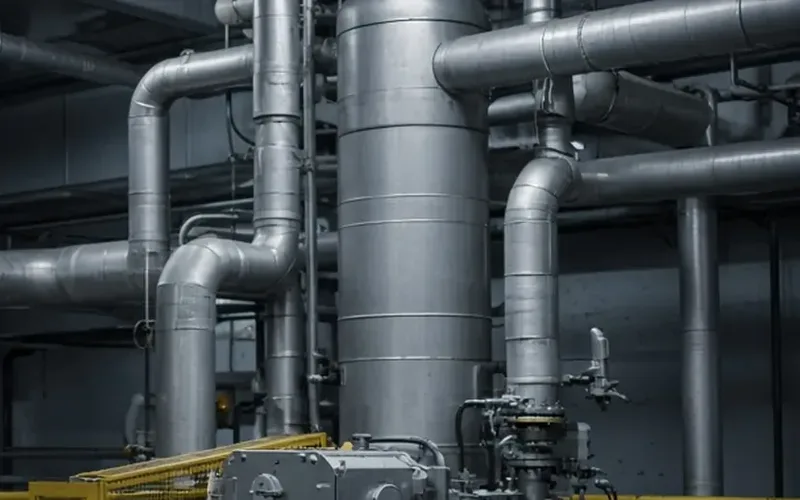
CIP Heaters
Steam-to-Caustic U-Tube
The construction behind most caustic heaters: steam condensing inside a U-bundle, caustic on the shell, and a bundle that slides out when the milkstone builds.
+ Learn More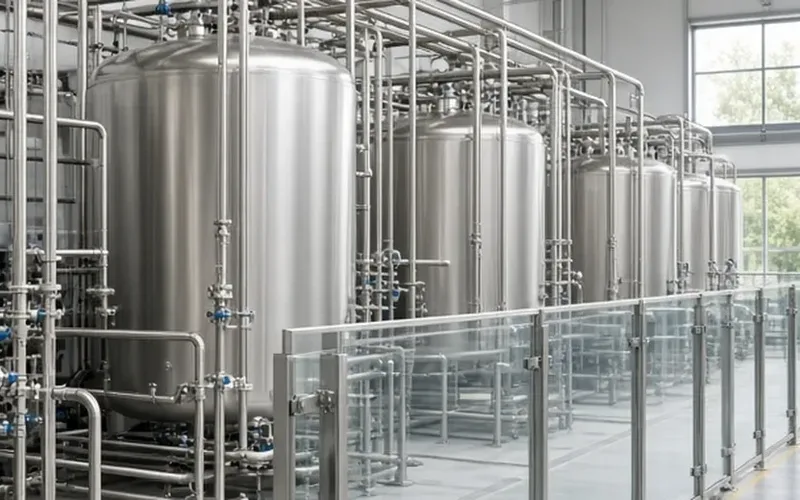
CIP Heaters
Tank Recirculation
A heater in the tank loop answers to gallons and minutes. How heat-up time sets the duty, what the loop pump has to move, and where the heater sits in the loop.
+ Learn More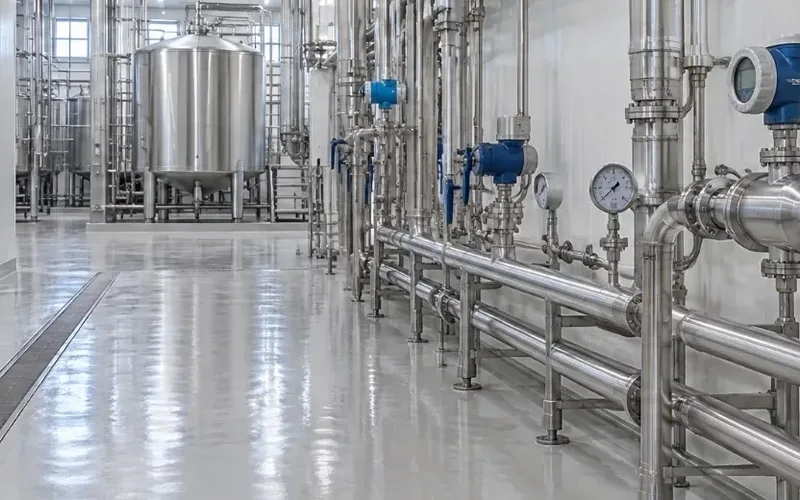
CIP Heaters
Inline Once-Through
No tank to average things out: an inline heater meets target temperature at circuit gpm on every pass. Line sizes, steam rates and the valve response it needs.
+ Learn More
