
1-805-484-2992
Quotes - Engineering - SalesOnce through, no second chance
Why rinse water wants steam on the tube side
A rinse heater has no tank behind it. Water enters at whatever the supply gives, 55°F from a well in January or 75°F from a city main in July, and must leave at the step temperature on that single pass. The steam-to-water shell-and-tube does this because steam carries a huge approach: 15 psig condenses at 250°F, so even a 185°F sanitize outlet sits 65°F below the steam, and a modulating valve can trim the duty from full flow down to a trickle without the surface running out.
Steam goes inside the U-tubes, water through the 316L shell. Condensing steam in 3/4-inch or 1-inch tubes gives a short, stiff bundle; the U-bend lets the tubes grow with steam temperature while the shell stays at water temperature; and whatever the water leaves behind, carbonate scale in hard water above about 160°F, lands on the outside of a bundle that slides out of the shell. The steam side never sees anything but condensate.
The sizing is simple and the mistakes are not. 70 gpm on a 3-inch circuit lifted from 120 to 185°F is 65°F and about 2.3 MBtu/h, which condenses roughly 2,400 lb/h of 15 psig steam. Size the bundle for the coldest inlet and the valve for the smallest flow, and send us the steam pressure measured at the heater, because a 125 psig boiler often delivers 40 psig at the far end of the CIP room.
See the U-Tube Removable Bundle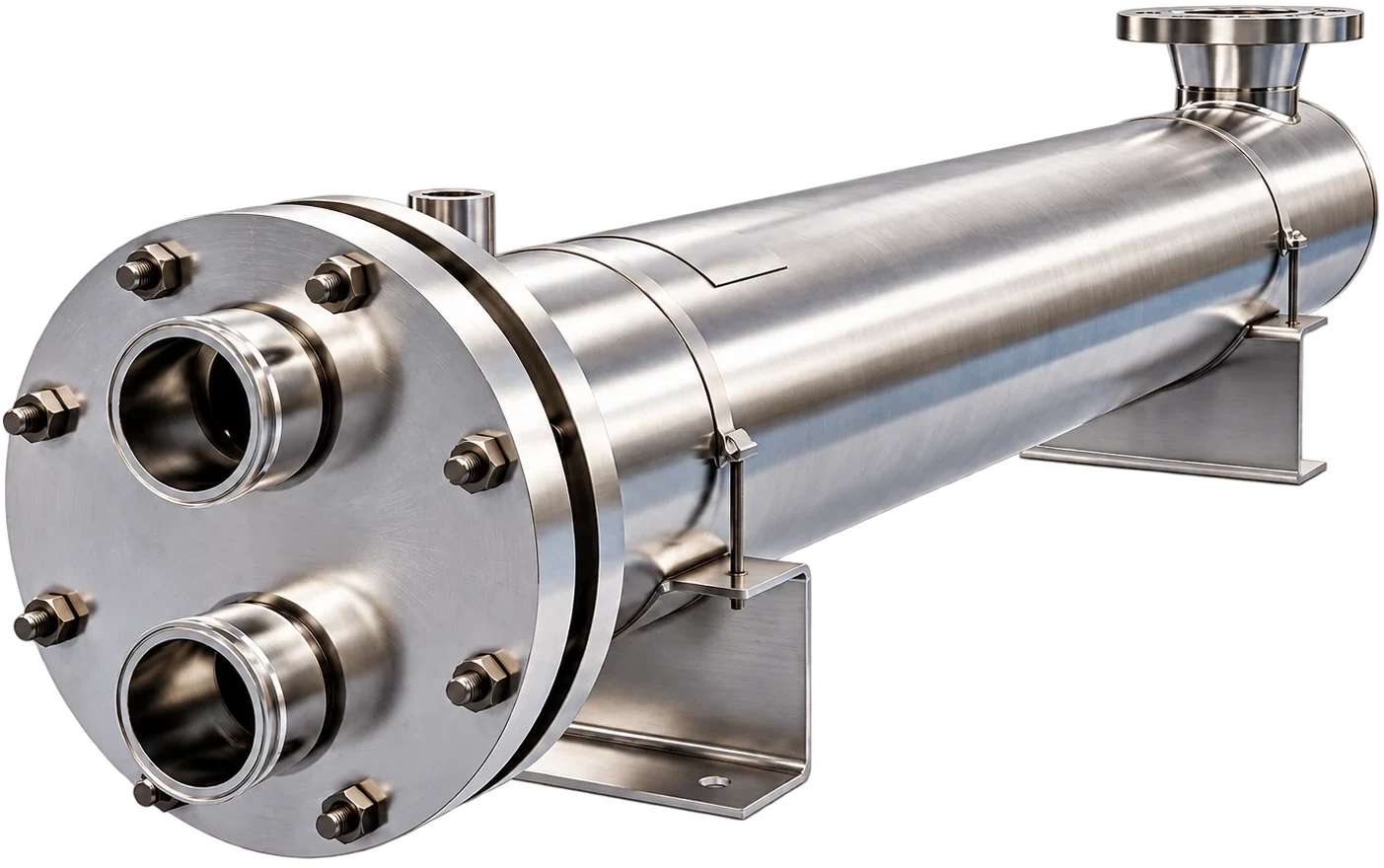
Steam-to-water rinse heater, typical conditions
Standard values for a once-through rinse and sanitize heater. Replace them with your own and the quote will match the circuit.
| Condition | Typical value |
| Water inlet | 55–75°F supply, or 100–120°F from a recovered-water tank |
| Water outlet | 120–140°F final rinse; 185–190°F sanitize |
| Flow | 30 gpm (2-inch line) to 200 gpm (6-inch line), once through |
| Steam at the heater | 15–125 psig, saturated, with control valve and trap |
| Tube side | Steam, 150 psig at 400°F design; 3/4-inch or 1-inch U-tubes |
| Shell side | Water, 150 psig at 250°F design; 316L shell and heads |
| Connections | Tri-clamp to 4 inches on the water side, flanged above; NPT or flanged steam |
| Finish | Mill finish for utility rinse; 32 Ra where the loop is treated as sanitary |
Making a once-through heater hold temperature
The valve does half the work
A once-through heater is only as good as its steam control. The outlet sensor sits a few feet downstream, the valve must respond before that water reaches the spray device, and flow can step from 30 gpm to 120 gpm when a second circuit opens. Specify a modulating valve with turndown for the smallest rinse case, a trap sized for the full condensate load, and a vacuum breaker so condensate drains when the valve closes. Those three items are why a heater that calculates perfectly can still overshoot.
Sizing on the cold inlet
Design on the coldest water the plant sees, not the yearly average. A heater sized on a 70°F inlet that meets 55°F water in winter is short by 15°F of rise on every gallon, and the return never makes 180°F. Include a fouling allowance of 0.001–0.002 on the water side, which adds roughly 10–20% surface, because hard rinse water scales the hot tubes even when the caustic circuit stays clean.
Drainable, and why it matters here
Rinse heaters stand idle between cycles with water in the shell. On a sanitary loop the shell should drain through the low nozzle with the bundle horizontal and the baffle cuts oriented to let it, and the tri-clamp connections come apart for inspection without tools. A heater that holds a few gallons of warm water for eight hours between washes is the one the inspector asks about.
When the plant brushes instead of pulls
On very hard water with no softener, scale on the water side is a yearly event. If the plant would rather brush than pull a bundle, the straight-tube version with removable heads puts the scaling water where a brush can reach it, and gives up the free expansion of the U-bend in exchange. The straight-tube page covers when that trade is worth making.
Before you size a rinse heater
Far enough to cover what the circuit loses, which on an insulated line of modest length is 5–10°F and on a long bare line through a cold room can be 15°F or more. A 190°F outlet for a 180°F return is the usual starting point. Measure the actual drop on the first cycles and bring the setpoint down; every degree of outlet you do not need is steam you do not burn.
15 psig is enough. It condenses at 250°F, a 65°F approach, and the bundle simply carries more surface than it would at 100 psig, where the steam is 338°F. Higher pressure buys a smaller shell and a harder control problem, because the valve is throttling a larger pressure drop onto a heater that reacts faster. Tell us what is actually at the heater and we size to that.
Yes. Rinse water carries whatever the caustic and acid steps left in the line, the heater sees 185°F at the wall, and in many plants the same heater also warms makeup water for the caustic tank. 316L on the shell, heads and tubes costs little against the price of the bundle and removes the question for the life of the unit. Carbon steel appears only on the steam head.
It can, and plants with one steam heater often pipe it that way through valves. The duties differ: the tank wants a long, modest load and the rinse a short, large one. Size for the rinse case, since it sets the surface, and make sure the valve can turn down to the tank-holding load without cycling. Two smaller heaters are often cheaper than the one valve that does both well.
Because the valve was sized for the big one. A valve picked for 120 gpm on the 4-inch circuit is at a few percent of travel when a 30 gpm circuit runs, and it hunts: open, overshoot, close, undershoot. The heater surface is fine. Fix the valve, or split the duty across two valves in parallel with the smaller one carrying the small circuit.
Related
CIP Heaters
Plate Type
When the plant has a hot-water loop, a gasketed plate pack heats rinse water to within a few degrees of it. Where that works, where it does not, and what decides.
+ Learn More
CIP Heaters
Hot-Water Rinse Heaters
Rinse and sanitize water runs hotter than the caustic and goes to drain, so the heater sees full circuit flow in one pass. Which construction handles that, and why.
+ Learn More
CIP Heaters
Caustic Heaters
Steam into a sodium hydroxide loop at 140–175°F: how the U-tube heater is built, and whether the tank loop or the supply line is the right place to put it.
+ Learn More
