
1-805-484-2992
Quotes - Engineering - SalesThe filler is the last place heat can be lost
On a bottling line the chemical steps are modest. Filler bowls, valves and product piping carry sugar, yeast and a thin protein haze, and a 1% caustic at 140°F followed by a short acid takes them off without drama. The step that decides the heater is the one after: hot-water sanitize, where the plant has to prove that every filling valve, the bowl, the return manifold and the slowest-flowing branch all sat at 180°F or better for 5 minutes. The thermocouple that counts is at the return, and a filler has more cold metal, more small passages and more air pockets than any tank.
That changes how the heater is sized. A tank-loop caustic heater is a batch problem; a sanitize heater on a filler is a once-through problem in which city or well water arrives at 55–60°F and must leave at 185–190°F on a single pass, at the full circuit flow, for the whole hold. Seventy gpm raised 125°F is about 4.4 MBtu/h, which condenses roughly 4,800 lb/h of 50 psig steam. Nothing stores that heat; the heater makes it in real time or the hold fails.
We put a steam-to-water shell-and-tube on that duty, and we size it to the rise, the gpm and the steam pressure the line actually has when the brewhouse is also drawing.
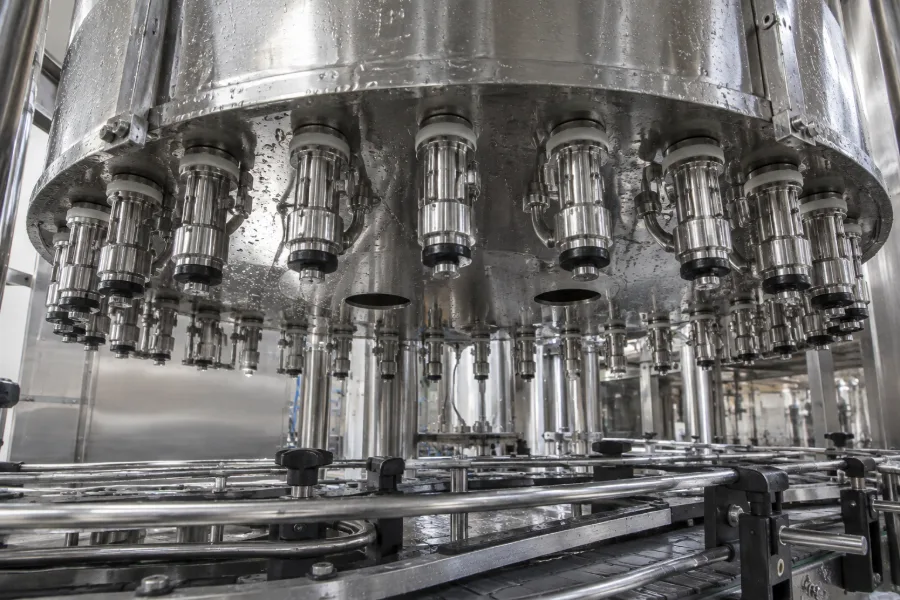
Prove 180°F for 5 minutes at the coldest filling valve, not at the heater
- Supply leaves the heater at 185–190°F to hold 180°F at the return
- Seventy gpm through a single pass needs about 4.4 MBtu/h of steam
- Steam pressure at the heater drops when the brewhouse is drawing too
What the bottling line runs and what we build for it
A filler circuit has a short chemical phase and a long hot-water phase, so the heater is chosen for the water. The left column shows the circuit; the right column shows the once-through heater that keeps the return at temperature.
The filler circuit
- Chemical: Caustic 0.5–1% at 140°F; phosphoric or nitric 0.5% at 120–130°F
- Sanitize water: 180°F minimum at the return, held 5 minutes; supply at 185–190°F
- Flow: Set by the filler manifold and valves, commonly 50–120 gpm
- Cycle: Rinse 5 min, caustic 20 min, rinse, acid 10 min, rinse, sanitize 5–15 min
- Soil: Sugar, yeast, light protein haze, beer or syrup residue in valve seats
The heater we recommend
- Construction: Steam-to-water shell-and-tube, U-tube, water on the shell side
- Materials: 316L on every water-side surface; EPDM head gasket
- Sizing basis: Inlet 45–55°F in winter, outlet 190°F, full circuit gpm, steam at the inlet after the valve
- Connections: Tri-clamp to 4 inches; drainable layout where the line is treated as sanitary
- Control: Steam valve on the outlet temperature; trap sized for the full condensate load
- Send us: Rinse gpm, supply water temperature in winter, hold temperature, steam psig
Sizing a once-through sanitize heater
Rise, not setpoint
Plants quote the sanitize target and forget the supply. In January a well in the upper Midwest delivers water near 45°F; in August the same well gives 65°F. A heater sized on the summer number is 15% short in winter, and the symptom is a return thermocouple that hovers at 176–178°F while the timer refuses to start. We size on the coldest supply the plant will see and let the control valve throttle in summer.
Steam at the heater, not at the boiler
A bottling hall is usually at the far end of the steam main. The header may read 100 psig, but after the drop, the strainer, the control valve and a long run, the heater sees 40–60 psig during the sanitize, and less when the brewhouse kettle is boiling. At 50 psig the steam condenses at 298°F, which gives a comfortable 108°F approach over a 190°F outlet. At 15 psig the approach shrinks to 60°F and the surface area roughly doubles.
- Give us the pressure at the heater inlet with the line in its worst case
- Oversize the trap for the full condensate load at the start of the hold
- Put the control sensor on the heater outlet, with the proving thermocouple at the return
Hot-water generator or shell-and-tube
Many bottling lines were built with a packaged hot-water generator and a storage tank on the sanitize step. When it fails or the line speeds up, a steam-to-water shell-and-tube sized for the rinse gpm takes its place without the storage, because the sanitize is a steady flow for a fixed time and there is nothing for a tank to smooth out. The hot-water generator swap page walks through the nameplate data we need.
Where plate fits on a filler line
A gasketed plate exchanger does well on the warm pre-rinse and on recovering heat from the sanitize return, where water meets water at modest pressure. For the steam-heated sanitize supply itself we stay with shell-and-tube: a plate pack cycled on and off against 50 psig steam every shift shortens its gasket life, and a filler line sanitizes several times a day. Water-to-water recovery, yes; steam on a plate, not for this duty.
Filler sanitize questions
Because the requirement is written for the coldest point, and the coldest point is not the heater. Water loses heat to the pipe, to the filler frame and to the slowest valve branch. A 5–10°F margin at the heater outlet is what keeps the return thermocouple above 180°F for the whole 5 minutes without stretching the hold or the steam bill.
Rarely well. The tank heater is sized to warm a stored volume over 20–60 minutes and works through the tank loop; the sanitize water is a once-through flow at full circuit gpm with a 125°F rise. If one heater must do both, it is sized for the once-through case and the tank simply heats faster than it needs to. Most plants find a dedicated steam-to-water unit simpler.
At 70 gpm for a 10-minute hold with warm-up, 700–1,000 gallons go to drain hot. That is why a plate recovery exchanger on the sanitize return pays back quickly on a line that sanitizes three or four times a shift. The recovered heat warms the next pre-rinse or the makeup water, and the steam heater sees a smaller rise.
If the water downstream contacts the filling valves and bowl, most sanitation managers treat the heater as part of the sanitary loop: 316L, tri-clamp connections, drainable, and a 32 Ra finish on the water side. On a line where the sanitize water only reaches utility piping, mill-finish 316L is enough. Tell us which side of that line your inspector draws.
The steam valve closes on the outlet temperture and the shell sits full of hot water. On a U-tube heater the bundle takes the thermal cycling without stress, because it is free to expand and contract. Keep the trap draining so condensate does not back up into the tubes between runs, and leave the water side full so the first minute of the next sanitize starts warm.
Related
Applications
Brewhouse & Fermenter
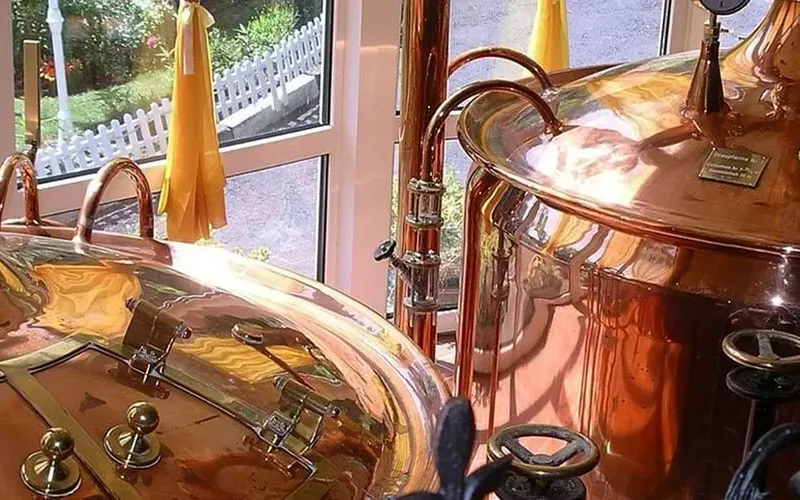
Kettles want hot caustic, fermenters knock it cold and CO2 turns it to carbonate. How we size the brewery caustic heater around the cellar instead of the brewhouse.
+ Learn More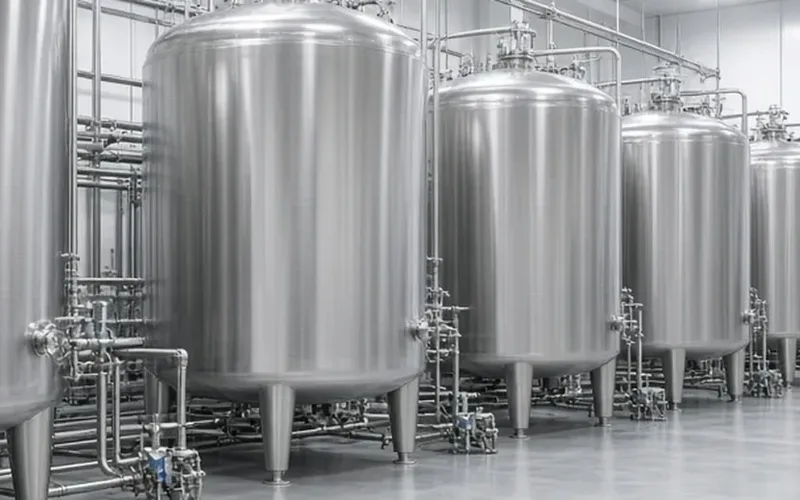
Applications
Juice & Soft Drink Lines
Juice and soft drink lines clean often, run acid most days and dump a lot of warm return. The caustic heater, the gasket for the acid, and where recovery pays.
+ Learn More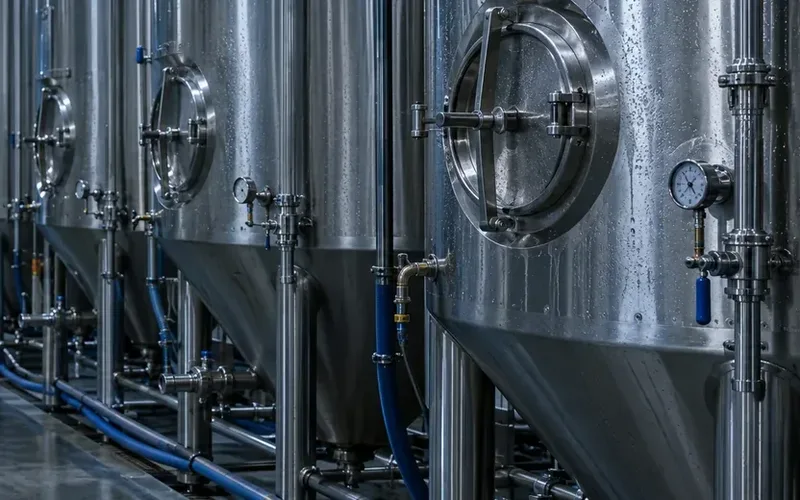
Applications
Brewery & Beverage
Breweries heat caustic against cold vessels and carbonate scale; beverage lines run the rinse heater hardest. Circuits, temperatures and the heater for each.
+ Learn More
