
1-805-484-2992
Quotes - Engineering - SalesWhere the plate pack belongs in a CIP system
A gasketed plate exchanger is a stack of thin pressed 316L plates, each with a gasket around its edge, clamped between two heavy frame plates by tie bolts. Alternate channels carry the hot stream and the cold stream, so every plate has 150–160°F return solution on one face and 60°F makeup water on the other. With a channel gap of only 3–5 mm and a corrugated plate that keeps the flow turbulent, the two streams get within 5–10°F of each other at the outlets. That is the job this construction does better than anything else we build: liquid against liquid, the two temperatures close together, the heat that would have gone down the drain carried back into the next batch.
It also serves as a hot-water heater when the heating medium is itself hot water or a glycol loop at modest pressure, and it holds a sanitary pre-rinse or final-rinse circuit at 120–140°F without complaint. What we do not recommend it for is the main steam-to-caustic duty. Steam at 15–125 psig cycling on and off against a stack of rubber gaskets shortens their life every time the valve opens, and that is a duty we send to the U-tube steam heater.
Specified for liquid-to-liquid work, a plate pack takes about a third of the floor space of a shell-and-tube of the same surface, opens in an hour, and grows by adding plates when the plant adds a circuit.
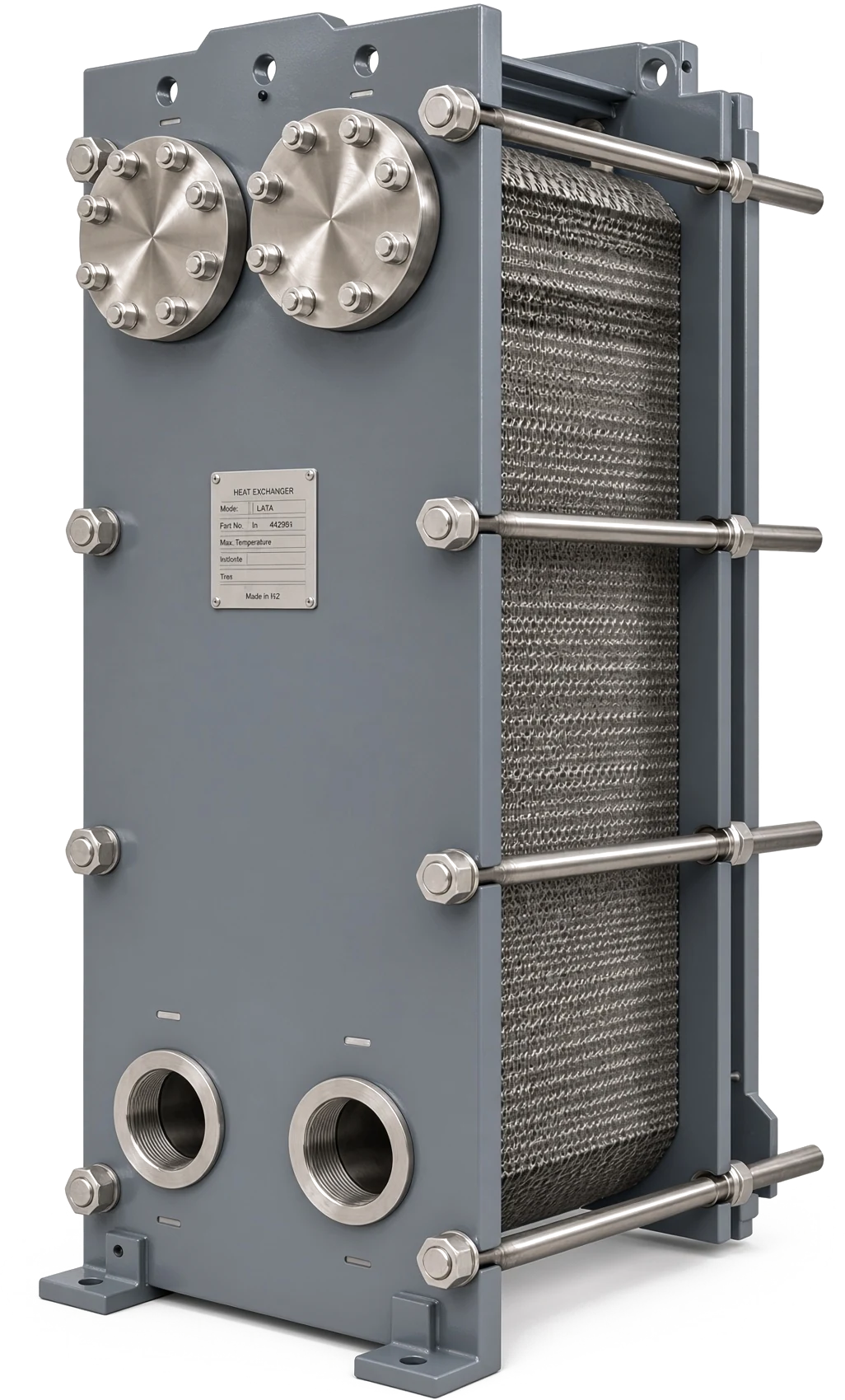
A return line at 150–160°F and makeup water at 60°F leave a plate pack within a few degrees of each other, and 60–70% of the heat stays in the plant.
Recovery lowers what the steam heater has to do; it does not take its place.
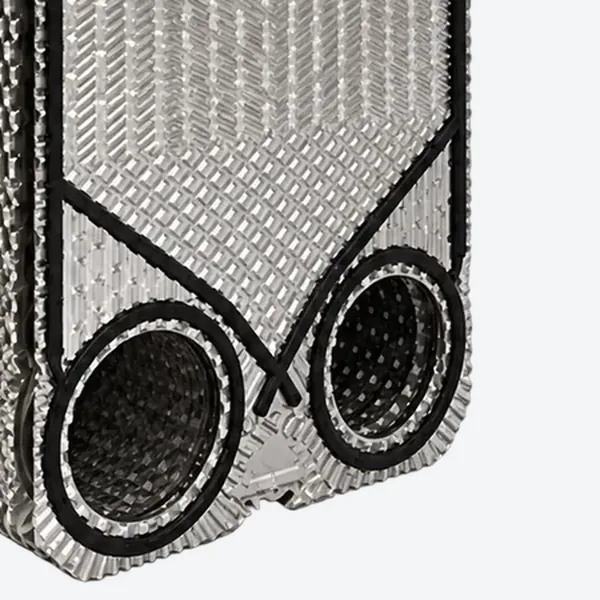
The plate pack
- 316L plates, 0.5–0.6 mm, pressed with a herringbone pattern
- Channel gap about 3–5 mm; high turbulence at low flow
- Glued or clip-on gaskets, EPDM standard, FKM on acid duty
- Plate count set by the duty, with room on the frame to add more
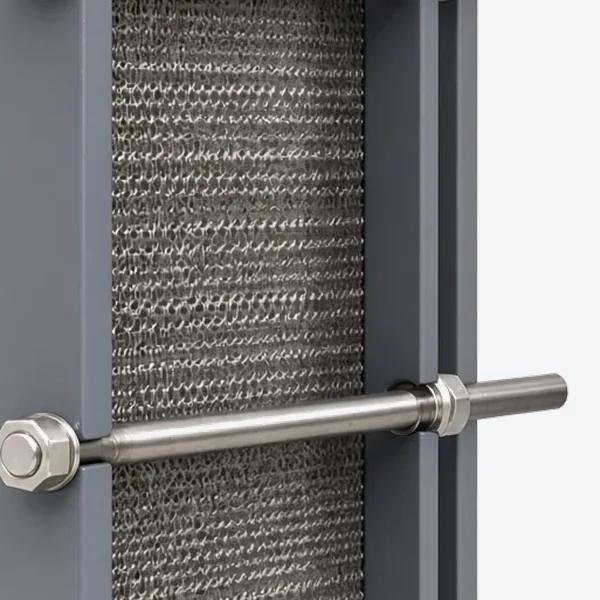
- Pack opens by backing off the tie bolts; no lifting gear
The frame
- Fixed and movable frame plates, carrying and guide bars
- Frame rated to 150 psig; design temperature set by the gasket
- Nozzles on the fixed plate so piping stays made up when the pack opens
- Tri-clamp to 4 inches or flanged connections
- Painted carbon steel frame standard; stainless-clad on request
Four things to decide




Standard build, plate pack and frame
A recovery exchanger and a rinse heater share this frame; what changes is plate count, gasket compound and nozzle size.
| Feature | Standard build |
| Plates | 316L, 0.5–0.6 mm, corrugated; plate count to the duty |
| Gaskets | EPDM for caustic and hot water, rated to about 300°F; FKM where the acid step runs through the pack |
| Frame | Carbon steel, painted, fixed and movable frame plates on carrying bars; 150 psig design |
| Flow arrangement | Counterflow, single pass; multi-pass where the approach has to be tight |
| Connections | Tri-clamp to 4 inches; flanged at 6 inches and larger; all ports on the fixed frame plate |
| Surface finish | 32 Ra plate faces where the loop is sanitary; mill finish on utility recovery |
| Drainability | Vertical ports arranged to drain the channels; drain plugs on the frame |
| Testing and papers | Hydrotest of each side; plate hanger drawing and gasket list shipped with the unit |
Applying a plate pack to the CIP loop
Return-to-makeup is the primary duty
The hottest stream a CIP system throws away is the caustic return at the end of the wash step, or the rinse that follows it, often at 150–160°F and moving at the full circuit flow of 70–200 gpm. Run that return through one side of the pack and the cold makeup water filling the next tank through the other, and the makeup arrives at the tank 50–60°F warmer than it left the main. The steam heater then lifts the tank from a warm start instead of from 60°F, and the cycle reaches temperature sooner. The pack sees two clean liquids and the gaskets see nothing hotter than the return.
Both streams must flow at the same time
A plate recovery exchanger only works while both sides are moving. If the return comes back during the wash but the makeup water is only drawn an hour later, the pack sits with hot solution on one side and nothing on the other and recovers no heat at all. Plants solve this with a warm-water holding tank between the pack and the CIP makeup, or by timing the fill to the return. We will ask how the two flows line up in your sequence before we size the plates, because the answer decides whether the pack earns its keep.
- Simultaneous flows: size for the circuit gpm on both sides
- Staggered flows: add a holding tank and size for the fill rate
- Intermittent return: a smaller pack with a longer transfer time
Fouling on a plate pack
Narrow channels foul faster than a shell, but the turbulence between corrugations keeps most soil moving, and the pack opens for a look in the time it takes to back off the tie bolts. On a return-to-makeup duty the soil is mostly carried over from the circuit in dilute form and rinses away in the plant's own acid step; on a rinse heater fed by hard water it is carbonate scale on the hot plates. Either way, a plate pack that must be opened monthly belongs on a circuit where someone will do it; where no one will, the shell-and-tube is the honest choice.
Frames grow
We size the frame with spare carrying-bar length so the plant can add plates later. A brewery that adds a second CIP circuit in three years can take the pack from 40 plates to 60 inside the same frame, with a new hanger drawing from us and a new tightening dimension stamped on the frame. The nozzles stay where they are. That headroom costs little at purchase and avoids a second exchanger when the plant outgrows the first duty.
Frame and plate questions
It is the distance between the frame plates when the pack is correctly compressed, stamped on the frame for the plate count installed. Too loose and the gaskets leak at the frame edge; too tight and the gaskets are crushed past their recovery and leak after the next thermal cycle. Measure it at four corners when closing the pack and bring the bolts in evenly. Every pack we ship has the figure on its drawing.
Yes. 316L plates and EPDM gaskets are at home in warm caustic, and a pack is often use to recover heat from the caustic return itself rather than from a rinse. The limit is temperature and pressure cycling, not the chemistry. Keep steam off the pack, run it liquid against liquid, and it will see service for years with a gasket change at the interval your soil and acid step dictate.
A counterflow plate pack commonly reaches a 5–10°F approach, and tighter is possible with more plates or a second pass. In practice the economic point for a recovery exchanger is around 60–70% of the available heat; the last few degrees cost a disproportionate number of plates. We will show two sizes on the quote if the difference is meaningful, so you can see what the extra plates buy.
The frame never touches either liquid; the plates and gaskets form the pressure boundary and the ports pass through lined holes in the fixed frame plate. A painted carbon steel frame is standard and lasts in a washdown area if the paint is kept up. Plants that hose the mechanical room daily, or that want everything in the room to look alike, specify a stainless-clad frame, and we supply it.
Related
Heat Exchangers
EPDM & Acid Elastomers
Which rubber goes on the plate: EPDM for sodium hydroxide and hot water, FKM where nitric runs through the same pack, and the temperatures where each gives up.
+ Learn More
Heat Exchangers
Replacement Plate Packs
The frame has years left; the plates do not. A complete new pack of 316L plates and gaskets, matched to the hanger and port pattern, restores the exchanger fast.
+ Learn More
Heat Exchangers
Gasketed Plate
Pressed 316L plates in a frame, with the elastomer picked for caustic or acid: the construction for recovery and water-heated rinse, and the three ways to buy it.
+ Learn More