
1-805-484-2992
Quotes - Engineering - SalesWhere the heat in the return line goes
On a tank-based system the caustic return comes back at 150–160°F while the makeup water that refills the tank arrives at 60°F. Run the two through a plate pack and the makeup leaves at about 120°F, so the steam heater only has to add 45°F instead of more than 100°F. Equal flows are the usual design basis; a tighter approach is available at the cost of more plates.
The caustic traces in the return call for EPDM gaskets and 316L plates; the acid step, when it passes through, is the one question that changes the elastomer. Return-to-makeup works the arithmetic for a 100 gpm circuit.
Final rinse water at 120–140°F goes to drain on most plants, clean enough to give up its heat. A plate pack against incoming cold water lifts the next pre-rinse or the makeup to about 105°F, which on a 70 gpm rinse is about 1.6 MBtu/h the steam heater never has to supply.
The rinse and the stream it heats rarely run at the same time, so a recovered-water tank usually sits between them. Rinse water recovery covers that timing problem.
Every CIP cycle sends hot solution and hot rinse water down the return line, and much of it ends up in the drain at 130–160°F. A recovery exchanger puts that stream against the cold water the plant is about to heat anyway. It is solution-to-solution, so it is a gasketed plate pack, and it does not replace the steam heater; it cuts the steam heater's job by more than half.
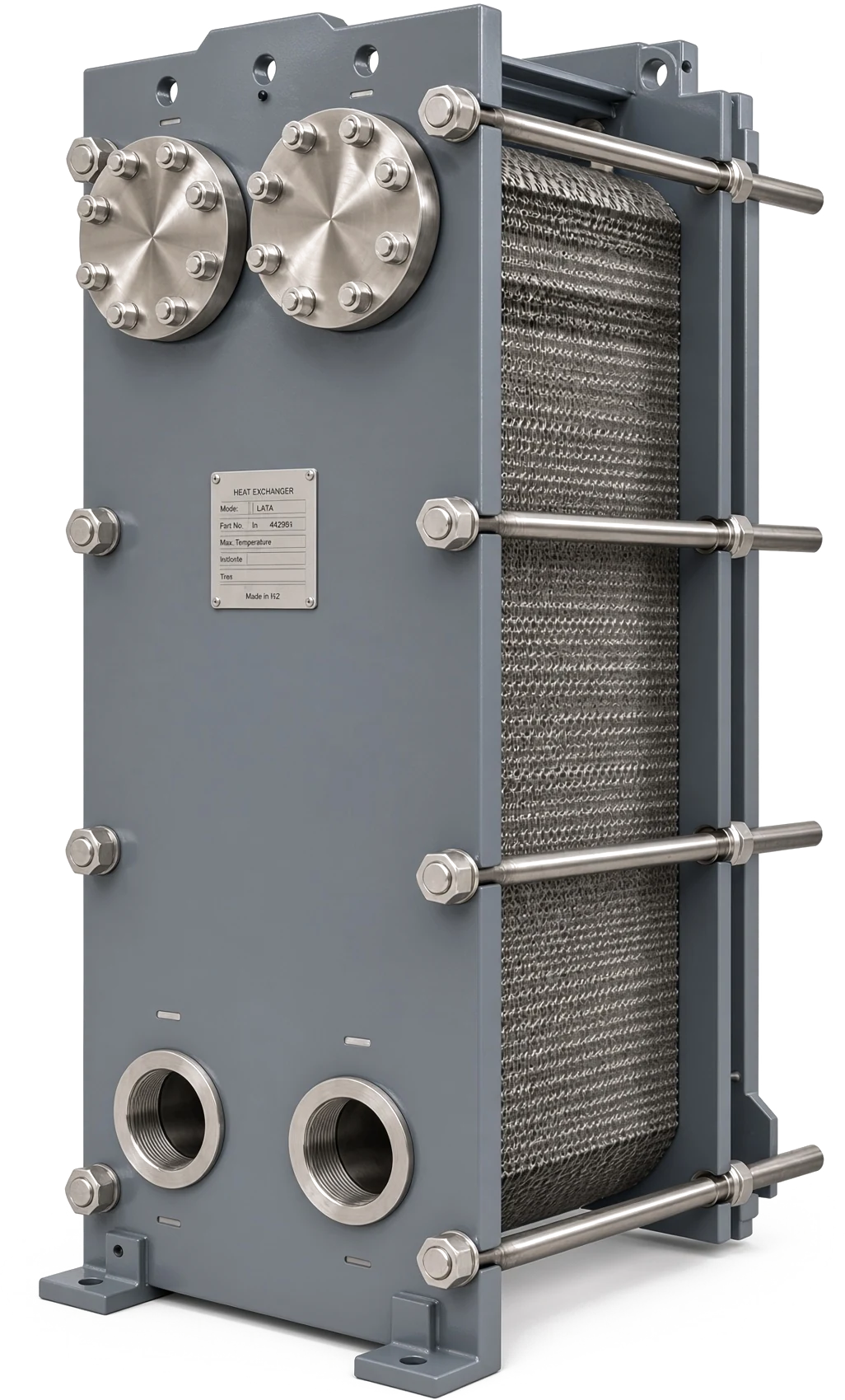
What recovery changes about the steam heater behind it
- Makeup arrives at 120°F instead of 60°F
- Steam duty at 100 gpm drops from 5.25 to 2.25 MBtu/h
- The same bundle, fewer pounds of steam every cycle
Recovery cases and the exchanger we would quote
Five recovery duties. Four are plate; the fifth is the steam heater that recovery shrinks, included to show where the plate stops and the tubes begin.
| RECOVERY CASE | CONSTRUCTION | WHY |
| Caustic return at 155°F heating tank makeup, 100 gpm each side | Gasketed plate pack, 316L, EPDM | Liquid to liquid in counterflow; recovers 60–70% of the heat at equal flows |
| Final rinse to drain preheating the next pre-rinse | Gasketed plate pack with a recovered-water tank between | The two streams do not run together; the tank decouples them |
| Return line that carries the acid step as well | Plate pack with FKM gaskets | Nitric at about pH 2 a few times a week hardens EPDM over time |
| Existing recovery frame with a tired pack | New plates and gaskets to the frame's pattern | The frame outlives several packs; a new pack restores the approach |
| Finishing the makeup from 120 to 165°F with steam | U-tube steam heater, downsized | Steam-to-solution stays shell-and-tube; recovery only shrinks its duty |
Four things that decide whether recovery pays
Recovery exchangers are cheap relative to the steam they save, but only when the two streams line up. Before we size one we want the four answers below, because the most common disappointment is a pack that could recover 65% of the heat and does not, because the streams never meet.
Timing
The return runs during the wash; the makeup fills after the tank is dumped. On a tank system the two overlap for only part of the cycle, which is why return-to-makeup often works through the tank itself as the buffer. Rinse recovery almost always needs a recovered-water tank between the two streams.
Flow match
A plate pack gives its best approach with equal flows on both sides. 100 gpm of return against 100 gpm of makeup is the clean case. 200 gpm of return against 50 gpm of makeup heats the makeup to nearly return temperature and leaves most of the heat in the return anyway.
The arithmetic
- Without recovery, 100 gpm from 60 to 165°F is 105°F of rise and 5.25 MBtu/h
- Makeup preheated to 120°F cuts that to 45°F and about 2.25 MBtu/h
- Over a 20-minute fill that is roughly 1,000 lb of 15 psig steam saved per cycle
- Several cycles a day, everyday, is where the pack pays for itself
What fouls
- The return side carries protein, fat and carbonate from the wash
- The makeup side scales if the water is hard and the plates run hot
- Both sides are 316L; the pack opens for inspection
- Fouling allowance of 0.001–0.002 on the return side
Recovery questions
No. A plate pack can only bring the makeup to within 5–10°F of the return temperature, and the return is at 150–160°F because it has already lost heat on the circuit. The caustic tank still has to reach 165–175°F, and only steam gets it there. Recovery makes the steam heater smaller and its valve less busy; it does not retire it.
Because both streams are liquid at similar temperatures and the whole point is a small approach. A shell-and-tube chasing 10°F between two water streams grows into a long bundle; a plate pack does it in a frame a person can walk around. Steam is the one duty that stays on tubes, and recovery has no steam in it.
Very little to the metal and something to the gasket choice. 316L plates are indifferent to 1–2% sodium hydroxide at 160°F. The gaskets are EPDM, which is the right elastomer for caustic and hot water. The return also carries what the caustic lifted, protein and fat and some carbonate, which lands on the return-side plates and is why the pack must open.
60–70% of the heat in the return stream when flows are matched and the streams run together. A 155°F return against 60°F makeup at equal flow puts the makeup at about 120°F and sends the return to drain near 95°F. Mismatched flows or a tank that fills after the return has stopped cut the number quickly, which is why we ask about timing before we talk about plates.
Related
CIP Heaters
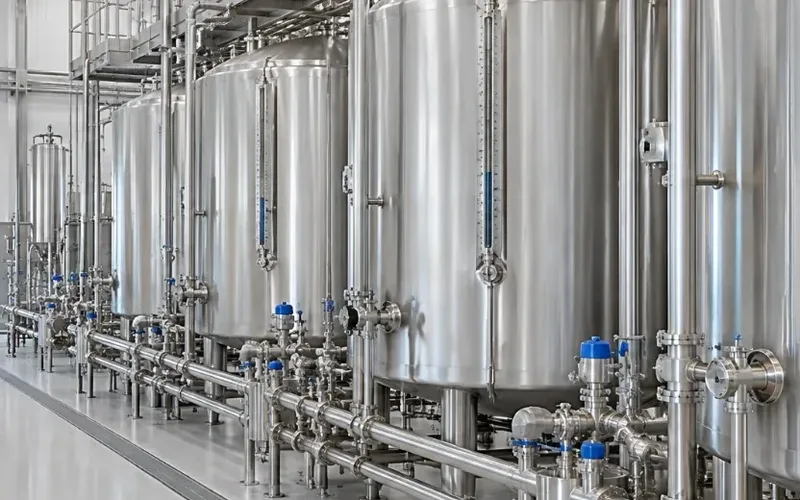
Return-to-Makeup
What the return gives up, what the makeup gains, the approach to expect, and the steam the finishing heater no longer burns, worked for a 100 gpm caustic circuit.
+ Learn More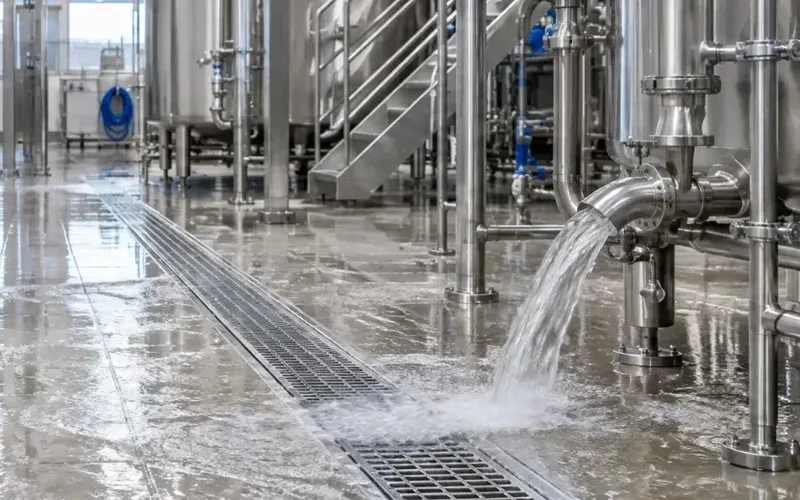
CIP Heaters
Rinse Water Recovery
The final rinse is clean water at 120–140°F, and most plants pour it away. A plate pack and a holding tank turn it into the warm pre-rinse for the next cycle.
+ Learn More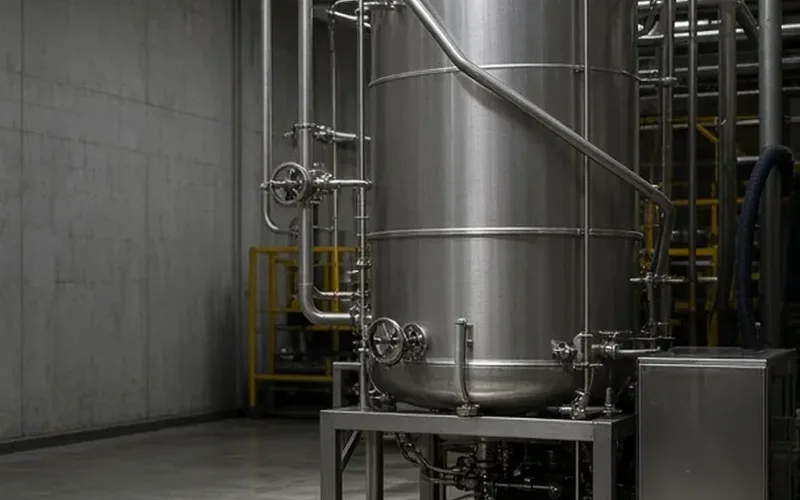
CIP Heaters
Caustic Heaters
Steam into a sodium hydroxide loop at 140–175°F: how the U-tube heater is built, and whether the tank loop or the supply line is the right place to put it.
+ Learn More