
1-805-484-2992
Quotes - Engineering - SalesWhy the U-bend earns its place on a caustic heater
A caustic heater lives a hard thermal life. Steam at 250–353°F arrives in tubes that were sitting at room temperature an hour earlier, the solution side swings from 70°F makeup to a 165°F hold, and the whole thing does it once or twice a shift, every shift. Tubes rolled into two fixed tubesheets have nowhere to go when they grow, so they push on the tube joints or demand an expansion joint in the shell. A U-tube has only one tubesheet. Each tube leaves it, turns around at the far end and comes back, and when it heats up it simply lengthens into open shell space. Nothing is restrained, nothing is bellowed, and the roll joints see only the pressure load they were designed for.
The second thing the single tubesheet buys you is a bundle that comes out. Unbolt the steam head, break the shell flange, and the entire tube field slides forward on its baffles. Milkstone that built up on the outside of the tubes, where the caustic was, is now in the open where a wand or a soak tank can reach it. The shell stays bolted to its saddles and the piping stays made up.
That combination, free expansion plus a removable bundle, is why this construction carries the main duty on this site. Steam condenses inside the tubes, so the only carbon steel permitted anywhere is the steam head; shell, tubes, tubesheet and solution-side bonnet are 316L.
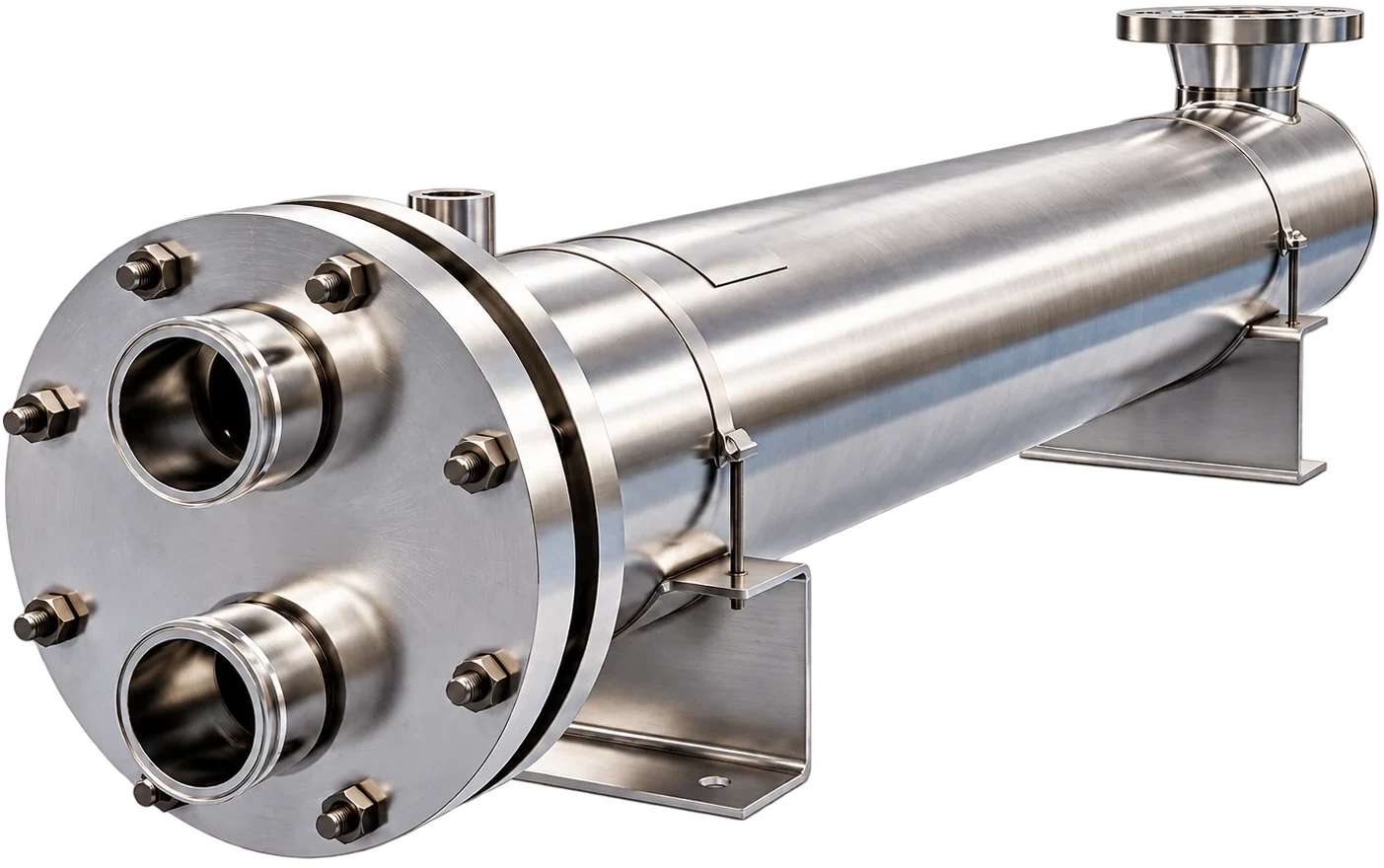
Steam inside the U-tubes, 1–2% caustic in a 316L shell, and the whole bundle pulls forward for cleaning without touching the piping.
Sized for the gpm and the temperature rise you give us, not picked from a shelf.
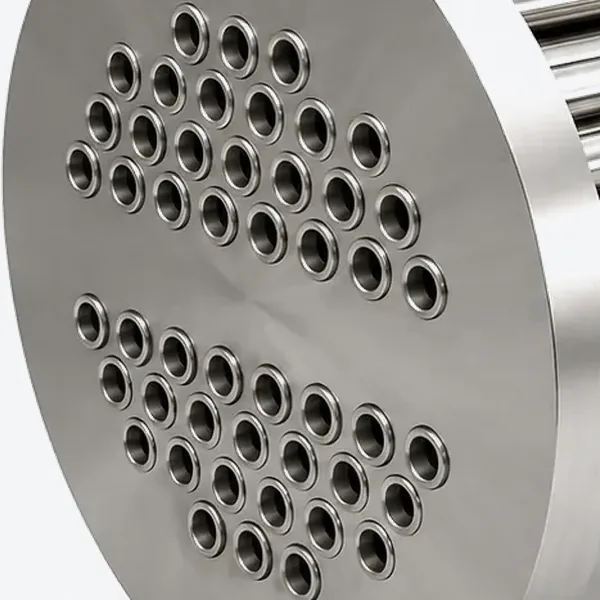
What the bundle gives the solution side
- 316L tubes, 3/4-inch or 1-inch, rolled into one 316L tubesheet
- Segmental baffles hold cross-flow velocity over the tubes
- Fouling allowance of 0.001–0.002 built into the surface
- Shell-side design 150 psig at 250°F
- Bundle pulls from the shell; tube field cleaned in the open
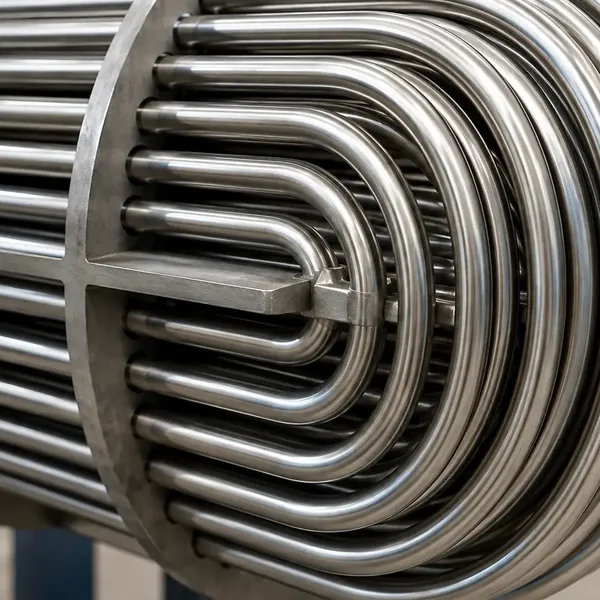
What the steam side gets
- Tube-side design 150 psig at 400°F
- Pass partition splits steam in from condensate out
- Head drains fully so condensate never backs up into the tubes
- Carbon steel head standard; 316L head on request
- Vent and vacuum-breaker tappings on the head
Specify it your way




Standard build, U-tube removable bundle
The build below is what a quote for a caustic, acid or rinse duty starts from. Change any line and tell us why; the sizing follows.
| Feature | Standard build |
| Tube side (steam) | 150 psig at 400°F; plant steam 15–125 psig through a control valve and trap |
| Shell side (solution) | 150 psig at 250°F; caustic 1–2%, acid 0.5–1.5%, or rinse water |
| Tubes | 316L, 3/4-inch or 1-inch, U-bent, rolled and optionally seal-welded into the tubesheet |
| Tubesheet | Single, 316L, with the bundle removable through the shell flange |
| Shell and bonnet | 316L; EPDM bonnet gasket standard, FKM on acid duty |
| Steam head | Carbon steel standard, 316L optional; two-pass partition |
| Connections | Tri-clamp to 4 inches, flanged at 6 inches and larger; drainable layout |
| Finish | 32 Ra (about 0.8 µm) on the solution side where the loop is sanitary; mill finish on a utility heater |
| Code | ASME Section VIII U stamp on request; hydrotest of both sides |
Getting the most out of a removable bundle
Leave the pull space on the drawing, not in your head
The bundle is as long as the shell. To get it out you need that much clear floor in front of the steam head, plus room for the lifting gear, and the clearance has to survive whoever installs the next conduit run. We print the pull length on the general arrangement drawing. If the heater has to go against a wall, say so with the quote request; a shorter, larger-diameter bundle is an easy change on paper and a miserable one after the concrete is poured.
- Pull length equals bundle length plus about 24 inches for rigging
- A monorail or trolley beam over the heater pays for itself at the first pull
- Keep the steam head on the accessible end; the shell flange follows it
Flow the solution hard enough to stay clean
Milkstone and protein film form fastest where caustic moves slowly over a hot surface. The baffle spacing in the bundle is set to hold a real cross-flow velocity at your gpm, which is why we ask for the flow rather than the duty alone. A tank recirculation circuit moving 150 gpm through a shell sized for 60 gpm will heat the solution fine and foul it quickly; a shell sized for 150 gpm with 60 gpm through it will drop into laminar flow and do the same. Pick the circuit, then the heater.
Run the steam side like a steam user
Condensate standing in the bottom U-tubes is the common cause of a heater that cannot make temperature. The control valve throttles, tube-side pressure falls below the return-line pressure, and the trap stops passing. Put a vacuum breaker on the head, trap below the outlet with a drop leg, and give us the steam pressure at the heater inlet with the valve wide open. 15 psig still gives at least 50°F of approach above a 175°F caustic target, so low-pressure steam is not the problem; stalled condensate is.
When this is not the right heater
If your water is hard enough that carbonate scale forms inside a day and the sanitation crew wants to brush tubes rather than pull a bundle, the straight-tube build with removable heads at both ends is the better buy. If the duty is solution-to-solution recovery with no steam at all, a gasketed plate pack takes less floor and gets closer temperatures. For steam against caustic, acid or rinse water, this page is the answer.
U-tube questions
They rarely need it. Steam condenses inside the tubes and leaves nothing behind except the mineral trace in the condensate, so the tube interior stays bright for years. The fouling on a CIP heater is on the solution side, outside the tubes, and that is the surface that comes into the open when the bundle is pulled. The U-bend prevents rodding, which is the trade you make for free expansion.
On a dairy circuit running 160–175°F in hard water, plants commonly pull once or twice a year for a milkstone soak and a look at the baffles. A brewery circuit at 140–160°F with softened water may go several years. The bundle is designed to come out; whether it has to depends on your water and how well the acid step keeps the mineral off the tubes.
Weight depends on shell diameter and length, so it appears on the quote drawing rather than here. The shell carries two saddles with slotted holes on one so the shell can grow lengthwise against the steam head. The bundle itself is not supported by the piping at any point; the nozzles are for flow, and we ask that the pump discharge and return lines be braced separately.
Everything the solution touches is 316L: shell, tubes, tubesheet face, bonnet and nozzles. Caustic at 1–2% and 165°F is mild to stainless, but the acid step and the hard-water chlorides are not kind to anything less, and a carbon steel shell would also shed iron into the circuit. Carbon steel is permitted on the steam head alone, because only steam and condensate touch it.
Yes, as long as the circuit valves keep the two solutions from meeting inside it and the bonnet gasket is FKM rather than EPDM. Sizing is set by the caustic step, which runs hotter and carries the larger heat load; the acid step at 120–150°F is well within what the same surface can do. Tell us both duties so the control valve range covers both.
Related
Heat Exchangers
Straight Tube, Brushable
For the plant that would rather brush tubes on a Saturday than rig a bundle: straight 316L tubes between two tubesheets, heads off at both ends in minutes.
+ Learn More
Heat Exchangers
Replacement Bundles
When the shell is sound and the tubes are not, a new 316L bundle made to the old one's tubesheet and length drops back in without a pipe fitter.
+ Learn More
Heat Exchangers
Shell & Tube
The construction that carries the main CIP duty: a U-tube bundle condensing steam inside, a 316L shell around it, and three ways to buy it, full unit to bundle.
+ Learn More