
1-805-484-2992
Quotes - Engineering - SalesLow soil, high flow, and every degree documented
A pharmaceutical or biotech vessel circuit is nearly the opposite of a dairy one. The soil is light: residual buffer, media, cell debris or a cream base that was never baked on. What is heavy is the flow and the standard. A 2,000-liter bioreactor or a 5,000-liter formulation tank is cleaned through spray devices that each take 25–100 gpm, so a single vessel circuit runs 100–300 gpm, and the rinse is not city water but purified water or water for injection that the plant made at some expense and wants hot, commonly 176°F (80°C) at the return.
The caustic is mild, 0.5–1% sodium hydroxide at 140–160°F, often followed by a phosphoric acid at 0.5% and 120°F, and the sanitize is hot water rather than a chemical, because residues must be rinsed to a measured conductivity and TOC. Every temperature is a validated parameter with a sensor, an alarm and a batch record. The heater is therefore judged less on Btu and more on whether it drains fully, whether its product-side surfaces and welds pass inspection, and whether it can hold 176°F at the return at 200 gpm without hunting.
We build that heater as a sanitary U-tube steam-to-water or steam-to-solution unit, 316L on the solution side at 32 Ra, tri-clamp, self-draining, with the steam side on plant steam because the heater keeps the two apart.
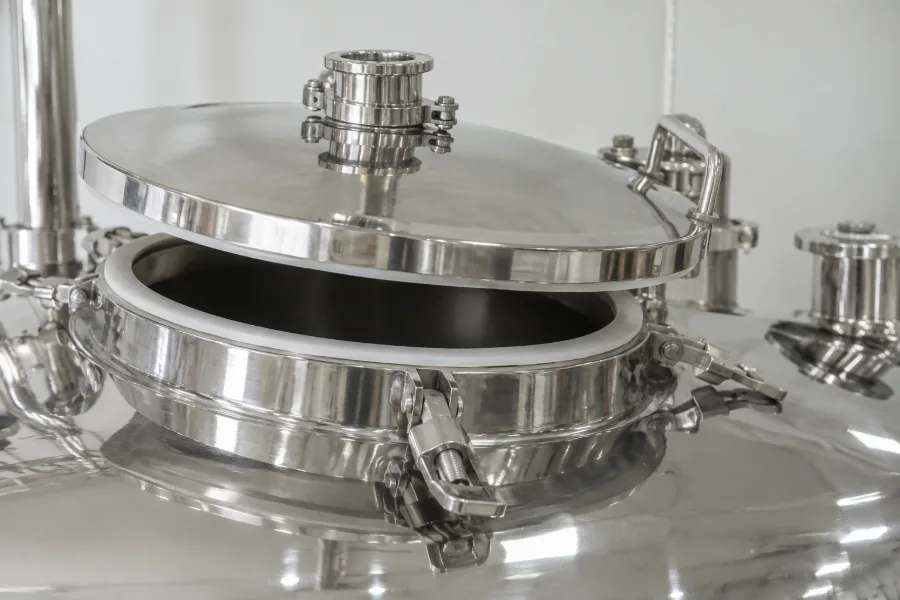
A pharma vessel heater is judged on drainability and 176°F at the return
- Spray devices at 25–100 gpm each put 100–300 gpm through a vessel
- Purified water or WFI rinse arrives expensive and leaves hot
- Solution-side 316L at 32 Ra, tri-clamp, drainable, documented for validation
The vessel circuit beside the heater that passes validation
Figures for a formulation, media or buffer vessel circuit in a pharmaceutical plant appear on the left. On the right is the sanitary heater we build for it and the documents that travel with it.
How the suite runs the circuit
- Chemical: Sodium hydroxide 0.5–1%; phosphoric acid 0.5% where mineral or protein needs it
- Temperature: Caustic 140–160°F; acid 120°F; hot purified water rinse 176°F at the return
- Flow: 100–300 gpm per vessel through spray devices; 30–70 gpm on transfer lines
- Cycle: Pre-rinse, caustic 15–30 minutes, rinse, optional acid, final rinse to conductivity, hot hold
- Water: Purified water or WFI on final rinse; softened or purified on caustic makeup
- Record: Return temperature, conductivity and flow logged each cycle for the batch record
The heater we recommend
- Construction: Sanitary U-tube shell-and-tube, steam in the tubes, solution or water on the shell
- Materials: 316L shell, bundle and heads at 32 Ra on the solution side; EPDM head gasket
- Layout: Self-draining shell with low-point drain, sloped to the outlet, no dead legs
- Connections: Tri-clamp to 4 inches, 6-inch flanged; 3-A where the inspector asks for it
- Steam side: Plant steam at 15–50 psig; carbon steel head allowed because steam never touches the solution
- Send us: Vessel volume and spray count, gpm, rinse water type and return temperature, steam psig, documents required
Heating a validated circuit
Once-through hot water at 200 gpm
A final rinse that must reach 176°F at the return at 200 gpm from purified water stored at 70°F is a 106°F rise, about 10.6 MBtu/h while it runs. Few plants hold that much water hot, so the heater makes it on the fly, and the control valve has to settle within a minute or the batch record shows a temperature excursion. Size the heater for the full gpm and the coldest storage temperature, give the steam valve a fast-acting positioner, and put the controlling sensor at the heater outlet with the recorded sensor at the return.
Why the steam side can be plant steam
Validation teams sometimes ask for clean steam on a CIP heater. On an indirect heater it is not needed: the steam condenses inside the tubes and never meets the solution, so plant steam with its boiler treatment is acceptable and the carbon steel steam head is allowed. What matters is the tube wall between them, which is why we use 316L tubes and offer a hydrostatic test record and material certificates for the solution side. Clean steam is reserved for sterilize-in-place, which this heater is not part of.
- Material test reports on every solution-side component
- Weld maps and surface finish report at 32 Ra where specified
- Drainability demonstrated at the factory acceptance test
- Pressure test certificates for both sides
Drainable means every drop
A dairy accepts a shell that holds a cup of caustic between cycles. A pharma suite does not, because carryover from one product campaign to the next is a deviation. The U-tube shell is oriented and sloped so the solution side drains through a low-point tri-clamp valve, the heads have no pockets, and the bundle supports are cut away at the bottom. When the plant wants to brush rather than pull, a straight-tube heater with removable heads can be made drainable too; it is a longer conversation about expansion and we have it on the straight-tube page.
Recovering heat from expensive water
Hot purified water going to drain at 170°F is heat paid for twice, once to make the water and once to heat it. A gasketed plate exchanger on the final-rinse return against incoming purified water at 60–70°F recovers 60–70% of that heat and cuts the steam heater duty for the next vessel. The plate pack sits on the drain side of the process, so it carries utility-grade EPDM gaskets and 316L plates without the validation burden of the heater itself.
Questions from the suite
Only if the plant's own specification calls for it on the CIP system, and many do not, treating CIP supply as utility-side equipment. What most quality groups do ask for is 316L on the solution side, 32 Ra, tri-clamp fittings, full drainability and material certificates. We build to that as standard on a sanitary heater, and we can quote to a tighter finish or a specific code stamp when the user requirement specification names one.
If it is sized for it. A 5,000-liter vessel at room temperature absorbs heat during the first minutes of the hot rinse and the return lags the supply by 10–20°F until the steel warms. The heater and its control valve must have capacity to run the outlet at 185°F during that lag and ease back as the return climbs. Sizing on steady-state alone produces a rinse that passes only after an extended hold.
Because the residue limits are set by conductivity and total organic carbon on the final rinse, and a chemical sanitizer adds exactly what the rinse is trying to remove. Hot purified water at 176°F for a set hold sanitizes without leaving anything to rinse away. That puts the heater on the critical path of every batch, which is why the suite asks about control response and drainability before it asks about price.
For heating purified water with steam we stay with a sanitary shell-and-tube; the gasketed joints of a plate pack on steam duty cycle hard and the frame is difficult to verify as drainable. For water-to-water recovery on the drain side a plate exchanger is a good fit. Where a plant insists on plate for the supply, we size it for hot water at modest pressure and keep steam off the plates.
Related
Applications
Lotion & Emulsion Vessels
Lotion and cream residues are wax and oil, and nothing moves until they melt. The hot pre-rinse, the surfactant caustic and the tank heater sized for a melting soil.
+ Learn More
Applications
Pharma & Personal Care
Pharma suites and cosmetics plants clean like a dairy but specify like a validation group. What changes in the heater, and what does not, for each circuit.
+ Learn More
Applications
Dairy
Dairy circuits run the hottest caustic on this site and foul the heater itself. Why dairies pull bundles, and how pasteurizer, vat and silo loops differ.
+ Learn More
