
1-805-484-2992
Quotes - Engineering - SalesName the circuit before you name the heater
Every CIP heater inquiry that stalls does so on the same point: nobody wrote down which wash step the heater serves. A caustic tank heater, an acid loop heater and a rinse-water heater are three different pieces of equipment that happen to look alike from across the room. The chemical sets the metal and the elastomer, the concentration sets how hard the chemical works on both, and the circuit sets the temperature the solution has to reach. Fix those three and the construction choice is nearly made for you.
How the chemical decides the build
Caustic is the circuit most plants mean when they ask for a CIP heater. The solution is sodium hydroxide at 1–2%, lighter at 0.5% on a beverage line with little fat, heavier at 3% on a kettle with burnt-on soil. A dairy runs it at 160–175°F; a brewery more often holds 140–160°F because cold fermenters and dissolved CO2 pull the temperature down and the caustic slowly carbonates. Protein and fat lift off in this step, and milkstone begins to form on any hot surface above about 160°F in hard water, which is why the heater itself is the first thing in the loop to foul.
The acid circuit is nitric or phosphoric at 0.5–1.5%, near pH 2, run at 120–150°F and usually only a few times a week. It dissolves the mineral the caustic left behind. Rinse water sits between and after the chemical steps: pre-rinse at 100–120°F, final rinse at 120–140°F, and a hot-water sanitize that holds 180–190°F at the return. Recovery is not a wash step at all but a plate exchanger that hands return-line heat to makeup water. Each of these asks something different of the heater.
Write these down for every circuit the heater will see
- Caustic at 1–2%, up to 3% on heavy soil: 316L on the solution side, EPDM at the head gasket
- Nitric acid, hot or daily: FKM elastomers, because nitric is oxidizing and hardens EPDM
- Phosphoric acid at the same strength: easier on gaskets, still 316L and still called out
- Rinse and sanitize water: 316L is the same, the duty is set by gpm and the 180°F hold
- One heater, two chemicals: the gasket is chosen for the harsher one, the metal does not change
- Chlorides from a brine step: the one thing that moves the metal question past 316L
the caustic most CIP heaters seeSodium hydroxide at that strength and 175°F is comfortable for 316L and EPDM; it is the acid step, not the caustic, that moves the elastomer choice.
Concentration questions sales will ask back
A concentration written as a percentage is what we need; conductivity setpoints and dosing-pump strokes can be converted, but the plant knows its own chemistry better than we do. If the answer is "whatever the supplier recommends", read the drum label for the active ingredient and give us the dilution ratio. These are the points that change the quotation when they come in late.
- Caustic strength as a percentage of sodium hydroxide, and whether it ever runs above 2%
- Which acid: nitric, phosphoric or a blend, and how many days a week it runs
- Acid temperature, since nitric at 150°F is a different gasket duty from nitric at 120°F
- Whether any sanitizer or chlorinated product passes through the same heater
- Water hardness at the plant, which tells us how fast milkstone will build on the shell side
Call and talk it through with an engineer: 1-805-484-2992
Where the chemistry actually bites
The caustic itself is seldom the problem. Sodium hydroxide at CIP strength does nothing to 316L at 175°F, and EPDM lasts for years in it. What the caustic does is leave a mineral layer wherever it runs hot, and on a steam heater the hottest wetted surface is the outside of the tubes. That is a fouling argument, not a corrosion one, and it is answered on the fouling and bundle removal page. The chemistry answer for caustic is simple: 316L shell, 316L bundle, EPDM head gasket.
The acid step is where the questions start. Nitric acid oxidizes elastomers, and a head gasket that is fine on caustic will harden and crack if nitric at 1.5% passes through it hot every day. FKM solves that. Phosphoric acid is gentler, and a plant that uses it a few times a week at 120°F can often stay with EPDM, but we want to see that written on the inquiry rather than assume it. 316L handles either acid at CIP strength; the metal question does not change between the two.
On a gasketed plate exchanger the elastomer matters far more, because there are dozens of gaskets rather than one, and they are thin. EPDM is the standard plate gasket for caustic and hot water and is rated to about 300°F. Where the acid step is nitric, hot or frequent, the pack is gasketed in FKM from the start. A pack that is quoted in EPDM because the inquiry said only "CIP solution" and then meets nitric every night is the single most common gasket failure we see.
Chlorides are the one chemistry that moves 316L out of the comfortable zone. A brine chiller circuit, a salt-cure operation or a plant that sanitizes with hypochlorite and leaves it in the loop can pit 316L, especially under a milkstone deposit where the chloride concentrates. Tell us about any chloride source and we will size and build for it rather than find out later.
Breweries add one more wrinkle. Caustic absorbs CO2 from fermenters and bright tanks, turning to sodium carbonate and losing cleaning strength. The plant makes up more often and may run a little hotter to compensate, and the carbonate shows up as scale on the heater. None of that changes the materials; it changes the fouling allowance and the makeup heat, and both belong on the inquiry.
Metal for the caustic, gasket for the acid, allowance for the water.
The three answers on this page are the first three lines of every quotation we price.
Request a QuoteConcentration questions
Not the metal and not the gasket; 316L and EPDM are untroubled at either strength. What changes is the fouling rate. Stronger caustic carries more dissolved mineral out of the circuit and deposits more of it on the hot tube surface, so we add to the fouling allowance and recommend the removable U-tube bundle rather than a fixed design. The duty in Btu per hour is unchanged.
The one the acid needs. A shared heater sees nitric or phosphoric for a shorter time each week than it sees caustic, but gasket damage from acid is cumulative and does not heal during the caustic step. If the acid is nitric, specify FKM at the head or in the plate pack and it will be comfortable on caustic as well. If it is phosphoric at modest temperature, EPDM may serve; tell us and we will say which.
For caustic, nitric and phosphoric at CIP strength and temperature, 316L is the right answer and a higher alloy buys nothing. The exception is chloride. If the plant has a brine circuit, cures with salt, or leaves hypochlorite in the loop, tell us the chloride level and we will look at the alloy. Carbon steel appears only on a steam-side head that the solution never touches.
Two reasons that both come from CO2. Fermenters and bright tanks hold dissolved gas, and caustic sprayed into them absorbs it and converts to carbonate, so the plant keeps makeup frequent and temperature moderate. Cold vessel walls also pull a hot wash down faster than a dairy silo does. A 140–160°F caustic heater for a brewery is therefore sized for a lower target but often a higher recirculation rate.
Related
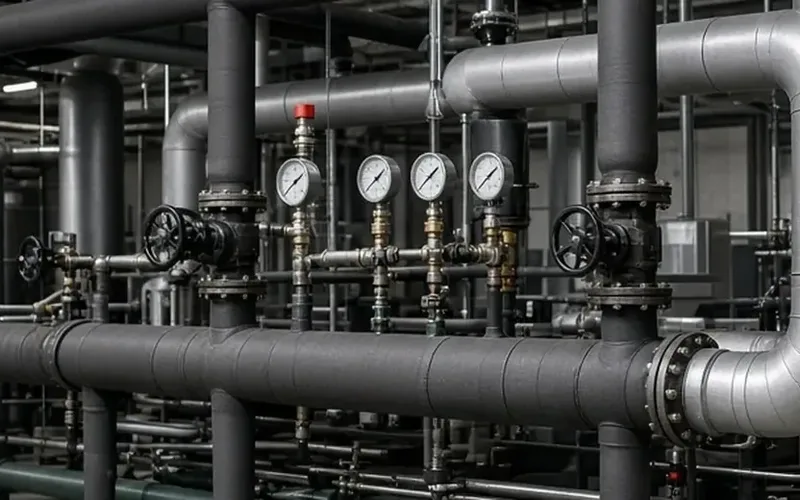
Sizing & Selection
Tank Recirculation or Once-Through
A tank loop is sized in gallons and minutes, an inline heater in gpm and degrees. How to tell which circuit you are heating and why the answer can triple the duty.
+ Learn More
Sizing & Selection
Duty Point & Steam Pressure
Flow, inlet, target and steam pressure at the heater make the duty point. How Btu/h and steam lb/h fall out of them, and why the boiler gauge is the wrong figure.
+ Learn More
Sizing & Selection
Define the Duty
Five answers size the heater: circuit and chemical, tank or inline, gpm, inlet and target temperature, and steam pressure at the heater. Collect them here first.
+ Learn More
