
1-805-484-2992
Quotes - Engineering - SalesA protein soil on a clock
Liquid egg is the closest thing to a dairy soil outside a dairy, and in one way it is worse. Egg albumin denatures from about 140°F, so the regenerator and heating sections of an egg pasteurizer start to coat within the first hour of a run, and iron and sulfur in the yolk darken the film. Egg plants therefore run short: 4 to 8 hours of product, then a full clean, around the clock on a busy line. The caustic tank never gets a day off, and the heater that keeps it at 160–165°F is in effect continuous-duty equipment.
Fruit puree pasteurizers share the pattern for a different reason. Pectin, sugar and fruit fiber char on holding tubes and plates, and the acid in the fruit leaves a mineral film under the organic layer. Both lines run caustic at 1–2% and 160–170°F, both run acid on every cycle rather than weekly, and both carry protein or pectin back into the caustic tank where it ends up on the heater tubes.
The heater we put on these lines is a U-tube steam heater on the caustic tank loop, 316L throughout the solution side, head gasket chosen for daily acid, and a bundle that comes out when the protein film on the tubes has to be removed by hand rather than by chemistry.
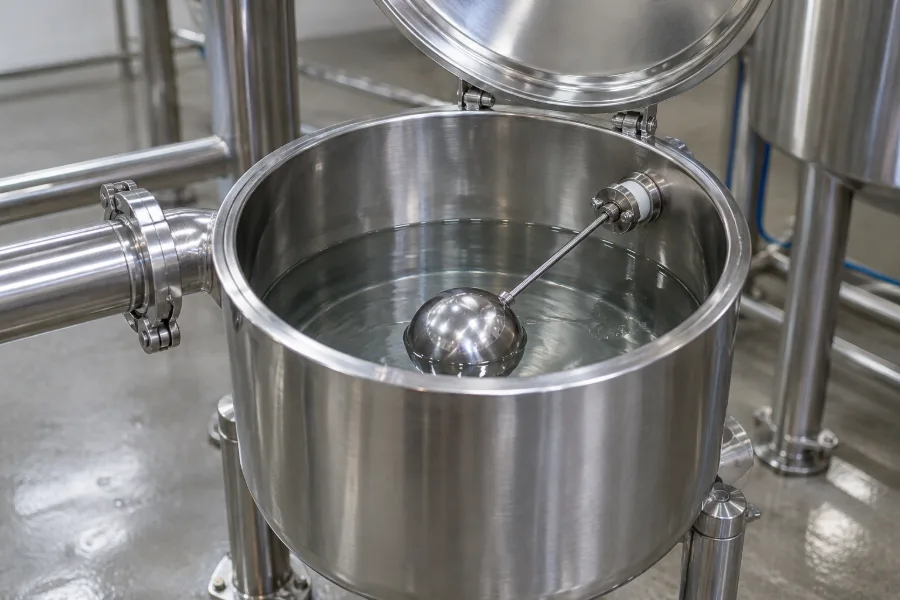
An egg line cleans every 4 to 8 hours, so the heater never gets to cool off
- Albumin denatures from 140°F and coats the pasteurizer within the first hour
- Caustic at 160–170°F lifts protein, acid every cycle takes the mineral
- Protein carried back to the tank ends up on the heater tubes
How egg and puree lines run CIP, and the heater for it
A liquid egg breaking and pasteurizing plant and a fruit puree line run close enough to share one set of figures. The right column shows the heater construction that survives the schedule.
The pasteurizer circuit
- Chemical: Sodium hydroxide 1–2%; nitric or phosphoric acid 0.5–1% on every cycle
- Temperature: Caustic 160–170°F; acid 130–140°F; hot-water sanitize 180°F at the return
- Flow: 30–70 gpm through 2- and 3-inch pasteurizer piping at about 5 ft/s
- Cycle: Every 4–8 hours of run; caustic 30 minutes, acid 15, full cycle about 75 minutes
- Soil: Denatured albumin, yolk fat and iron sulfide stain; pectin and fruit fiber on puree
- Fouling side: Solution side of the heater; the steam side stays clean
The heater we recommend
- Construction: U-tube shell-and-tube, steam inside the tubes, caustic in the shell
- Materials: 316L shell, bundle and heads; FKM head gasket for daily nitric, EPDM on phosphoric
- Duty: Hold a 1,000–2,000-gallon tank at 165°F; recover 20°F lost per cycle
- Connections: Tri-clamp to 4 inches; drainable; 32 Ra where the loop is treated as sanitary
- Rating: 150 psig at 250°F caustic side; 150 psig at 400°F steam side
- Send us: Hours between cleans, tank gallons, pasteurizer gpm, acid type, steam psig
Sizing for a line that never stops cleaning
Hold duty, not heat-up duty
A dairy tank heater is sized to bring a cold tank up before the morning wash. An egg-line tank rarely drops below 140°F because the next clean is a few hours away, so the heater's job is to replace what each cycle removes: roughly 20°F of tank temperature lost to a cold pasteurizer plus the heat in the water the plant adds back. For a 2,000-gallon tank that is about 330,000 Btu per cycle, delivered over 15–20 minutes before the next caustic step, or roughly 1–1.3 MBtu/h. The heater is smaller than a cold-start unit but it runs six times a day.
Daily acid and the gasket
Many egg plants run an acid step after every caustic wash, and some use nitric, because the mineral in albumin and in hard rinse water binds the next protein layer to the surface. Nitric at 130–140°F six times a day is hard on an EPDM gasket; it stiffens, loses its seal at the head joint, and the first sign is a damp flange after the acid rinse. We fit FKM on the head gasket where nitric is the daily acid and keep EPDM where the plant uses phosphoric. The tubes and shell are 316L either way and are indifferent to the choice.
- Name the acid and how often it runs on the data sheet
- FKM for daily nitric; EPDM for phosphoric or occasional nitric
- Inspect the head gasket at each bundle pull, not just when it leaks
Protein on the tubes
Albumin carried back in the caustic return does what it does on the pasteurizer: it denatures on the hottest surface and bonds to the mineral underneath. On the heater that surface is the tube wall, and the film builds despite the caustic around it because the wall is 100°F hotter than the solution. The acid step dissolves the mineral layer and loosens most of the film, but a plant running at full schedule will still want the bundle out once or twice a year. A straight-tube heater brushable from the heads is the alternative where the crew prefers to brush; on egg duty we favor the U-tube and the pull.
Hot water on the sanitize step
Egg plants finish with a hot-water sanitize at 180°F for 5 minutes at the return more often than beverage plants do, because a chemical sanitizer can leave a taste in a product with no flavor to hide it. That is a once-through duty on rinse water at full pasteurizer flow, separate from the caustic tank heater. On lines with four to six cleans a day the steam-to-water shell-and-tube on the sanitize supply is usually the second heater in the room.
Egg and puree questions
Albumin denatures and sticks from about 140°F, lower than milk protein, and liquid egg has no sugar buffer to slow the deposit. Fouling on the pasteurizer plates raises the pressure drop and lowers the heat transfer within hours, and the pasteurization record starts to drift. Plants stop at 4 to 8 hours and clean rather than fight it. The caustic heater has to be ready each time.
It pushes the caustic toward 2% and sometimes adds a chlorinated alkaline on whole-egg lines, because the fat saponifies and the iron sulfide stain needs chlorine to bleach. The heater construction does not change; 316L and the standard U-tube serve. The soap that forms in the tank does foam, so plants watch the tank level and the return pump, and dump the caustic more often than a puree line would.
Yes, and arguably more so. Fruit acid dissolves calcium and magnesium out of the hard rinse water and the fruit itself, and when the puree is heated that mineral comes out on the hot surface under the pectin char. Caustic takes the organic layer; only acid takes the mineral. Skipping it leaves a rough gray base that the next run's pectin grips, and the clean takes longer every time.
Many plants do run caustic through the pasteurizer with its heating section live, and it helps the solution reach the plates hot. It does not replace the tank heater, because the tank, the balance tank and the supply piping all need the solution at temperature before it reaches the pasteurizer, and the heat-up between cycles happens in the tank loop. We size the tank heater as if the pasteurizer contributed nothing.
Related
Applications
Kettle & Sauce Lines
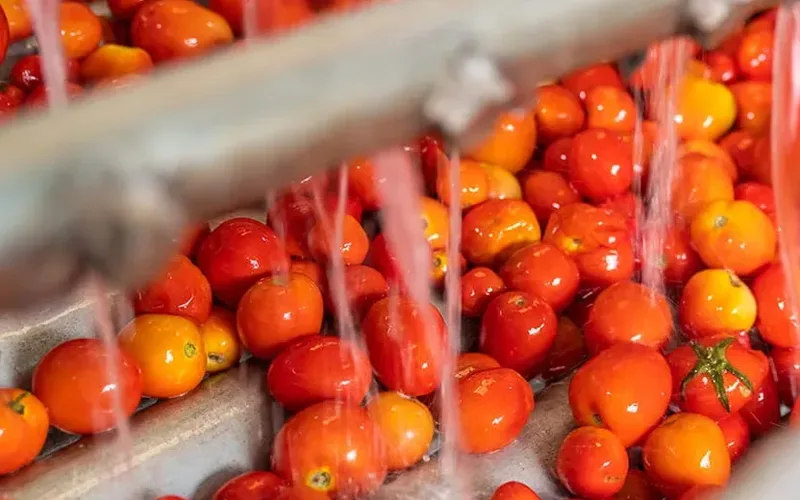
Burnt-on starch and fat need caustic at the top of the range for most of an hour. Sizing a kettle-line tank heater that holds 175°F while the soil fights back.
+ Learn More
Applications
Meat, Pet Food & Brine
Fat wants the caustic hot and salt wants the stainless cool. Where the chloride line falls for a 316L heater, and how brine plants keep salt out of the caustic loop.
+ Learn More
Applications
Food Plants
Food soils are the heaviest we heat against: hotter, stronger caustic, bigger tanks and a chloride check for brine plants. How the heater is sized for each.
+ Learn More
