
1-805-484-2992
Quotes - Engineering - SalesSoft soils, many cycles, and acid that runs most days
Juice and soft-drink soils are kinder than milk or wort. Sugar syrup, fruit pulp, pectin and citrus oil come off in caustic at 150–160°F without the burnt-on fight a cook kettle puts up, and a 1% sodium hydroxide is usually enough. What the circuit lacks in difficulty it makes up in frequency. A blending and filling line changes flavor several times a shift, every change is a rinse and often a short caustic, and the plant may run eight or ten cycles a day where a dairy runs two. The heater sees constant on-off duty and the return line carries a lot of warm water to drain.
The acid step is the other difference. Fruit acids and hard makeup water leave a mineral haze on evaporator tubes, pasteurizer plates and holding tanks, so juice plants run phosphoric or nitric acid at 0.5–1% and 120–140°F far more often than the few-times-a-week dairy habit, sometimes on every full cycle. That acid passes through the same heater as the caustic, and it decides the elastomer.
The construction we recommend is a U-tube steam heater for the caustic loop, with the head gasket chosen for the acid, and a gasketed plate exchanger on the return where the cycle count makes heat recovery worth the frame.
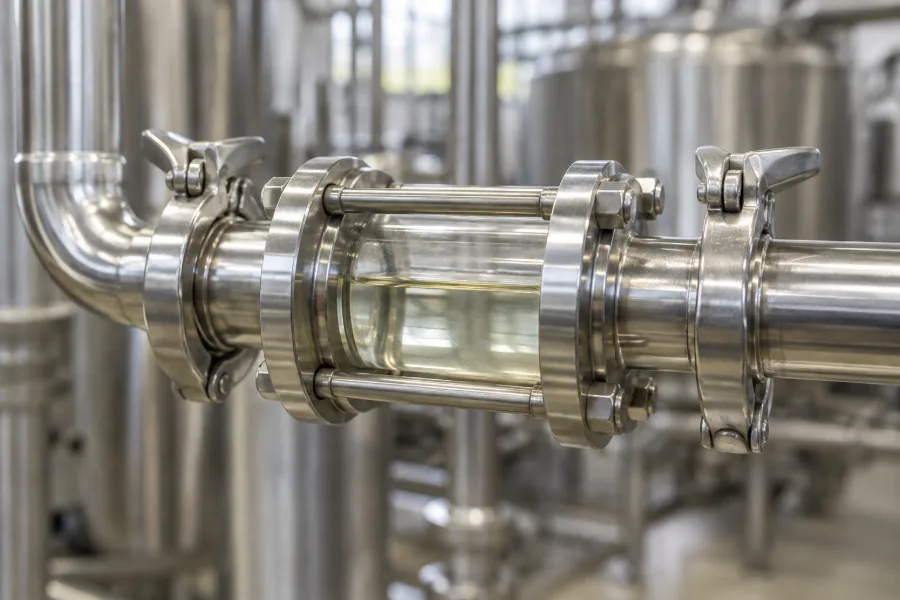
On a line that cleans ten times a day the return heat is worth money
- Caustic at 150–160°F lifts syrup and pulp without a long soak
- Phosphoric or nitric at 120–140°F dissolves the mineral haze most cycles
- A plate recovery exchanger returns 60–70% of the heat in the return
The juice line circuit next to the heater for it
These are the figures a blending, pasteurizing and filling line commonly runs and the heater construction that matches them. A concentrate plant with evaporators will sit at the hot end of each range.
How the beverage plant runs it
- Chemical: Sodium hydroxide 0.5–1%; phosphoric or nitric 0.5–1% on most full cycles
- Temperature: Caustic 150–160°F; acid 120–140°F; final rinse 120–140°F
- Flow: 30 gpm in a 2-inch line, 70 gpm in 3-inch, 120 gpm in 4-inch at about 5 ft/s
- Cycle: Short cycles, 45–60 minutes full, with rinse-only changeovers between flavors
- Soil: Sugar, pectin, pulp fiber, citrus oil, mineral haze from fruit acid and hard water
- Return: 140–155°F leaving the line, dumped or recovered against 60°F makeup
The heater we recommend
- Caustic duty: U-tube shell-and-tube, steam in the tubes, solution on the shell
- Materials: 316L shell, bundle and heads; EPDM gasket on phosphoric, FKM where nitric runs hot
- Recovery duty: Gasketed plate, 316L plates 0.5–0.6 mm, EPDM gaskets, return against makeup
- Connections: Tri-clamp to 4 inches; 6-inch and up flanged; mill finish on the utility loop
- Rating: 150 psig at 250°F solution side; frames to 150 psig on the plate unit
- Send us: Cycles per day, line size and gpm, acid type, return temperature, steam psig
Three things juice plants get wrong on the CIP heater
Treating the acid as an afterthought
In a dairy the acid wash is occasional and an EPDM gasket shrugs it off. In a juice plant that runs nitric at 140°F on every cycle, EPDM hardens and takes a set within a season, and the first sign is a weep at the head joint after the acid step. Phosphoric is gentler and EPDM lives with it; nitric used hot or often wants FKM. The metal does not care either way: 316L handles both acids at CIP strength. Write the acid on the data sheet so the gasket is right the first time.
Sizing the heater for one cycle a day
Juice lines rarely let the caustic tank cool to room temperature, because the next cycle is an hour away. The heater therefore sees a smaller rise than a dairy tank heater but sees it constantly, and the steam valve cycles all day. That favors a heater with surface area to spare at low steam pressure rather than one that depends on 100 psig to make the number. Sizing on 15–30 psig at the inlet means the heater still keeps up on the shift when the pasteurizer takes the steam first.
- Count cycles per shift, not per day, when the line is on a flavor change schedule
- Size the steam valve for the heat-up case and let it throttle during the hold
- Expect the tank to sit at 130–140°F between cycles rather than cold
Dumping the return
A line running ten short cycles sends thousands of gallons of 140–155°F rinse and caustic return to drain every day. A plate exchanger between that return and the 60°F makeup water recovers 60–70% of the heat at a 5–10°F approach, which cuts the steam heater duty by the same share. It does not replace the steam heater; it shrinks the job the heater has to finish. On a beverage line with a high cycle count the return-to-makeup exchanger is often the first unit to pay for itself.
Pulp and fiber in the solution
Pulp carried back from the line settles in the caustic tank and some of it reaches the heater. On a U-tube shell it collects at the low point and comes out when the bundle is pulled; on a plate pack it bridges the 3–5 mm channels and raises the pressure drop first. Keep a strainer ahead of the plate recovery unit and keep the caustic heater shell-and-tube, where fiber has room to pass.
Juice line questions
Not the metal and not the construction. Citric at 1–2% is mild on 316L and on EPDM, so the standard U-tube heater with an EPDM head gasket serves. It is weaker than nitric on mineral scale, so plants that use it tend to run the step longer or hotter, and the heater sees a little more time at 140°F on acid. Tell us the acid and we pick the gasket to match.
If both draw from one caustic tank, yes, because the heater is on the tank loop and does not care which circuit the supply pump feeds. What matters is the combined schedule. When the syrup room and the filler both wash in the same hour, the tank sees two cold returns and two sets of makeup, and the heater duty is the sum. Give us both circuits' gpm and timing.
Steam on a plate pack is not our recommendation for the caustic duty. The gaskets see steam-side pressure and temperture swings every cycle, and on a line with ten cycles a day that is thousands of cycles a year. A U-tube bundle takes the swings with free expansion. We put plate where it belongs on a juice line: solution-to-solution recovery and warm water at modest pressure.
Most beverage plants rinse at 120–140°F and follow with a chemical sanitizer rather than hot water, so the rinse heater duty is modest and a plate rinse heater or recovered heat often covers it. Lines that sanitize with hot water instead hold 180°F at the return, and that step moves the heater choice to a once-through steam-to-water shell-and-tube sized for the full rise.
Related
Applications
Brewhouse & Fermenter
Kettles want hot caustic, fermenters knock it cold and CO2 turns it to carbonate. How we size the brewery caustic heater around the cellar instead of the brewhouse.
+ Learn More
Applications
Filler & Bottling Rinse
A filler sanitize is a time-at-temperature test at the coldest valve, not at the heater. Why bottling lines get a once-through heater sized for the full rise.
+ Learn More
Applications
Brewery & Beverage
Breweries heat caustic against cold vessels and carbonate scale; beverage lines run the rinse heater hardest. Circuits, temperatures and the heater for each.
+ Learn More
