
1-805-484-2992
Quotes - Engineering - SalesA sanitary CIP heater is built so the inspector can trust it empty
A sanitary CIP heater does the same work as the industrial build, steam condensing inside a 316L U-bundle while 1–2% caustic or dilute acid runs across the shell, but it is built so that when the pump stops the solution side empties on its own and nothing is left in a corner for an inspector to find. That means tri-clamp connections, a shell and nozzles laid out to drain to one low point, a 32 Ra finish inside, and head gaskets that seal without a crevice.
What sanitary adds
The plants that need it are the ones whose CIP return is drawn inside the sanitary boundary: a dairy that treats the loop as an extension of the pasteurizer circuit, a pharma or personal-care plant whose validation covers the cleaning system, a juice or beverage plant whose customer audits ask for it. In those plants the pipe is already 32 Ra and tri-clamp, the pump is a sanitary centrifugal, and a mill-finish flanged heater would be the one piece of the loop the auditor could point at.
What a sanitary build does not change is the thermal design, the materials or the ratings. The shell is still 150 psig at 250°F and the tubes 150 psig at 400°F; the alloy is still 316L; the fouling allowance is still 0.001–0.002 on the shell side, and the bundle still pulls for the milkstone that forms whatever the finish. Expect the sanitary build to cost more than the industrial one for the same duty, almost all of it in finishing hours and in the drawing package.
The sanitary specification
- Tri-clamp nozzles on the solution side to 4 inches; 6-inch and larger go flanged
- Shell, heads and nozzles arranged to drain fully to one point without tilting the unit
- 32 Ra, about 0.8 µm, on every solution-contact surface, verified with a profilometer
- Head gaskets of EPDM or FKM in a controlled-compression joint with no exposed crevice
- Full-penetration welds ground flush on the solution side, dye-penetrant checked
- Steam side unchanged: flanged or threaded, carbon steel head permitted if the plant allows it
on the solution sideA 32 Ra finish, about 0.8 µm, is what most sanitary specifications call for; it is smooth enough to inspect and rough enough to be achieved on a shell without electropolishing.
What to settle before ordering a sanitary heater
Sanitary is a specification, not an adjective, and the heater has to match the one the plant already applies to its loop. Send us the plant's standard so the heater is built to it rather than to ours.
- The finish the loop is validated to, in Ra, and whether it covers the shell interior or only the nozzles
- Connection standard and sizes on the solution side, and whether any 6-inch runs need flanges
- Whether the unit must drain in its installed attitude, and which nozzle is low
- Gasket material the plant's chemical list requires: EPDM on caustic, FKM where nitric runs hot
- Documentation wanted: material certificates, weld maps, finish readings, passivation record
- Whether the steam head may be carbon steel or must be stainless for washdown
Call and talk it through with an engineer: 1-805-484-2992
Where sanitary design shows on a CIP heater
Start with the connections. A tri-clamp joint seals on a gasket held between two ferrules by a clamp, with no threads or bolt holes exposed to the solution, and it opens in a minute for inspection. We fit them on the solution-side nozzles to 4 inches. Above that, a full silo circuit at 200 gpm or more needs 6-inch piping, and a clamp of that size will not hold the loads, so the connection goes flanged with a sanitary-pattern gasket; no auditor objects.
Drainability is the part a drawing has to prove. The shell is horizontal, the solution inlet is high and the outlet low, the baffles are notched at the bottom so no pocket of caustic sits between them, and the low nozzle is set so the shell empties to it at the slope the installation gives. A unit that drains only when jacked up at one end is not sanitary, however it is polished, and it is the most common failing in heaters that were sold as sanitary.
The finish is 32 Ra on the shell interior, the solution-side heads, the nozzles and the outside of the tubes. That last item is the expensive one, because a bundle of 3/4-inch U-tubes cannot be polished after assembly and must be built from polished tube. The weld between each tube and the tubesheet is made flush and ground on the solution face. Electropolishing beyond 32 Ra is a pharma request we supply when the plant's standard asks; on a cleaning-solution heater it buys inspection comfort rather than cleaning.
Gaskets are where the chemistry and the sanitary design meet. The solution-side head gasket sits in a groove sized so it compresses to a known depth and presents a flush face to the shell interior, with no crevice for caustic to lodge in. EPDM is standard; a plant that runs nitric acid hot or often gets FKM, and the plant's own chemical list decides. Both are available in sanitary grades with the documentation an auditor expects.
The steam side is left alone. Steam and condensate have no sanitary standing, so the steam head, its nozzles and the condensate connection are flanged or threaded as on an industrial unit, and the head may be carbon steel. Plants that wash down the area or prefer one alloy ask for stainless, and we build it so, but it is a housekeeping choice. The sanitary money is spent where the solution runs, which is the only place it does anything.
Sanitary is proved on a drawing and in a drain test, not by a polish.
The loop's own standard, sent with the quote, is what the heater is built to.
Request a QuoteSanitary design questions
Not quite. Sanitary is the plant's own standard for finish, connections and drainability, and we build to it. 3-A is a published standard with its own material, finish, gasket and drainage rules and a symbol that maybe applied only when the design has been reviewed against them. A 3-A heater is sanitary; a sanitary heater is 3-A only if the plant asks for the symbol and the design is reviewed.
If the solution side is specified at 32 Ra, yes, because the outside of the tubes is the largest solution-contact surface in the unit. It is also the surface that fouls first with milkstone, polished or not, so the bundle still pulls. Some plants accept mill-finish tube with a polished shell and heads, and say so in their standard; we build to what is written.
Clamp fittings exist in 6-inch, but a 200 gpm circuit with a heater in it puts pipe loads and water hammer on the joint that a clamp was never meant to carry, and plants that have tried it have found the gasket extruded. Flanged nozzles with a sanitary-pattern gasket are the accepted practice above 4 inches, and the drainability of the joint is the same.
Yes, because the question is not what is in the heater during the wash but what sits there between washes. A pocket of caustic left in a shell overnight sits on the same patch of steel for hours, and a pocket of rinse water grows what rinse water grows. A unit that empties to its low nozzle when the pump stops has nothing left to concentrate, which is the whole argument for the sloped layout.
Related

Sizing & Selection
Industrial
The industrial build: ASME shell, mill-finish 316L solution side, carbon steel steam head, flanged or NPT ends. What it saves and what it gives up.
+ Learn More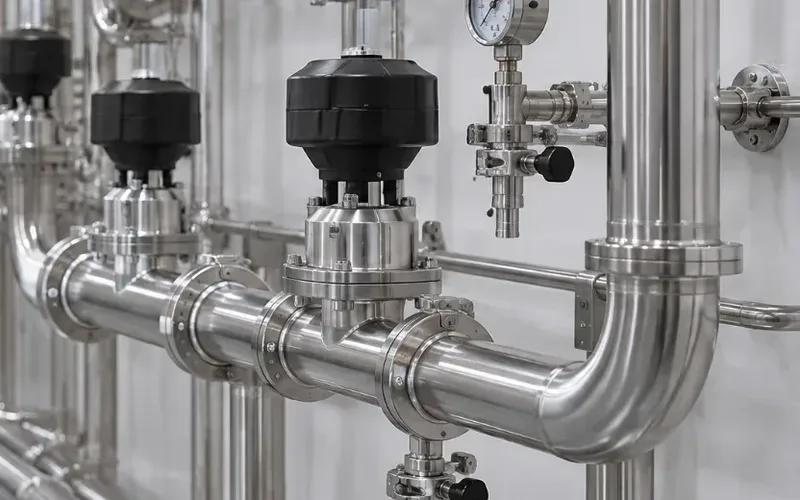
Sizing & Selection
3-A Sanitary
The 3-A symbol on a CIP heater means a third party reviewed the design against the sanitary standard. Who needs it on the heater and what it adds to the build.
+ Learn More
Sizing & Selection
Certifications & Design
Three build levels for the same duty, from mill-finish utility stainless to a 3-A marked drainable unit. Which one the loop needs, and what each adds to the cost.
+ Learn More
