
1-805-484-2992
Quotes - Engineering - SalesA line circuit is sized by its pipe, not its tank
An HTST or UHT pasteurizer is cleaned as a closed loop: caustic is pumped through the balance tank, the regenerator and heating sections, the holding tube and the cooler, and back to the CIP return. The flow is whatever keeps about 5 ft/s in the line, which is roughly 30 gpm in a 2-inch line, 70 gpm in 3-inch and 120 gpm in 4-inch, and the plant cannot change it much without starving the velocity that scours the plates.
The soil is the heaviest protein film in the dairy, baked onto the pasteurizer's own heating section at 165–180°F product temperature, so the caustic runs at 170°F or a little above and the acid step is not optional. Separators and homogenizers usually hang on the same loop, adding cream solids and mineral-rich sediment, and the holding tube and flow-diversion valve add the dead legs where film hides.
The CIP heater for a line circuit therefore sees a steady flow at a steady return temperature, and the question is whether it heats a tank the loop draws from or heats the line itself once-through. Most pasteurizer skids do the first; a few plants with no CIP tank near the pasteurizer do the second, and the heater is sized completely differently in each case.
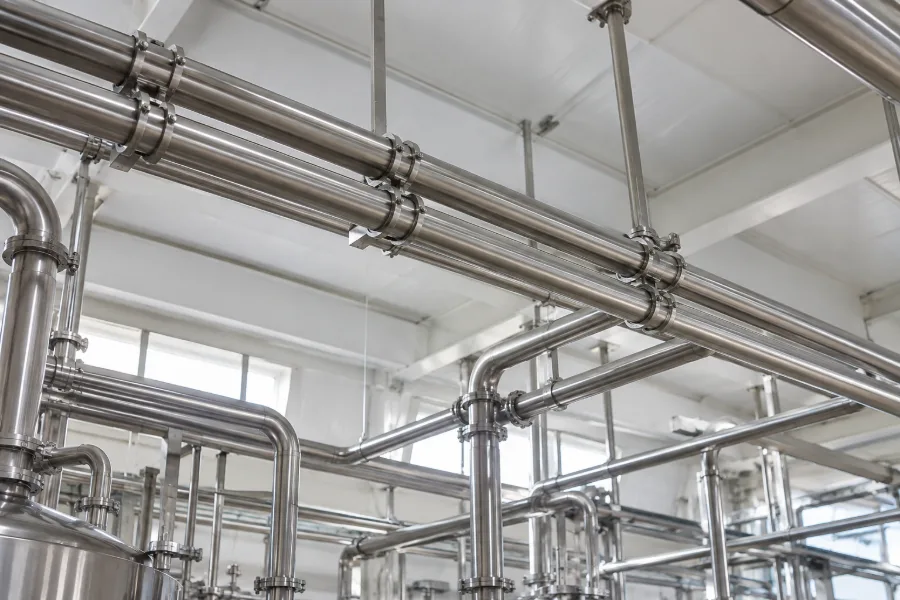
Two ways to heat a pasteurizer loop
- Tank loop: heater sized on heat-up minutes and losses
- Once-through: heater sized on the full rise at 70 gpm
- Either way, steam pressure read at the heater inlet
The pasteurizer circuit and the heater behind it
A pasteurizer loop is the most predictable circuit in a dairy: the flow is fixed by the pipe, the temperature by the soil, and the cycle by the production schedule. That makes it the easiest circuit to size well and the most common one to get wrong by sizing on the supply instead of the return.
How the circuit runs
- Chemical: Sodium hydroxide 1–2%, run hotter than the vat circuits
- Caustic temperature: 170°F at the return; up to 175°F on UHT lines
- Flow: 30 gpm in 2-inch, 70 gpm in 3-inch, 120 gpm in 4-inch
- Cycle: Caustic 30–45 min after every production run
- Acid step: Phosphoric or nitric at 130–150°F, most cycles on hard water
- Sanitize: Hot water at 180°F at the return for 5 minutes before startup
The heater we recommend
- Construction: U-tube shell-and-tube, steam inside the tubes, solution in the shell
- Tank loop duty: Heat-up of the CIP tank plus what the loop carries away
- Once-through duty: 70 gpm from 60 to 170°F is about 3.9 MBtu/h
- Materials: 316L solution side; EPDM head gasket, FKM for hot nitric
- Connections: Flanged or tri-clamp to 4 inches, matched to the skid
- What to send: Line size, loop return temperature, tank or once-through, steam psig
Sizing the heater for a line loop
Tank loop: the heater follows the tank
When the pasteurizer loop draws from a CIP tank, the heater's first job is bringing the tank to 170°F before the cycle, and its second is replacing what the loop carries away. A 1,000-gallon tank from 70 to 170°F in 30 minutes is about 1.7 MBtu/h; a 70 gpm loop returning 10°F cool adds 0.35 MBtu/h. Size for the sum and the loop will hold temperature from the first minute.
Once-through: no tank to lean on
Without a tank, the heater takes the loop's return water from whatever temperature it arrives at and delivers 170°F at the full 70 gpm, every second. The duty is the whole rise at the whole flow, and on a cold start that is 3.9 MBtu/h for a 3-inch line. The steam control valve has to follow a step change when the pump starts, so we ask for the control scheme with the quote.
- Steam at 15 psig still leaves an 80°F approach above 170°F
- A 4-inch line at 120 gpm is 6.6 MBtu/h on the same rise
- Select the control valve for the cold start, not the hold
Separators and homogenizers on the loop
A separator adds cream solids and bowl sediment to the return; a homogenizer adds high-pressure components whose seals the plant worries about more than the soil. Neither changes the heater construction, but both raise the mineral load, so the acid step runs more often on a loop that carries them. Check that every component on the circuit is rated for the 170°F caustic and the pressure the circuit pump can reach.
The sanitize water on the same loop
Pasteurizers are sanitized with hot water at 180°F for 5 minutes before startup, and in many plants that water comes from the CIP heater. A heater sized for the caustic heat-up will often carry the sanitize duty too, because the rise is similar and the flow is the same. We check both cases and size for the larger.
Pasteurizer circuit questions
If the shell is 316L and sound, usually yes. We build a new U-bundle to the tube-sheet drilling, tube count and length of the existing shell, with the same head gasket, and it slides in where the old one came out. Send the shell drawing or a set of measurements, the steam pressure at the heater and the loop flow, and we confirm the new bundle meets the 170°F duty before it is built.
Because the pasteurizer's own heating section is the coldest soil surface in the loop at the start of a cycle, and the return is the only place that tells you the whole loop is at temperature. A supply at 175°F with a return at 150°F for the first ten minutes is a cycle that is partly wasted. We size so the return reaches 170°F within the time the plant allows.
The pasteurizer's product-side gaskets are rated well above 170°F, so caustic temperature is not usually what wears them. Running cooler, say 150°F, lengthens the caustic step and leaves more protein for the next cycle to bake on. If gasket life is the concern, the acid choice matters more: phosphoric is kinder to EPDM than hot nitric, on the pasteurizer and on our heater's head gasket alike.
Any plant steam from 15 psig up will do the thermal job, because 15 psig condenses at 250°F and the caustic target is 170°F. What pressure changes is the size of the heater: at 15 psig the approach is 80°F and the bundle is larger; at 50 psig it is 128°F and the bundle is smaller. Tell us what is at the heater inlet after the control valve and we size to it.
Often not. The sanitize step is 180°F water at the same 70 gpm the caustic ran at, and a caustic heater sized for the tank heat-up usually has the capacity. Plants that sanitize the pasteurizer while the caustic tank is heating for another circuit are the exception, and they need a steam-to-water heater on the rinse line. We size both cases and tell you which applies.
Related
Applications
Milkstone & Protein Film
Milkstone forms on the heater before it forms anywhere else. How the film builds, what it costs in heat-up time, and how the heater is sized and built for it.
+ Learn More
Applications
Vat & Silo Circuits
Vats and silos are cleaned by spray devices at 100–300 gpm, so the heater's real job is tank heat-up. How the minutes you allow set the heater size.
+ Learn More
Applications
Dairy
Dairy circuits run the hottest caustic on this site and foul the heater itself. Why dairies pull bundles, and how pasteurizer, vat and silo loops differ.
+ Learn More
