
1-805-484-2992
Quotes - Engineering - SalesDairy line circuits
A fat-dominated circuit asks a different question of the heater
A centrifugal separator spins warm whole milk at 100–130°F into skim and cream, and the solids it throws out collect as sludge in the bowl and on the disc stack. The soil is therefore mostly butterfat, with fine protein and a mineral residue from the sludge, and it does not bake on the way pasteurizer milkstone does because the separator itself runs below the denaturing range. What it does do is smear. Cold fat is waxy and clings to the discs and the bowl wall, and a wash that arrives at 120°F pushes it around without removing it.
Sodium hydroxide converts fat into water-soluble soap, but the reaction needs heat. At 160°F and above, 1–2% caustic breaks down a fat film in a 20–30 minute recirculation; at 140°F the same wash needs 3% and still leaves a greasy feel on the disc stack. That is why the separator circuit, though it carries the lightest mineral load in the dairy, often runs its caustic as hot as the pasteurizer does. Heavier cream lines and buttermilk service push concentration toward 3%.
The separator is normally washed on the same line circuit as the pasteurizer it feeds, or on a small dedicated loop through a 2-inch line at about 30 gpm. Either way, a steam heater keeps the caustic hot between the supply pump and the machine, and this page covers how we size and build that heater.
Temperature does the work on fat where concentration cannot
Pushing caustic from 1% to 3% buys less on a greasy disc stack than lifting the solution from 140°F to 165°F. The heater that reliably holds 165°F at 30 gpm lets the plant run the lower strength and still get a squeak-clean bowl.
What the separator circuit runs at
Pre-rinse is where the separator differs from everything else on the line. A rinse at 100–120°F, warm enough to soften the fat, carries off most of the bowl sludge before caustic ever arrives, and a plant that pre-rinses cold spends the whole caustic step dissolving fat the rinse should have removed. Caustic at 1–2% then runs 20–30 minutes at 160–170°F. Acid at 0.5–1.5% and 120–140°F is run two or three times a week to clear the mineral the sludge leaves behind, less often than on a pasteurizer because there is little calcium phosphate to remove.
Flow is set by the line, not the machine. A 2-inch separator loop runs about 30 gpm; a separator washed in series with a 3-inch pasteurizer sees 70 gpm. Because the volume of a separator-only circuit is small, the first-pass temperature drop is mild, and the heater's duty is dominated by holding temperature against the warm, open bowl housing rather than by recovering a cold start.
The heater that suits it
At 30 gpm and a 60°F rise from a 100°F tank, the duty is about 900,000 Btu/h, which is a compact steam-to-caustic U-tube with 3/4-inch tubes in a 316L shell. Steam goes inside the tubes, where 15–50 psig gives a saturation temperature of 250–298°F and an approach of 85°F or more above a 165°F target, so even low-pressure plant steam does the job without a large bundle. Solution on the shell side keeps the fouling where it can be inspected.
What to watch is soap. Saponified fat carried back to the heater is slippery rather than hard, and it tends to collect in low-velocity corners of the shell. We lay the shell out for drainage and keep shell-side velocity up so the soap stays suspended; where the plant treats the separator loop as sanitary, the heater is built self-draining with tri-clamp connections and a 32 Ra finish. The inline once-through arrangement suits a small separator-only loop fed from a makeup line, with the heater sized for the full temperature rise at 30 gpm.
Send us these points for a separator circuit
A separator heater is a small unit, and the details below decide wether it is the right small unit. Most plants can read them off the CIP program and the line drawing.
- Whether the separator washes on the pasteurizer circuit or on its own loop
- Line size and flow: 2-inch at about 30 gpm, or 3-inch at about 70 gpm
- Pre-rinse temperature, since a cold pre-rinse shifts work onto the caustic step
- Caustic strength and target temperature, usually 160–170°F
- Steam pressure at the heater, even if it is only 15 psig
- Sanitary drainable or mill-finish utility construction
Call and talk it through with an engineer: 1-805-484-2992
Separator circuit questions
That cloud is emulsified fat and soap. The separator concentrates butterfat and solids, and when caustic hits them at temperature the fat saponifies and carries back to the tank. It is a sign the chemistry is working, but a wash that stays cloudy run after run means the pre-rinse is too cold and the caustic is doing the rinse's job. Warming the pre-rinse to 110–120°F usually clears it.
No. A 30 gpm, 60°F rise is about 900,000 Btu/h, and a U-tube unit for that duty is a short shell a person can carry with help. Small does not change the construction logic: steam in the tubes for free expansion, caustic in a 316L shell that can be opened, and a head gasket in EPDM or FKM depending on the acid step. A plate exchanger on steam at this duty would trade a small bundle for gaskets that cycle with every wash.
Yes. Fifteen psig condenses at 250°F, which is 85°F above a 165°F caustic target, and that margin is more than enough to size a compact bundle. The cost of low-pressure steam is surface, not feasibility: the bundle is somewhat longer than it would be on 50 psig. Tell us the pressure actually measured at the heater inlet after the control valve so the surface is right.
Soap can settle on the shell side where velocity is low, and it shows up as a slow loss of outlet temperature over several weeks rather than a sudden drop. Because the solution is on the shell and the bundle pulls, a visual check at the next shutdown settles it. We size with a fouling allowance of 0.001–0.002 so that build-up between inspections does not take the circuit below temperature.
Related
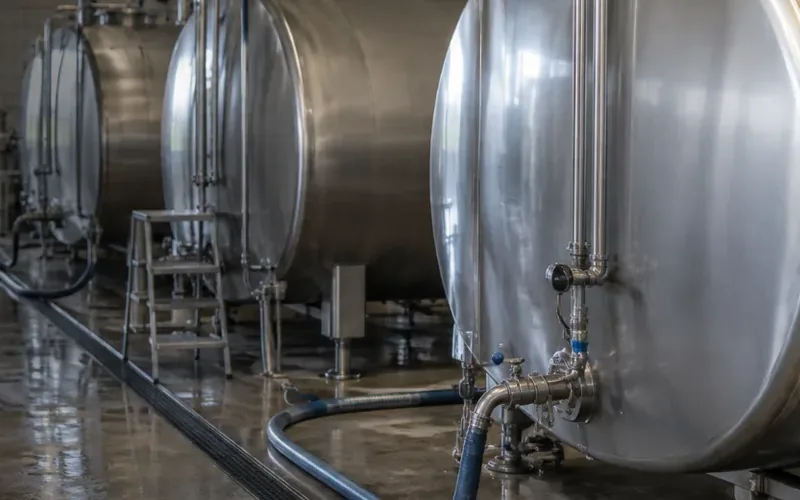
Applications
UHT & Pasteurizer Line CIP
The pasteurizer is itself a heat exchanger that bakes protein onto hot plates every shift. Its caustic heater runs hotter and more often than any other in the dairy.
+ Learn More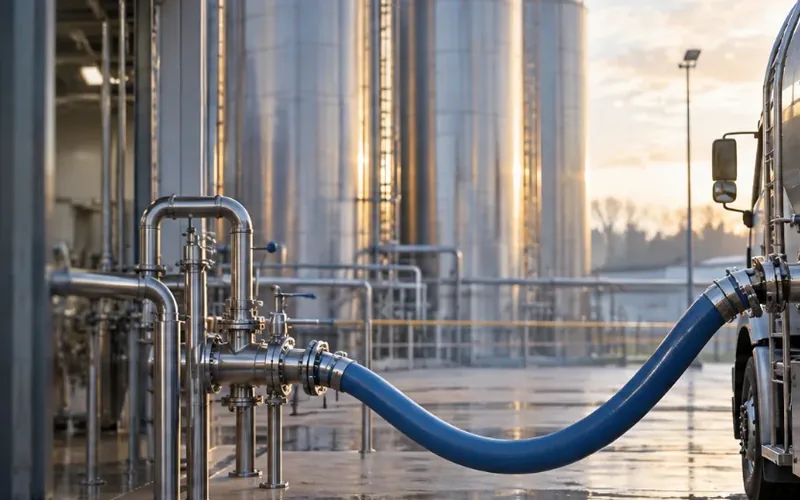
Applications
High-Pressure Homogenizer CIP
The homogenizing valve is a gap measured in thousandths of an inch and fouls faster than any pipe. Its CIP heater must hold temperature in a small, fast circuit.
+ Learn More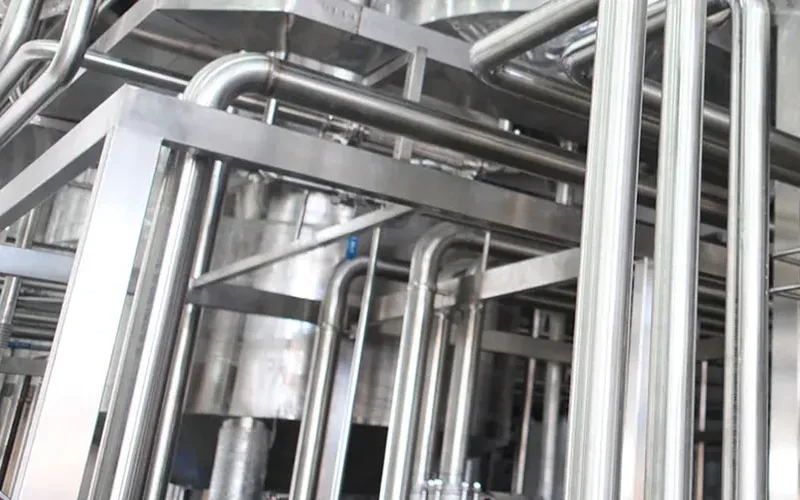
Applications
Pasteurizer & Line Circuits
HTST and UHT loops run a fixed flow at the hottest caustic in the plant. How a tank loop and a once-through heater are sized differently for the same line.
+ Learn More
