
1-805-484-2992
Quotes - Engineering - SalesThe cooler step with the harder gasket question
316L handles both acids at CIP strength and temperature without trouble; the metallurgy risk in a CIP heater is chloride from brine or softener regeneration, not the acid. Nitric is the more aggressive of the two toward elastomers because it oxidizes, and the hotter and more often it runs the shorter a standard gasket lasts. Phosphoric is gentler on everything that is not metal.
Nitric and phosphoric goes through what changes with concentration and temperature on each acid, and where chloride actually comes from.
On a shell-and-tube acid heater the only elastomer in the solution path is the head gasket, and swapping it from EPDM to FKM is a line item. On a gasketed plate pack there are hundreds of feet of gasket, and the choice is the whole exchanger.
Acid-duty gaskets sets out when EPDM survives the acid step, when it does not, and what a hardened pack looks like when it is opened.
Acid follows caustic to take off what caustic leaves: the mineral. Caustic lifts protein and fat; nitric or phosphoric acid at 0.5–1.5%, about pH 2, dissolves the calcium phosphate and carbonate scale behind them. It runs cooler, 120–150°F, and on many plants only a few times a week rather than every cycle. The heater duty is smaller than the caustic heater's, but the chemistry asks a question the caustic step never does: what happens to the gasket.
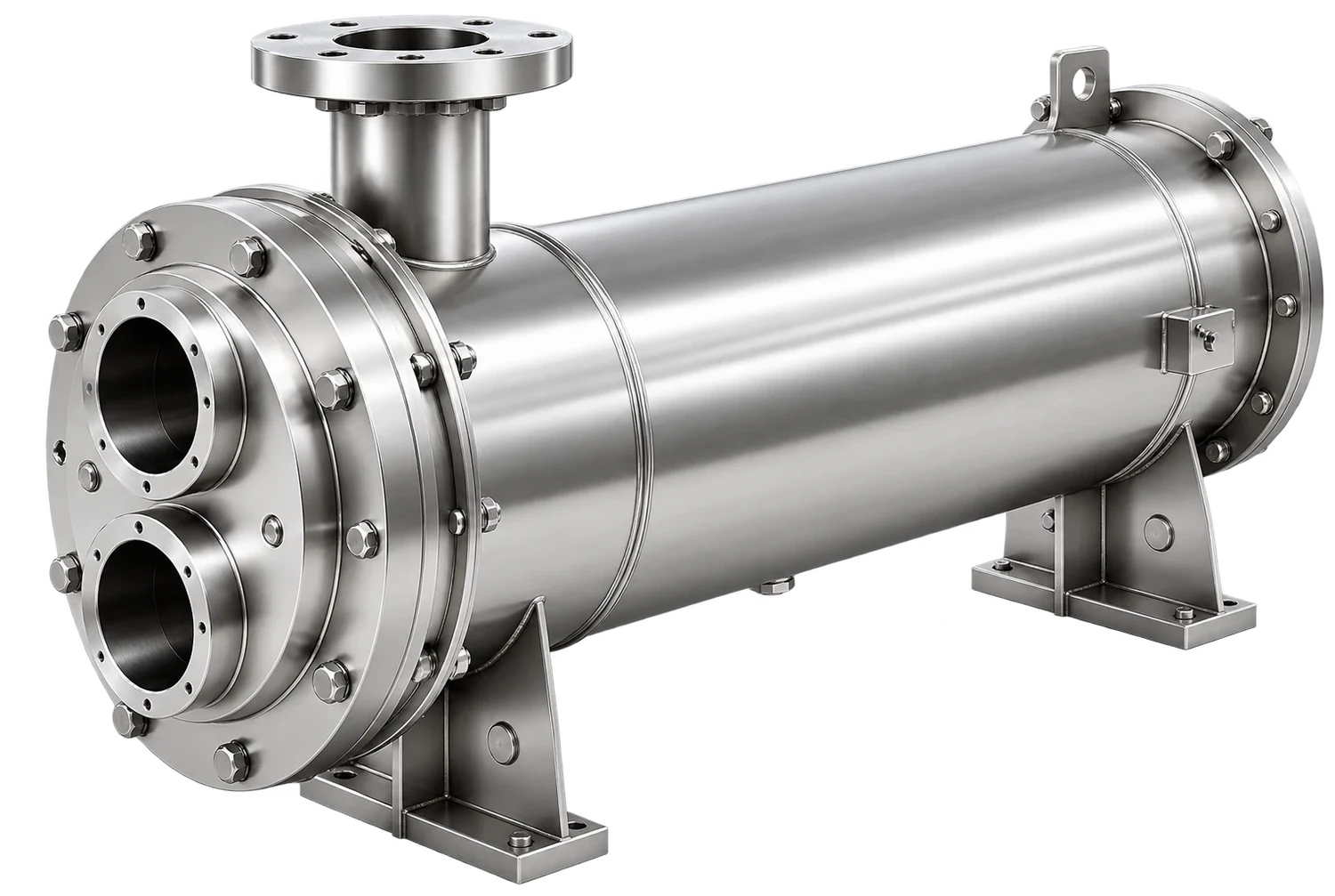
The acid step is called out on the quote, never assumed
- Which acid, nitric or phosphoric, and at what percent
- How hot and how often the acid step runs each week
- Whether acid passes through the caustic or rinse heater too
Acid cases and the construction for each
The acid heater we would quote for the cases that come up most, with the one-line reason. Each row ties back to a construction page.
| ACID CASE | CONSTRUCTION | WHY |
| Dedicated acid tank loop, phosphoric 1%, 130°F | 316L U-tube steam heater, EPDM head gasket | Phosphoric at this strength and temperature is within EPDM range; 316L is untouched |
| Dedicated acid loop, nitric 1–1.5%, 150°F | 316L U-tube steam heater, FKM head gasket | Hot, oxidizing nitric hardens EPDM over a season; FKM holds |
| Single supply heater, caustic then acid then rinse | 316L U-tube sized for caustic, FKM head gasket | Sized by the caustic rise, gasketed for the acid step it also sees |
| Acid heated from plant hot water, no steam | Gasketed plate pack, FKM gaskets | Liquid-to-liquid at modest pressure suits plates; nitric rules out EPDM |
| Plate pack whose gaskets hardened after the acid step | New plate pack in FKM to the existing frame | The frame is fine; the elastomer was wrong for the chemical |
Four things the acid step changes
Most of the acid heater is the caustic heater at a lower temperature: 316L, steam in the tubes, solution in the shell. The differences are in the gasket, the duty, the fouling and how the heater is shared. Settling these four turns an acid heater into a quote without a long call.
Elastomer
EPDM is the standard gasket on caustic and hot water and is rated to about 300°F. Hot nitric oxidizes it, and a gasket that went in soft comes out hard and cracked after a few months of acid steps. FKM is the answer on nitric duty; phosphoric at 120–150°F usually stays on EPDM.
Duty
- 120–150°F target, 20–40°F below the caustic step
- 10–20 minutes per cycle, a few times a week
- Smaller Btu/h than caustic at the same gpm
- Still sized for a cold start on the acid tank
Fouling
Acid dissolves the mineral the caustic step left, so the acid heater runs cleaner than the caustic one. The solution side still gets a fouling allowance of 0.001–0.002 because carry-over protein arrives with the first acid pass, but bundle pulls are rare on a dedicated acid loop.
Sharing
On single-use CIP the same heater sees caustic, acid and rinse in sequence. Then the surface is sized for the caustic rise and the gasket is chosen for the acid. Say so on the inquiry; a heater quoted as a caustic heater and later handed nitric is the usual way a gasket fails.
Acid step questions
No. Nitric is an oxidizing acid and 316L relies on an oxide film, so at 0.5–1.5% and 150°F the two get along. Phosphoric is equally benign at that strength. The 316L problem in CIP is chloride: brine, softener regeneration water or a chlorinated sanitizer left in a hot loop. Keep those away from a hot heater and the acid is not the issue.
Because the mineral dissolves readily at 120–150°F and running hotter only shortens gasket life and wastes steam. Caustic needs the heat to denature and lift protein; acid is doing a different job on a surface the caustic already cleared. The lower temperature is also why the acid heater can usually be smaller than the caustic heater on the same circuit.
Plant chemistry and water hardness decide that, not the heater. Hard-water dairies may run acid daily; a brewery on soft water may run it weekly. For heater sizing it matters because an infrequent step means a cold acid tank at every start, so the heat-up duty is set by the tank volume and the time allowed, exactly as on the caustic tank.
On a shell-and-tube, yes: the solution-side head gasket is the only elastomer in the path, and a new one in FKM is a quick swap at the next opening. On a gasketed plate heater the gaskets are the exchanger, so the realistic answer is a new plate pack in FKM, which we supply to fit the existing frame.
On the gaskets, clearly: phosphoric is not oxidizing and EPDM usually lives with it at CIP strength and temperature. On the metal there is no difference at these concentrations; 316L is fine with both. If the plant alternates acids or might switch programs, specify the heater for nitric and phosphoric comes along at no extra cost.
Related
CIP Heaters
Nitric & Phosphoric
Two acids, one alloy. What nitric and phosphoric each do to steel and elastomer at wash strength, and how concentration and temperature move the answer.
+ Learn More
CIP Heaters
Acid-Duty Gaskets
The acid step is the test every plate gasket has to pass. Why EPDM is right on caustic and wrong on hot nitric, and how to specify the pack before it fails.
+ Learn More
CIP Heaters
Caustic Heaters
Steam into a sodium hydroxide loop at 140–175°F: how the U-tube heater is built, and whether the tank loop or the supply line is the right place to put it.
+ Learn More
