
1-805-484-2992
Quotes - Engineering - SalesSoil that went on at 212°F does not come off at 140°F
A sauce or soup cook room is the hardest caustic duty on this site. Starch, fat, tomato solids and protein were cooked onto the kettle wall, the agitator and the transfer lines at boiling temperature, and some of it caramelized where the jacket ran hot. Caustic that is fine for a cold tank does nothing here. Cook-room sanitation runs sodium hydroxide at 2–3% and 170–175°F, holds it for 45 minutes rather than 20, and still expects a second pass on a bad batch. The acid step that follows is for the hard-water and phosphate scale underneath, not for the soil.
That duty puts two loads on the heater at once. The caustic tank has to be at 175°F when the kettles are emptied, and it has to stay there while 70–120 gpm circulates through cold stainless kettles and comes back carrying fat and starch. The heater is therefore a tank-loop unit sized for heat-up, with enough margin to hold temperature against a loaded return. A heater that only manages the hold leaves the tank at 155°F when the cycle timer starts, and the crew compensates by stretching the wash or by hand-scrubbing the kettle afterward.
The return is dirty. Fat saponifies in the hot caustic and starch gels, and both reach the heater. We build the kettle-line heater as a U-tube with the bundle removable, 316L on the solution side, and a solution-side fouling allowance at the high end.
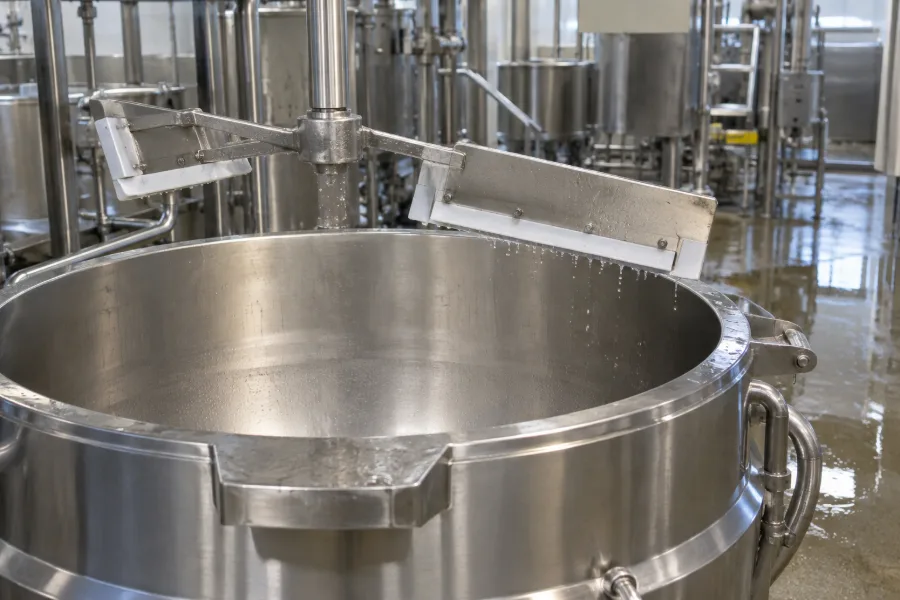
A kettle-line caustic heater holds 175°F against a cold, dirty return
- Sodium hydroxide at 2–3% strength and 170–175°F for 45 minutes
- Saponified fat and gelled starch foul the solution side only
- The bundle comes out through a clearance left on the drawing
The cook room circuit and the heater that keeps up
The left column shows how a sauce, soup or tomato line runs its caustic; the right column is the heater we build for it. Duty figures are for a 2,000-gallon tank.
Kettle-line caustic in practice
- Chemical: Sodium hydroxide 2–3%, chlorinated or with a surfactant on fatty sauces
- Temperature: 170–175°F caustic; acid 130–150°F; hot rinse 140°F
- Flow: 70–120 gpm on 3- and 4-inch kettle outlet lines; 100–200 gpm on a spray device
- Cycle: Caustic 45 minutes, acid 15–20 minutes, full cycle close to 90 minutes
- Soil: Caramelized starch and sugar, cooked tomato, saponified fat, meat and dairy protein
- Steam available: Cook rooms usually have 100–125 psig; the heater needs 15–50 psig after the valve
The heater we recommend
- Construction: U-tube shell-and-tube tank heater, steam in the tubes, caustic on the shell
- Duty: 5.25 MBtu/h to reach 175°F in 20 minutes on 2,000 gallons; 1.75 MBtu/h in 60 minutes
- Materials: 316L shell, bundle and heads; EPDM head gasket, FKM where nitric is the acid
- Fouling allowance: 0.002 on the caustic side, roughly 20% extra surface over clean
- Connections: 150-pound flanges on the utility loop; tri-clamp where the plant asks
- Send us: Tank gallons, minutes to temperature, kettle count and volume, steam psig at the heater
What a cook-room caustic heater has to put up with
Fat in the caustic
Hot sodium hydroxide turns animal and vegetable fat into soap, which is the point, but soap in a recirculating tank foams, coats the tank wall and plates out on the hottest surface in the loop: the steam-tube wall at 300°F and more. The deposit insulates, the outlet temperature falls, the operator opens the steam valve, and the hotter wall bakes the deposit harder. The cure is mechanical: pull the bundle at the interval the soil load dictates and clean the shell side.
- Order the bundle removable and show the pull length on the layout
- Keep steam pressure at the heater to 15–50 psig; hotter tube walls cook the soap on faster
- Skim or dump the caustic tank more often on a fatty sauce line
Starch and the acid step
Gelled starch swells in hot caustic and is lifted off the kettle, but the mineral left behind, calcium and phosphate from stock, dairy and hard water, needs nitric or phosphoric acid at 0.5–1.5% and 130–150°F. Cook rooms that run acid weekly rather than daily find the heater losing capacity between acid washes as the carbonate and phosphate scale builds.
Steam pressure in a cook room
Cook rooms are rich in steam. The 100–125 psig header that feeds the kettle jackets usually feeds the CIP heater too, and we still ask for 15–50 psig at the heater inlet after the control valve. Saturated steam at 125 psig is 353°F, and a tube wall that hot bakes soap and starch onto the shell side faster than the caustic can lift it, while 50 psig at 298°F still leaves more than 120°F of approach to a 175°F target.
Two kettles or ten
A single 500-gallon kettle washed once a shift and a bank of ten kettles on a staggered schedule draw from the same tank very differently. Ten kettles mean the caustic never rests and the return is always cold and loaded; one kettle means a heat-up problem followed by a light hold. Tell us how many vessels, how large, and how the schedule stacks them; that decides whether the tank recirculation heater is sized for heat-up or for the loaded hold.
Questions from the cook room
Usually because the heater was sized to hold a hot tank, not to lift a cold one. A 2,000-gallon tank that cooled to 70°F overnight needs about 5.25 MBtu/h to reach 175°F in 20 minutes, and a heater sized for an hour of warm-up delivers a third of that. The other cause is steam pressure: 100 psig at the header becoming 10 psig at the heater while the kettles cook.
We do not recommend it here. The return carries fat, starch and particles that bridge a 3–5 mm plate channel, and the steam side would cycle a gasketed frame on and off against pressure every wash. A U-tube shell-and-tube passes the soil, takes the steam cycling without stress, and gives up its bundle for cleaning. Plate earns its place on this line recovering heat from the return.
It depends on fat load and on how often the plant runs acid. A line that runs acid every day and skims the caustic tank may go a year; a fatty line running acid weekly may need the bundle out every quarter. The signal is the steam valve creeping open over weeks at the same outlet temperature. Leave the pull clearance and the interval becomes a maintenance choice.
No. 316L is comfortable with sodium hydroxide well past 3% at 175°F, and EPDM gaskets are rated for it. The stronger solution matters for safety handling and for how fast it saponifies fat, not for the heater metallurgy. What does change at 3% is the carbonate scale rate when CO2 is present and the amount of soap produced on a fatty line, both of which argue for the removable bundle.
The soil is lighter, mostly starch, chlorophyll and hard-water scale, and the caustic can run at 140–150°F and 0.5–1%. The circuit is long and open, so heat loss to the equipment is larger than on a kettle, and the acid step depends on the water, since blanch water on a hard supply leaves carbonate. The same U-tube heater serves; the sizing shifts toward volume and hold time.
Related
Applications
Egg & Puree Pasteurizers
Egg albumin cooks onto a pasteurizer faster than milk does, so the line cleans every few hours. The heater that keeps a caustic tank at 165°F through that schedule.
+ Learn More
Applications
Meat, Pet Food & Brine
Fat wants the caustic hot and salt wants the stainless cool. Where the chloride line falls for a 316L heater, and how brine plants keep salt out of the caustic loop.
+ Learn More
Applications
Food Plants
Food soils are the heaviest we heat against: hotter, stronger caustic, bigger tanks and a chloride check for brine plants. How the heater is sized for each.
+ Learn More
