
1-805-484-2992
Quotes - Engineering - SalesWater loop
Heating a purified water loop for hot sanitization
A purified water loop is different from every other circuit on this site because the cleaning fluid is the water itself. There is no caustic and no acid in routine service; the loop is kept in control by velocity, by draining the dead legs, and by a periodic hot sanitize step that brings the storage tank and the whole distribution ring to 180°F and holds it there, often for an hour. Where the loop also feeds the final rinse of the plant's tank and line CIP, the same heater supplies that rinse water hot. The soil is biofilm, which does not foul a heater but does survive anything short of a proper thermal hold, so the heater is sized to a temperature and a time rather than to a chemical.
The loop runs continuously at 3–5 ft/s, which in a 2-inch ring is 20–30 gpm, and the storage tank behind it holds 1,000–3,000 gallons. A hot sanitize step therefore has two parts: a ramp, in which the tank contents and the ring are lifted from ambient to 180°F, and a hold, in which the heater only replaces what the insulation loses. The ramp sets the heater size. Taking 1,000 gallons from 70 to 180°F in 30 minutes is about 1.8 MBtu/h; the same ring held at temperature afterward may need a tenth of that.
Size the loop heater on the ramp, run it on the hold
Lifting a 1,000-gallon purified water tank and ring from 70 to 180°F in 30 minutes takes about 1.8 MBtu/h, roughly 1,900 lb/h of 15 psig steam. Once the loop is hot, the steam valve closes to a crack and the same heater simply holds it.
What the loop needs from a heater
Purified water is low in conductivity and has no chlorides to speak of, so 316L on the water side is a quality requirement rather than a corrosion one. What the water side does demand is cleanliness: every surface the loop touches must drain, must have no crevice to shelter biofilm, and must itself reach 180°F during the hold. A heater with a pocket of standing water at the bottom of the shell is a place the sanitize step never reaches, which is why the shell is sloped to a low-point drain and the connections are tri-clamp.
The hold temperature is set by the site's own water specification, commonly at least 180°F at the coldest point in the ring, and the return RTD is what proves it. Because the ring loses heat to the room continuously, the heater outlet runs 5–10°F above the return reading. That difference is small on a well-insulated loop and large on one that runs through a cold warehouse, so we ask for the ring length and whether it is insulated before we fix the outlet set point.
A steam-to-water shell-and-tube for the loop
The construction is a U-tube shell-and-tube with plant steam in the tubes and purified water in a 316L shell, built drainable with a 32 Ra interior and tri-clamp ends. Steam is on the tube side so that the water side, the sanitary side, has no gasketed plate joints; the bundle comes out for inspection and the shell wipes clean. A gasketed plate pack is the wrong tool here even though the duty is water-to-water in scale, because the plate side cannot be shown to drain and the gaskets live inside the sanitary boundary.
At 1.8 MBtu/h the heater condenses roughly 1,900 lb/h of 15 psig steam at 250°F; the approach above a 180°F outlet is 70°F and the bundle is short. On 50 psig steam it is shorter still, but we size the control valve for the hold, when the duty falls to a fraction of the ramp, so that the outlet does not hunt above set point and send water to the ring hotter than the specification allows. Shell-side rating is 150 psig at 250°F; the loop pump pressure is well inside it.
For a purified water loop quotation
Loop heaters are sized from the tank, the ring and the clock. These are the figures that let us fix the surface and the valve.
- Storage tank volume and loop pipe size
- Ring length, and whether it is insulated
- Sanitize set point at the return and the hold time
- Minutes allowed for the ramp from ambient
- Steam pressure at the heater inlet
- Whether the loop also feeds hot CIP rinse water, and at what gpm
Call and talk it through with an engineer: 1-805-484-2992
Water loop questions
Some site specifications ask for it, most do not. Steam is on the tube side at a higher pressure than the water, so a tube leak would push condensate into the water, and the loop's conductivity monitor would see it at once. Where the specification requires a double-wall construction we quote it; the default is a single-wall 316L U-tube with the steam at 150 psig and 400°F rating.
Yes, and it is a common arrangement. The loop heater is sized for the sanitize ramp, which is the larger duty, and the rinse draw of 30–70 gpm at 120–140°F is taken from the hot ring or lifted from ambient on demand. The one check is that a rinse draw during a sanitize hold does not pull the ring below its 180°F set point; a control sequence that blocks one during the other settles it.
Because the water side has to drain and has to be inspectable, and a gasketed plate pack is neither. The gaps between plates hold water, the gaskets sit in the sanitary boundary, and the pack has to be opened to look at it. A shell-and-tube with the water in a sloped 316L shell drains to one tri-clamp fitting and its bundle pulls for inspection on the schedule the site sets.
The upper limit is the site specification and the plant's own gaskets, not the heater; most loops are held between 180 and 190°F, and we rate the shell to 250°F so there is no equipment limit near the operating point. The risk is overshoot during the ramp, when a wide-open valve meets a tank that is nearly hot. A valve sized for the hold avoids it.
Related
Applications
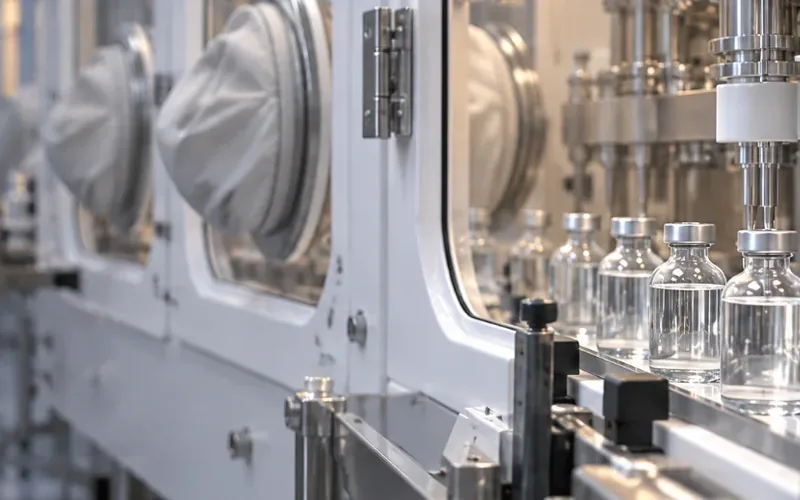
Vaccine Production Equipment CIP
Bioreactors, media and buffer vessels in a vaccine suite are cleaned often. The heater that gets each vessel's caustic and hot rinse to set point, on record.
+ Learn More
Applications
Antibiotic Fluid Lines CIP
Lines carrying fermentation broth and antibiotic concentrate are washed as a line circuit at 5 ft/s. The once-through heater that holds temperature over the run.
+ Learn More
Applications
Tank Sterilization & CIP
A tank that goes into sterilization dirty comes out sterile and dirty. The heater behind the caustic, acid and hot rinse steps that make the tank ready for it.
+ Learn More