
1-805-484-2992
Quotes - Engineering - SalesDairy heavy soils
The circuit with the most mineral per gallon, and a part of it that must not run hot
Whey is roughly 93% water carrying lactose, soluble minerals and the whey proteins that did not go into the curd. A whey plant then concentrates it, by membrane to a protein concentrate and by evaporator to a solids level the dryer can take, and every stage raises the concentration of calcium and phosphate against the hot wall. Beta-lactoglobulin denatures above 160°F and binds that mineral into milkstone, so the evaporator calandrias, preheaters and whey pasteurizer run with the heaviest scale in the dairy, and the acid step runs every day, not weekly.
The membrane stages are the opposite problem. Ultrafiltration and nanofiltration elements have a hard temperature ceiling, commonly about 120–130°F, and a wash that drifts to 150°F destroys them. Their chemistry is milder too, often a lower-strength caustic or an enzymatic step the membrane supplier approves. So a whey plant CIP system has two heater duties that look nothing alike: hot, strong caustic at 165–175°F for the evaporators and preheaters, and a tightly controlled 120–130°F solution for the membranes that must never overshoot.
We size and build the steam heaters for both. This page is about those heaters, how the whey soil changes the surface we put in them, and why the membrane heater is specified by its control, not its capacity.
On whey, the fouling allowance is not a formality
An evaporator caustic heater that is clean at commissioning loses as much as 20% of its capacity within weeks as carbonate and milkstone build on the shell side. We size whey duty with a fouling allowance of 0.002 so the circuit still reaches 175°F before inspection.
The circuit as a whey plant runs it
Evaporator and preheater circuits run caustic at 1.5–2% and 165–175°F for 30–45 minutes, followed by nitric or phosphoric at 1–1.5% and 130–150°F for 15–20 minutes, every production day; some plants alternate caustic and acid or run acid first because the mineral layer sits on top of the protein. Flows follow the line and the calandria: a 4-inch circuit at 120 gpm is common, and a large multi-effect evaporator may be washed in sections to keep the circuit within the CIP pump.
Membrane circuits run at the element's limit, 120–130°F, with lower caustic strength and frequent acid for mineral, and flow matched to the feed pump so each element sees the design crossflow. The heater on that loop may only need to lift makeup water 50°F, but it must do so with no excursion, which argues for a smaller unit on lower-pressure steam with a well-sized control valve rather than a large heater throttled down.
Two heaters, two designs
For the evaporator and preheater circuits, a steam-to-caustic U-tube in 316L with steam inside the tubes, 150 psig at 250°F on the shell, 3/4-inch tubes, and a fouling allowance of 0.002 rather than 0.001. The daily acid step is a design input, not an afterthought: the head gasket is FKM when nitric is used, and we expect the bundle to come out for inspection a few times a year, so the layout leaves pulling room. At 120 gpm and a 60°F rise the duty is about 3.6 MBtu/h.
For the membrane loop, a smaller steam-to-water or steam-to-solution shell-and-tube chosen so that 15 psig steam, condensing at 250°F, is enough, because the lower the steam temperature the smaller any overshoot on a valve fault. A gasketed plate exchanger in EPDM is a fair alternative here, using the hot evaporator return as the heating medium, which both recovers heat and caps the solution at a temperature the elements can take.
What to send for a whey circuit
Tell us which stage each heater serves. An evaporator heater and a membrane heater sized from the same data sheet will both be wrong.
- Stage served: whey pasteurizer, preheater, evaporator effect, or membrane loop
- Circuit flow in gpm and line size
- Caustic and acid concentration and the daily sequence
- Target temperature, 165–175°F on evaporators, 120–130°F on membranes
- Membrane element temperature limit from the element data sheet
- Steam pressure at the heater, and whether 15 psig is available
- Space to pull a bundle on the evaporator heater
Call and talk it through with an engineer: 1-805-484-2992
Whey line questions
Because whey carries more dissolved mineral per gallon, and the evaporator concentrates it further, so more carbonate and calcium phosphate come back in the caustic and precipitate on the hot shell side of the heater. The steam side stays clean. Sizing with a fouling allowance of 0.002 instead of 0.001 adds roughly 20% surface and buys the weeks between bundle inspections.
Not without a way to cap the temperature, because a 170°F caustic tank is 40°F above a typical membrane limit. Plants that do it blend in cold makeup or use a plate exchanger against the evaporator return to bring solution down to 125°F before the elements. A separate small heater on low-pressure steam with its own control loop is the simpler path and keeps a valve fault from costing a set of membranes.
Not the metal. 316L is unaffected by nitric at 1–1.5% and 150°F. The only part that cares is the head gasket, and daily nitric is precisely the case for FKM instead of EPDM. Order it that way from the start. The acid step also helps the heater, because it dissolves the mineral scale on the shell side each day instead of letting it harden over a month.
A 4-inch circuit at 120 gpm lifted 60°F needs about 3.6 MBtu/h, which at 15 psig steam condenses around 3,700 lb/h; with 50 psig at the inlet the bundle is noticeably shorter. Adding the 0.002 fouling allowance makes it larger than the same gpm on a milk line. Send the actual flow and the steam pressure measured at the heater, and we will size it rather than guess.
Related
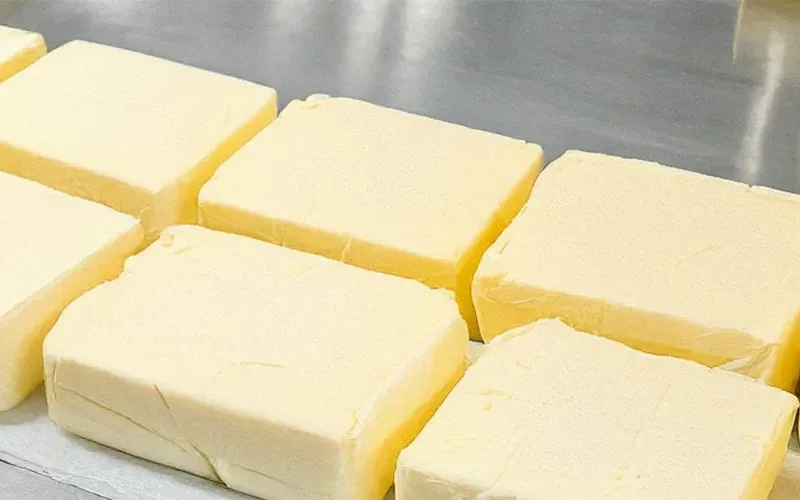
Applications
Butter Plant CIP
Churns, cream ripening tanks and buttermilk lines leave more fat per square foot than anything else in dairy. The heater behind them works harder than its gpm says.
+ Learn More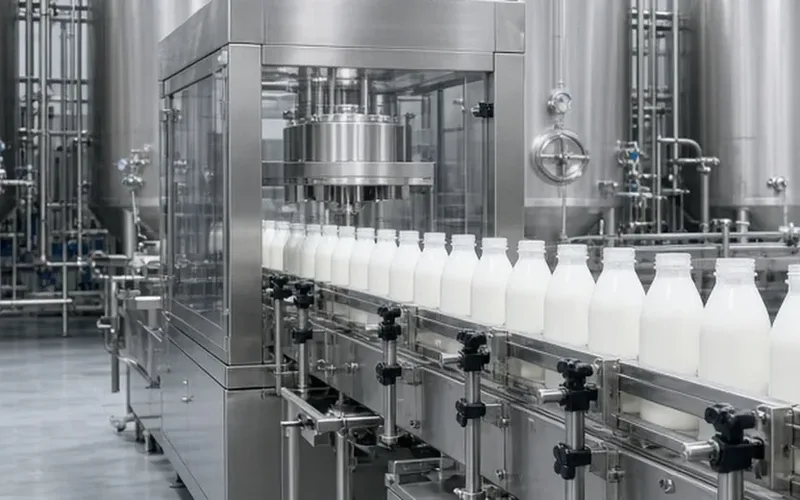
Applications
Milkstone & Protein Film
Milkstone forms on the heater before it forms anywhere else. How the film builds, what it costs in heat-up time, and how the heater is sized and built for it.
+ Learn More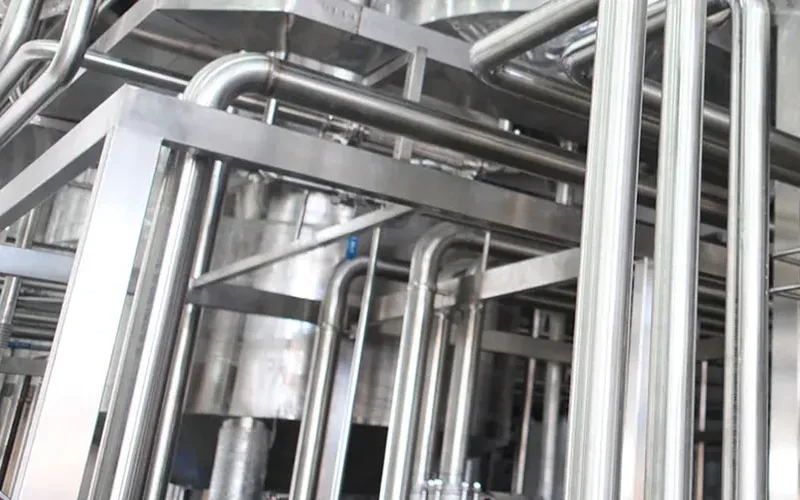
Applications
Pasteurizer & Line Circuits
HTST and UHT loops run a fixed flow at the hottest caustic in the plant. How a tank loop and a once-through heater are sized differently for the same line.
+ Learn More
