
1-805-484-2992
Quotes - Engineering - SalesFermenter circuits
The tank wall is a heat exchanger working against you
The interior of a fermentation tank, in a brewery, cidery or any beverage plant that ferments, carries a predictable set of soils. A ring of dead yeast, coagulated protein and hop or fruit solids forms at the top of the fill as the foam collapses, a thinner yeast film coats the cone and the wall below the liquid line, and over months a calcium oxalate scale builds wherever the surface stays wet and alkaline during cleaning. Manways, sample valves and the racking arm carry the same film into places the spray does not hit squarely.
What makes the fermenter interior different from a vessel of the same size in a dairy is the wall itself. The tank is jacketed and was holding product at 32–55°F until it was emptied, and the glycol in that jacket may still be circulating when CIP begins. Caustic sprayed onto that wall loses heat to the steel and then to the glycol, and a 160°F supply can return at 120°F for the whole first pass. Add a headspace full of carbon dioxide, which converts caustic to carbonate and robs it of strength, and the circuit runs cooler and weaker than any brewhouse wash, 140–160°F at 1–2%.
The steam heater on the supply side of that circuit is what we build, and it is sized for the cold wall rather than the soil.
Shut the glycol off before you blame the heater
Caustic at 140°F sprayed into a 40°F fermenter with the jacket still running is heating glycol, not cleaning steel. The return never climbs and the heater looks undersized. Isolate the jacket for CIP and the same heater holds 140°F with ease.
The fermenter interior circuit
CO2 purge or vent first, then a pre-rinse at ambient to 100°F that carries off the loose yeast; a hot pre-rinse on a cold tank wastes heat into the wall. Caustic at 1–2% and 140–160°F for 20–30 minutes through the spray device, which on a 100 to 400-barrel fermenter means 50–150 gpm; cone-bottom tanks need the cone and racking arm flooded as well. Acid at 0.5–1.5%, phosphoric most often, follows every caustic cycle on many cellar programs because it also removes the oxalate and leaves the surface at a pH the next fill tolerates.
The numbers that matter to the heater are the first-pass return and the holding load. A 400-barrel tank at 40°F with its jacket isolated returns the first pass of 150 gpm about 25°F below supply, which the heater must recover at about 1.9 MBtu/h. With the jacket still on there is no recovering it; the glycol chiller absorbs whatever the heater adds, the most common reason a cellar wash fails to reach temperature.
The heater for it
A steam-to-caustic U-tube in 316L, steam inside the tubes and solution in the shell, rated 150 psig at 250°F on the solution side, sized for the first-pass recovery of the largest cold tank on the set: 150 gpm lifted 25°F is about 1.9 MBtu/h and condenses roughly 2,000 lb/h of 15 psig steam. Because cellar caustic targets are modest, 140–160°F, even 15 psig steam at 250°F leaves a 90°F approach and the bundle stays compact. A free-expanding U-bundle takes the on-off steam cycling of several tank washes a day without stressing a fixed tubesheet.
Calcium carbonate, formed when CO2-laden caustic meets hard makeup water, is the fouling to expect, and it lands on the hottest surface, the outside of the heater tubes. We carry a fouling allowance of 0.001–0.002 and build the bundle to pull, so a cellar that purges poorly can see the scale. The head gasket is EPDM on phosphoric programs and FKM where nitric is run hot. A plate exchanger warming makeup water against the hot return takes 60–70% of the heat back and shrinks the steam load; see the return-to-makeup page.
Send us the fermenter circuit like this
The coldest and largest tank on the set sizes the heater. Give us that tank, and say whether the jacket can be isolated.
- Largest fermenter in barrels and its temperature when CIP starts
- Whether the glycol jacket is valved off during the wash
- Spray flow in gpm and whether the cone is flooded
- Caustic strength and target, 140–160°F
- Acid used after caustic, phosphoric or nitric
- Steam pressure at the heater inlet
- CIP tank volume and the time allowed to heat it between tanks
Call and talk it through with an engineer: 1-805-484-2992
Fermenter questions
First check whether the glycol jacket is still cooling the tank during CIP; if it is, the chiller takes everything the heater puts in and no heater will win. If the jacket is isolated and the return still lags, measure the steam pressure at the heater inlet during the wash and compare the first-pass drop with what the heater was sized for.
The soil does not need it and the tank punishes it. Yeast film and protein lift at 140°F with 1–2% caustic, while every degree above that is lost faster into the cold wall and the CO2-rich headspace. Hotter caustic also stresses the fermenter's own gaskets.
Indirectly. CO2 converts sodium hydroxide to sodium carbonate, which with hard water precipitates calcium carbonate on hot surfaces, so a cellar that does not purge sees a slow build of scale on the outside of the heater tubes and a gradual loss of outlet temperature. Purging the headspace before the wash protects the caustic strength and the heater at once.
It decides the head gasket and little else. Phosphoric acid at 0.5–1.5% is gentle on EPDM, and most cellars use it. Nitric run hot after every cycle calls for FKM. The 316L shell and bundle are unaffected either way, and the acid pass helps by dissolving carbonate off the shell side of the heater.
If both run through one heater at once, the recovery duty doubles to about 3.8 MBtu/h for two 150 gpm circuits each 25°F down. Most cellars stagger the two by ten or fifteen minutes so a heater sized for one recovery handles each in turn. Decide which, because it is the largest factor in the heater's size.
Related
Applications
Brewery CIP
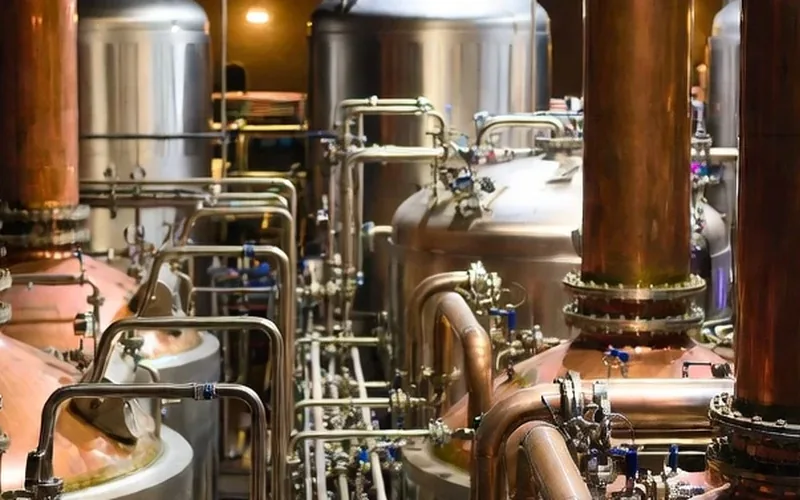
Kettles and whirlpools wash hot with heavy caustic against hop resin and beerstone; fermenters wash cool with CO2 pulling the strength down. One heater serves both.
+ Learn More
Applications
Wine Fermentation Tank CIP
Wineries clean more with hot water than with chemicals. The heater on a fermentation tank circuit is sized for rinse and sanitize gallons; caustic is lighter duty.
+ Learn More
Applications
Brewhouse & Fermenter
Kettles want hot caustic, fermenters knock it cold and CO2 turns it to carbonate. How we size the brewery caustic heater around the cellar instead of the brewhouse.
+ Learn More
