
1-805-484-2992
Quotes - Engineering - SalesWinery circuits
Tartrate, pigment and a seasonal rush decide the winery heater
A wine fermenter leaves three soils. Potassium bitartrate crystallizes out of the wine onto cold tank walls as a glassy crust, thickest where the tank was chilled during cold stabilization; anthocyanin pigment and tannin from red fermentations stain the stainless; and a yeast and lees ring forms at the wine line. None of this is a cooked protein film, and none of it needs the strength a dairy or a brewhouse uses. Tartrate dissolves readily in hot water and more quickly in mild caustic, pigment lifts with light caustic, and the lees rinse away.
So the winery circuit is built around temperature rather than chemistry. A hot-water rinse at 140–160°F does most of the work, a caustic step at 0.5–1% and 140–150°F follows where tartrate is heavy, a dilute acid rinse neutralizes and brightens, and a hot-water sanitize at 180°F or above replaces chemical sanitizers in many cellars because wine is sensitive to residues. The tanks are jacketed and often cold when the wash starts, so the first pass loses heat fast.
The other fact is the calendar. A winery cleans a few tanks a week for ten months and then, at crush, washes every fermenter in the building between fills. The heater has to be sized for crush, and this page is about how we size the steam heater that supplies hot water and light caustic to the fermenter circuit.
Crush sets the gallons, and the gallons set the heater
At harvest a mid-sized cellar may want 100 gpm of 180°F sanitize water for hours at a time. Raising that from 60°F well water is 6 MBtu/h, four times what the same winery needs in March. The heater is sized for September.
What the fermenter circuit runs
Hot-water rinse at 140–160°F for 10–15 minutes through the tank's spray device at 50–100 gpm, with tartrate coming off as the wall warms. Caustic at 0.5–1% and 140–150°F for 15–20 minutes where crust or pigment remains, which on red tanks is most of the time. A dilute acid pass at ambient to 120°F brings the surface back to a low pH. Then hot water at 180–190°F circulated until the return holds 180°F for 5 minutes or more, which on a cold 10,000-gallon tank can take a while.
Cold tanks drive the duty. A jacketed fermenter that came off cold stabilization at 30°F pulls the first pass of 180°F water down to 130°F, and the heater has to bring the return back up while the circuit runs. Many wineries also draw hot water from the same heater for barrel work and floor sanitation at the same time, so the demand at crush is the sum of several users rather than one circuit.
The heater we recommend
Because the dominant duty is water, not chemical, a steam-to-water shell-and-tube in 316L, steam inside the tubes, sized for the crush sanitize demand: 100 gpm from 60°F to 180°F is about 6 MBtu/h, condensing around 6,300 lb/h of 15 psig steam. The same unit heats the light caustic and the rinse at lower duty, and 316L shrugs off 1% sodium hydroxide and the dilute acid pass. At 15 psig the saturation temperature is 250°F, a 70°F approach to a 180°F target, so the bundle is somewhat larger than a 165°F caustic heater of the same gpm.
Where the winery already has a hot-water source, such as a sanitize return, and treats the circuit as pure hot water, a gasketed plate exchanger with EPDM gaskets is an alternative for the rinse duty at 150 psig and below. It falls short the moment steam is on it, and the frequent on-off cycling of a crush schedule is hard on plate gaskets, so for most wineries the shell-and-tube with a removable bundle is the unit that is still working in ten harvests. Tartrate on the shell side is soft and dissolves in the next hot rinse.
What a winery should send
Think about the busiest hour of crush rather then an average week, and tell us everyone who draws hot water from this heater.
- Peak hot-water demand at crush in gpm, and the target, often 180°F
- Well or city water temperature in September
- Largest fermenter volume and its temperature when washing starts
- Caustic strength and temperature where it is used
- Steam pressure at the heater, even if the boiler is small
- Whether the circuit is tri-clamp sanitary or utility stainless
Call and talk it through with an engineer: 1-805-484-2992
Winery tank questions
Yes, because the day you need caustic on a tartrate crust you will run it through the same heater, and 316L on the solution side costs little more than a water-only design. It also means the heater is already right if the cellar moves to a routine light-caustic step. What you do not need is the heavy fouling allowance a dairy heater carries; tartrate is soft and redissolves in hot water.
Two reasons. The target is 180°F for sanitize rather than 165°F, so with 15 psig steam the approach shrinks from 85°F to 70°F and more surface is needed for the same duty. And the winery heater is sized for the crush peak, when several users pull hot water together, rather than for one circuit at a time. Both push the bundle longer.
For hot water heated by hot water, such as recovering heat from a sanitize return into makeup, a gasketed plate in EPDM is a good fit and compact. For heating with steam it is not our recommendation: plate gaskets dislike the 250°F steam-side temperature and the start-stop cycling of a crush schedule. A steam-to-water shell-and-tube with a removable bundle is the choice that lasts.
It can if it is sized for the sum of the simultaneous demands and the steam supply can feed it. A 100 gpm total at 180°F from 60°F water is about 6 MBtu/h and roughly 6,300 lb/h of steam, which is a real load on a small winery boiler. Give us the users and their gpm, and we will size the heater and tell you what the boiler must deliver.
Related
Applications
Brewery CIP
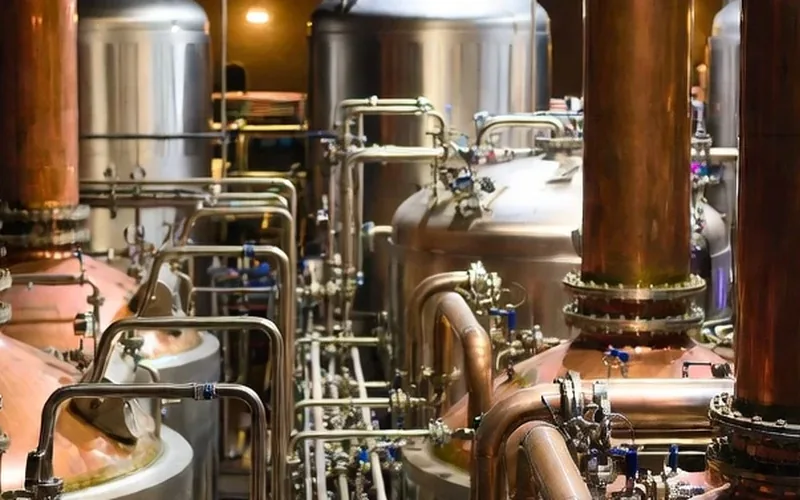
Kettles and whirlpools wash hot with heavy caustic against hop resin and beerstone; fermenters wash cool with CO2 pulling the strength down. One heater serves both.
+ Learn More
Applications
Fermentation Tank Interior CIP
Inside a fermenter the soil is a yeast and protein ring at the fill line on a wall that may still be jacket-cooled. The heater's job is keeping caustic warm there.
+ Learn More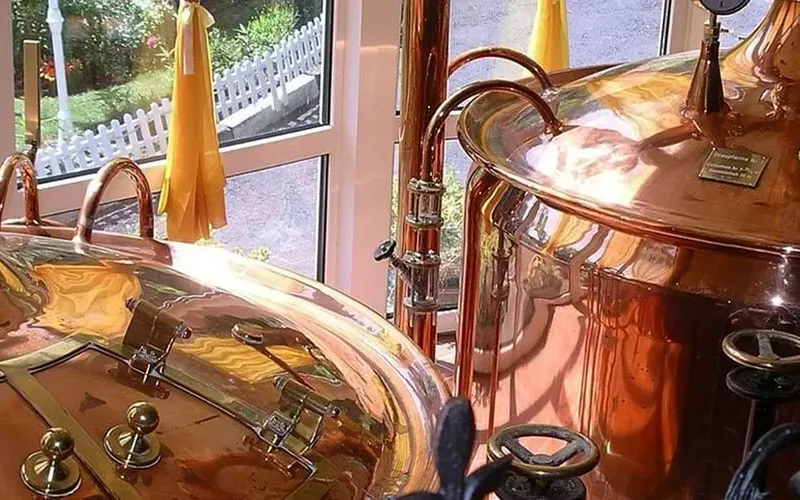
Applications
Brewhouse & Fermenter
Kettles want hot caustic, fermenters knock it cold and CO2 turns it to carbonate. How we size the brewery caustic heater around the cellar instead of the brewhouse.
+ Learn More